AI-Driven IT Staff Augmentation: A Playbook for the C-Suite
AI Development, IT Outsourcing & Delivery Models
Read more

Quick answer: FDE as a Service (Forward Deployed Engineering as a Service) is a delivery model where an outside firm embeds senior engineers inside your team to scope, build, ship, and run a specific system in production. You rent accountable engineering capacity instead of hiring it or buying a fixed-scope project. It fits best when an AI pilot or integration works in a demo but keeps stalling before production.
The model exists because the hard part of enterprise AI is rarely the model. It is the last mile: messy data, undocumented systems, security review, and edge cases nobody wrote down. Below, you'll find what the model is, how engagements run, how it compares to staff augmentation and consulting, and how to pick a provider.
FDE as a Service is forward deployed engineering supplied by a partner rather than built in-house. The partner places one engineer or a small pod inside your environment: your repositories, your standups, your data, and often your customers' calls. The pod is measured on whether the system runs in production, not on hours billed or documents delivered.
The term combines two ideas. Forward deployed engineering is the practice of putting engineers at the point of use, next to the people and systems the software must serve. As a Service means that capacity is bought as an ongoing, scalable engagement, usually priced per engineer or per pod each month.
Palantir created the forward deployed engineer role in the early 2010s, borrowing "forward deployed" from military language for units stationed near the front line. The Pragmatic Engineer reports that for years Palantir employed more of these engineers, internally called "Deltas," than conventional software engineers. The model has since spread to AI leaders such as OpenAI and Anthropic, and to data platforms like Databricks and Snowflake. FDE as a Service makes the same approach available to companies that can't, or don't want to, build that team themselves.
Providers sell the model to two different buyers, and it helps to know which one you are:
An FDE pod owns the work between a working prototype and a system people rely on: discovery with real users, integration with existing systems, production code, production readiness, and handoff. For a deeper look at the role itself, including the tools FDEs use, how they differ from solutions architects, and what they earn, see our guide to forward deployed engineers.
Buying the role as a service changes what you get compared with hiring one engineer:
Two pressures explain the growth: AI pilots that don't reach production, and a shortage of engineers who know how to get them there.
The pilot-to-production gap. Most enterprise AI work stalls after the demo, when it first meets real data, latency limits, and security review. Industry research compiled by The JADA Squad estimates that 80–89% of AI agent pilots never reach production. Google's 2025 DORA report adds that AI amplifies what is already there: strong teams speed up, while weak platforms and messy data become more unstable.
Execution, not spend, drives returns. McKinsey's research, based on more than 100 interviews with senior technology leaders, finds companies can triple the EBITDA impact of tech investment by fixing how they execute rather than spending more.
The talent shortage. Engineers who have shipped RAG systems, agents, and LLM integrations into regulated production environments are scarce and slow to hire. A senior search can take months. Renting an embedded pod puts that experience in place within days or weeks, and a good provider transfers the skills to your team as it works.
Vendors need deployment capacity. For AI startups, every enterprise customer brings its own stack. Without dedicated FDEs, core engineers get pulled off the roadmap for each deployment, which slows both product and revenue.
How Opinov8 answers both pressures. Opinov8 embeds engineers in your environment instead of handing off specs, as in our Databricks delivery work with forward deployed engineers. That means a pilot meets real data, integrations, and security review in the first weeks, not at launch. With teams in the UK, Portugal, and across Europe, plus Egypt, Colombia, and Brazil, we can place engineers with data engineering, generative AI, and cloud experience without a months-long hiring search. Our AI-native way of working also speeds up delivery: we've shown how it cut development time by 30%.
Most engagements move through six stages, from a scoping call to either handoff or continuous ownership:
Many providers offer a fixed-scope pilot as the first step: a defined production increment with a set cost and timeline. It lets you test the team before committing to a longer engagement.
There is no single pricing standard yet. Providers mix monthly subscriptions per engineer or pod, time and materials, fixed-price pilots, and phase-based fees. The JADA Squad, for example, describes a monthly subscription per pod, while CHI Software starts with a fixed-scope pilot that has a defined cost and timeline. Whatever the model, ask what is included, how scope changes are priced, and what happens after handoff.
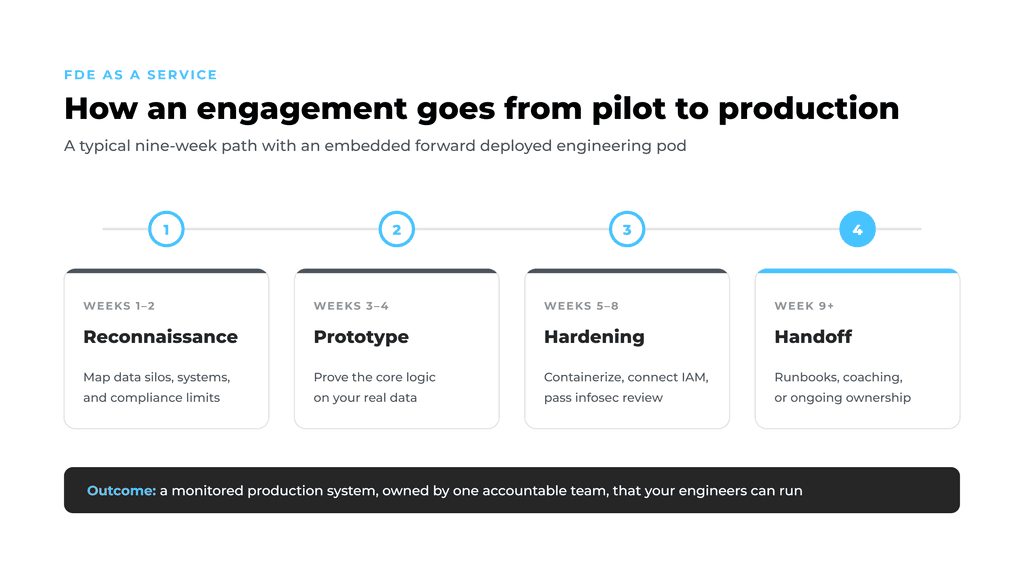
Opinov8 matches the pricing to who owns the outcome, through three engagement models. IT Staff Augmentation adds AI-vetted engineers to your team, billed as time and materials. Dedicated AI Development Teams are fully embedded squads on a retainer, the closest fit for FDE work. End-to-End Software Outsourcing hands Opinov8 the full lifecycle, from architecture to deployment, priced by milestones or outcomes. FDE work follows a nine-week playbook from reconnaissance to handoff.
The core difference is accountability: an FDE pod owns the production outcome, while other models own hours, headcount, or a document.
| Dimension | FDE as a Service | In-house FDE team | Staff augmentation | Traditional consulting |
|---|---|---|---|---|
| What you get | Running system in production | Permanent deployment capability | Extra hands on defined tasks | Strategy, specs, recommendations |
| Who scopes the work | Pod discovers it with you | Your team | You, in advance | Consultants, up front |
| Where they work | Inside your repos, data, and tools | Inside your org | Inside your team, to your spec | Mostly outside your systems |
| Accountability after launch | Stays on or hands off with runbooks | Full, permanent | Ends with the contract hours | Ends at sign-off |
| Typical pricing | Varies: monthly per pod, fixed pilot, or per phase | Salaries plus hiring cost | Hourly or day rate | Fixed fee or milestones |
| Time to start | Days to weeks | Months of hiring | Days to weeks | Weeks |
| Best fit | Ambiguous, high-stakes AI and integration work | Deployment as a long-term core function | Well-defined backlog overflow | Stable, well-scoped decisions |
| Main risk | Costly for simple tickets | Slow, expensive to build | Ownership gaps on complex systems | A plan nobody can execute |
Many companies combine models: they start with FDE as a Service to ship the first deployments, then build an in-house team once the pattern is proven, using the provider's knowledge transfer to train it.
FDE as a Service pays off when the work is ambiguous, integration-heavy, and important enough that a stalled project costs real money.
Good signs it fits:
Signs it doesn't:
FDE as a Service is not limited to AI. The same embedded model works for legacy modernization, cloud migration, and complex systems integration.
The best test is whether a provider writes production code in your environment and stays accountable for it. Ask these eight questions before you sign:
Be cautious if a provider defaults to hourly billing once scope shifts, avoids talking about post-launch ownership, or can't explain how your team will run the system without them.
Opinov8 embeds engineers in your environment instead of handing off specs, and keeps them there until the system runs in production. Our teams work from the UK, Portugal, and across Europe, as well as Egypt, Colombia, and Brazil, covering data engineering, generative AI, cloud, and legacy integration under one accountable team.
A typical Opinov8 FDE engagement follows a playbook of about nine weeks:
You can run that playbook through any of Opinov8's three engagement models, depending on who directs the work and who owns the outcome:
| Engagement model | What you get | Who owns direction | Typical pricing |
|---|---|---|---|
| IT Staff Augmentation | AI-vetted engineers integrated into your team | You | Time and materials |
| Dedicated AI Development Teams | Fully embedded squads (typically 3–6 people) with AI-accelerated delivery | You set priorities; the squad self-organizes | Squad or capacity retainer |
| End-to-End Software Outsourcing | Opinov8 owns the full lifecycle, from architecture to deployment | Opinov8, against agreed SLAs | Milestones or outcome-linked fees |
For most FDE work, a Dedicated AI Development Team is the natural fit: one accountable unit that pairs a senior engineer, a data specialist, an AI engineer, and a QA or evaluation lead, with fractional security and architecture support.
When the engagement involves AI agents, Opinov8's FDEs work on RAILS, Opinov8's AI-agent deployment platform. It aims to get your first agent live in production in six weeks, built to a spec you approve. Every agent passes four governance gates, each with a named owner on your side and on Opinov8's:
Once live, RAILS escalates every edge case to a human reviewer, tracks hours saved and costs reduced daily, and keeps an audit-ready record of every decision. It is built for EU AI Act, GDPR, and HIPAA requirements, with ongoing monitoring of regulatory changes. Opinov8 can also run the agents as a managed service after launch.
See the model in practice in how we deliver Databricks projects with forward deployed engineers and how we used AI-native engineering to cut development time by 30%. Explore our data engineering services and generative AI solutions, or talk to us about an FDE engagement.
What does FDE stand for?
FDE stands for Forward Deployed Engineer, or Forward Deployed Engineering. It describes software engineers who embed inside a client's environment to build and run production systems.
What is FDE as a Service?
FDE as a Service is a model where an outside firm provides forward deployed engineers, alone or as a pod, on an ongoing engagement. They work inside your systems and are accountable for taking a project, often an AI pilot, into production.
How is FDE as a Service different from staff augmentation?
Staff augmentation adds contractors who execute tasks your team has already defined. FDE as a Service adds engineers who help define the problem, ship production code, and stay accountable for results after launch.
How is FDE as a Service different from consulting?
Consulting usually ends with recommendations or a roadmap. FDE as a Service ends with a running system and a team trained to operate it.
How much does FDE as a Service cost?
There is no single standard. Providers use monthly fees per engineer or pod, time and materials, fixed-price pilots, or phase-based fees. Cost depends on pod size, seniority, and duration, so ask for a scoped quote.
How fast can an FDE engagement start?
After a scoping call, many providers embed engineers within days to a few weeks.
Is FDE as a Service only for AI projects?
No. It is most common for AI agents, RAG applications, copilots, and LLM integrations, but the model also fits legacy modernization, cloud migration, and complex systems integration.
Should we build an in-house FDE team or use a provider?
Use a provider when you need results quickly or deployment demand is uncertain. Build in-house once deployment is a permanent core function and you know the skills you need. Many companies start with a provider, then hire.