

How We Used AI-Native Engineering to Cut Development Time by 30%
AI, AI Development, Experts Voice, product & platform
Read more

Enterprise AI adoption is rapidly transitioning from isolated cloud experiments to embedded, agentic workflows operating securely behind corporate firewalls. As organizations integrate multimodal models directly into their core business logic, a massive execution gap emerges between abstract software capabilities and messy operational reality. Closing this gap demands a specialized technical approach, which is exactly why the tech industry is aggressively prioritizing forward deployed engineers.
If you are evaluating enterprise deployment models or considering a career pivot, understanding this embedded engineering paradigm is critical. This guide breaks down everything you need to know about this highly adaptable technical role and why it commands such high demand.
To understand this role, we first need to answer a fundamental question: what are forward deployed engineers? In traditional setups, software developers sit inside an insulated product team, building features based on roadmaps and user stories. A forward deployed engineer (FDE) completely breaks this mold by embedding directly inside a client’s operational environment.
They do not just write code in a vacuum. They interact with the customer's actual data, navigate strict compliance requirements, and adapt core software to solve hyper-specific business problems. The term itself points to a military-style deployment strategy where technical talent is positioned on the front lines of enterprise operations.
If a stakeholder asks what does forward deployed engineer mean, the simplest answer is that it represents a hybrid of a core software engineer, a solutions architect, and a highly technical consultant. They act as the crucial translation layer between theoretical technology and practical, ground-level business value.
The shift toward AI-native software demands rapid iteration on live data. Off-the-shelf software rarely survives the complexity of highly regulated industries without intense customization.
This is where the FDE model shines. By working alongside domain experts, these engineers prototype solutions using real-world constraints rather than staging environments. This operational proximity reduces integration friction, allowing enterprises to adopt complex machine learning and data pipelines faster than traditional IT onboarding methods would allow.
When technical recruiters ask what is a forward deployed software engineer, they are usually trying to pinpoint how the role differs from standard backend development. While backend developers optimize the core proprietary product, forward deployed engineers build the custom integration layer. They force the product to work flawlessly in the client’s unique ecosystem, ensuring rapid time-to-value.
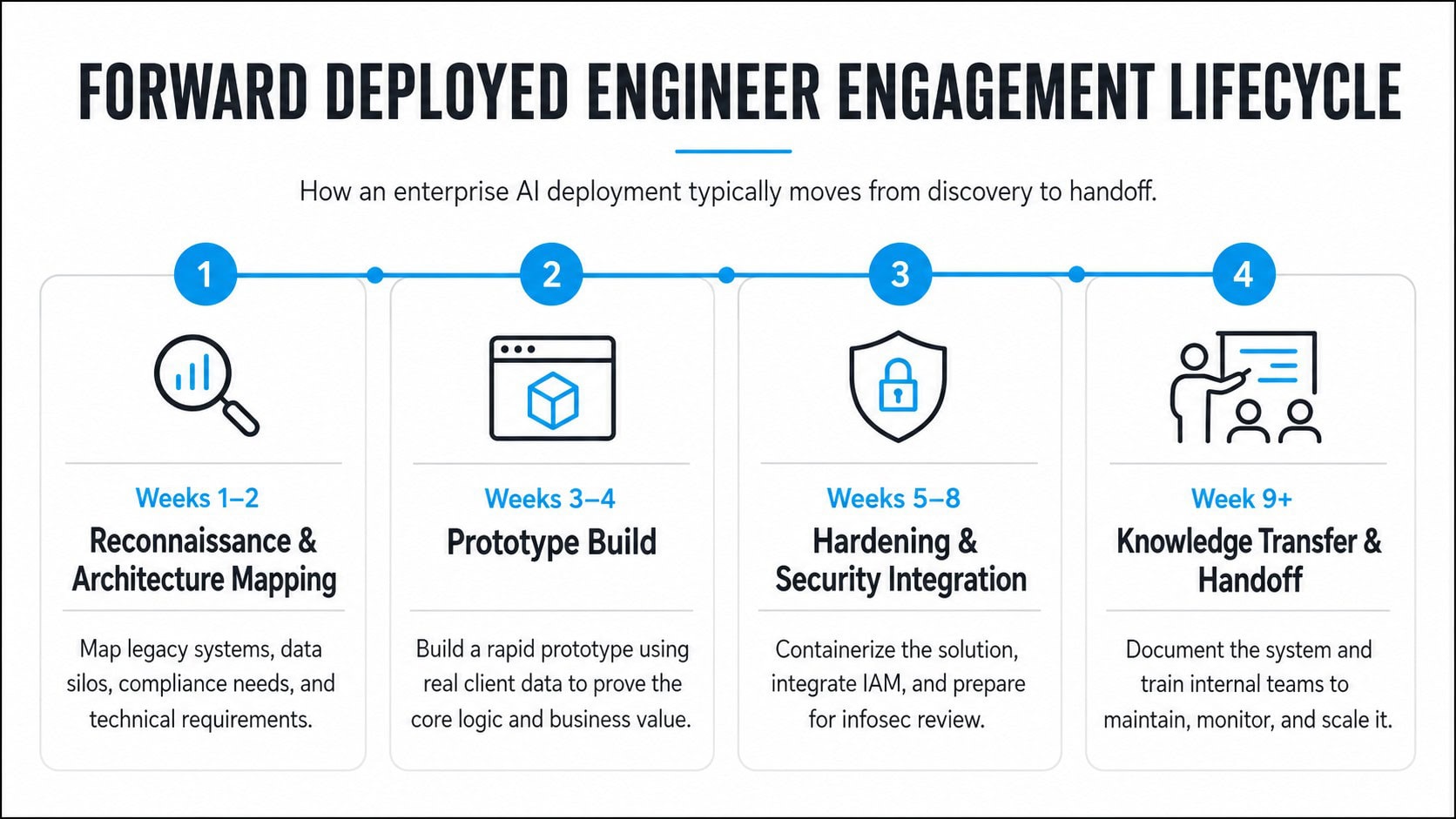
Understanding the theory is helpful, but seeing the execution proves the value. Forward deployed engineers follow a highly structured operational playbook to ensure custom integrations do not derail into endless consulting projects.
Here is the standard lifecycle of an embedded engineering deployment:
This is the most common confusion in the talent market. While both roles require intense client interaction, they operate at fundamentally different altitudes.
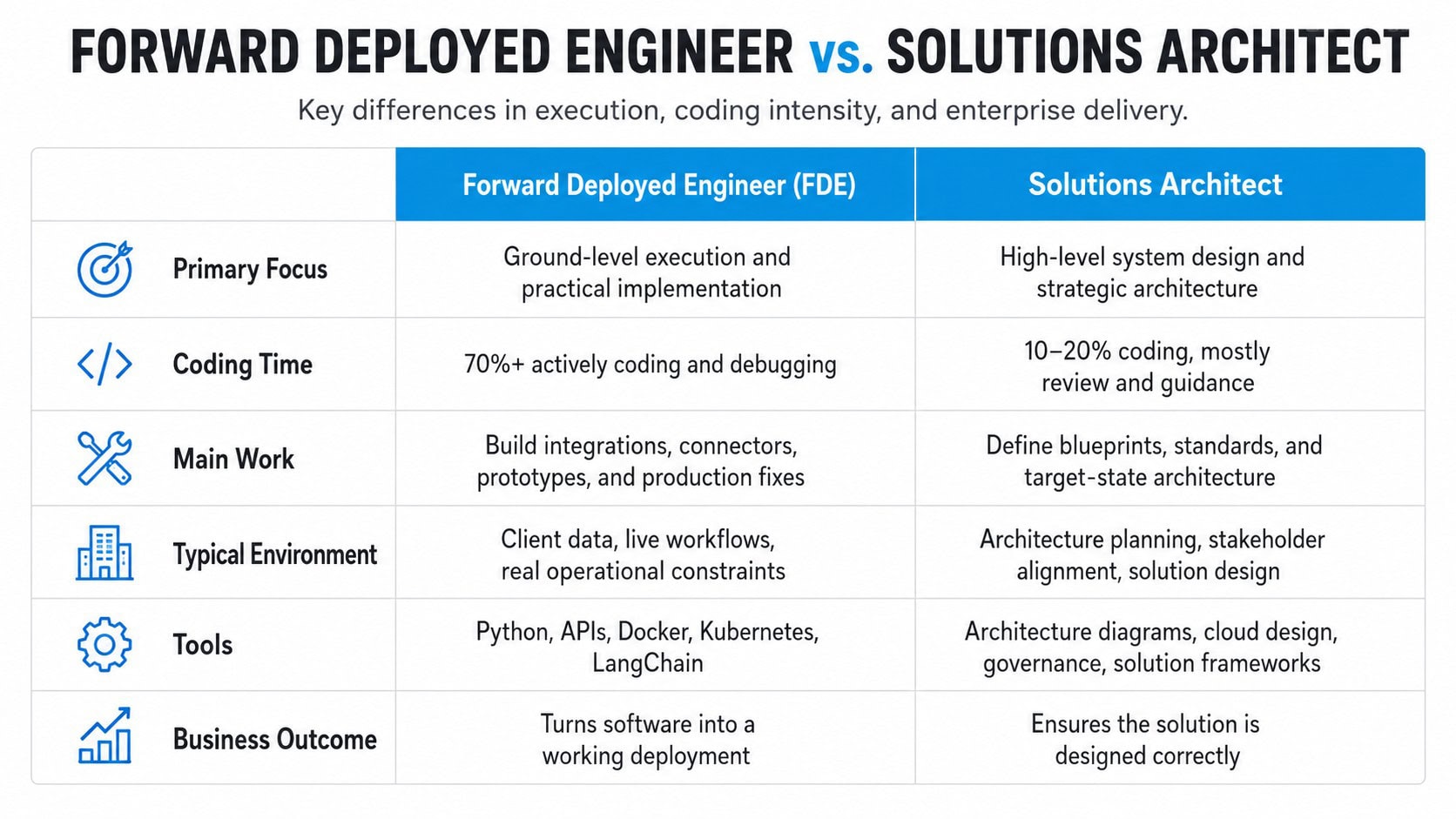
Solutions Architects primarily design the blueprint. They draw the diagrams, establish the high-level infrastructure requirements, and ensure the proposed software fits the client's macro strategy.
Forward deployed engineers actually write the code. They manipulate the data, build the custom connectors, and debug the live system to make that blueprint a reality. FDEs spend up to 70% of their time actively coding, whereas a Solutions Architect might spend 20% or less in an IDE.
This visual comparison highlights the key differences:
Because forward deployed engineers operate across diverse enterprise environments, they must maintain a highly adaptable and pragmatic technology stack. They do not have the luxury of dictating the tech stack; they must master whatever infrastructure the client already uses.
First and foremost, Python is the undisputed lingua franca. FDEs use it extensively for everything from data manipulation and pipeline orchestration to scripting custom LLM integrations.
Beyond coding languages, they rely heavily on:
Mastering these tools is essential for maintaining robust data observability standards within complex, highly regulated enterprise setups.
To understand why this role is exploding right now, consider a typical 2026 deployment scenario.
A global financial institution purchases an enterprise license for an advanced agentic workflow tool. The cloud version functions flawlessly. However, the bank's strict data residency laws absolutely prohibit them from sending Personally Identifiable Information (PII) to an external cloud environment. The deployment stalls.
A forward deployed engineer steps in. They build a custom, localized vector database (like Qdrant or Milvus) inside the bank's secure Virtual Private Cloud (VPC). They write a custom sanitation layer in Python to accurately strip all PII before any data hits the LLM. Finally, they orchestrate the entire deployment to meet the bank's rigorous Infosec standards. The FDE turns a theoretical software purchase into a compliant, operational reality.
The FDE model was famously pioneered by Palantir Technologies, which realized early on that selling complex intelligence software required engineers on the ground to handle sensitive, messy data integrations. Today, the role has expanded far beyond defense and intelligence.
Leading AI and data companies are aggressively recruiting for these positions. High-growth organizations actively hiring forward deployed engineers include:
Embedding engineering talent directly into client operations is one of the most effective ways for SaaS companies to guarantee product adoption and drive net revenue retention.
For engineers willing to step out of the traditional development silo, the compensation can be highly lucrative. The unique blend of hardcore coding and client management commands a significant premium in the talent market.
So, what is the typical compensation? In the US market, a typical forward deployed engineer salary features base pay ranging from $130,000 to $190,000, depending on seniority and the complexity of the domain.
When you factor in performance bonuses and aggressive equity packages common at AI startups, total compensation frequently exceeds traditional backend roles. This financial incentive reflects the sheer business impact forward deployed engineers generate by single-handedly securing and expanding multi-million dollar enterprise contracts.
While the impact and compensation are high, the role is not for everyone. The FDE position comes with intense friction that traditional engineers rarely face.
Transitioning into this highly coveted role requires a deliberate shift in both technical focus and soft skills. If you are wondering what is a forward deployed engineer going to need on their resume to stand out, the answer is a mix of autonomy, system design, and communication.
First, solidify your backend and data engineering fundamentals. You must be able to write production-grade code rapidly under client pressure. Focus heavily on Python, API architecture, and cloud deployment mechanisms. Ensure you can spin up secure infrastructure without relying on dedicated DevOps teams.
Next, develop your systems thinking. You must be comfortable walking into a chaotic, poorly documented IT environment and quickly mapping out a secure integration strategy.
Finally, refine your communication skills. You need the ability to sit in a boardroom, listen to a non-technical executive describe a workflow bottleneck, and immediately translate that into a scoped technical roadmap.
As we look toward the future of enterprise software, the deployment of multimodal AI models and autonomous agents will only accelerate. However, these advanced systems hold zero value if they cannot communicate securely with a company’s legacy databases and existing security protocols.
Embedded engineers serve as the essential bridge over this technical divide. They ensure that cutting-edge technology actually drives measurable business outcomes rather than just generating theoretical hype. Understanding what defines an AI native business requires acknowledging the human engineers who make these complex integrations possible.
The most successful tech companies in the coming decade will not just build the best models. They will build the best deployment engines. And at the heart of those engines, driving real-world adoption, will be forward deployed engineers.
Whether you need to modernize legacy systems, optimize your data pipelines with our tailored data engineering services, or deploy agentic workflows securely behind your firewall utilizing custom Generative AI solutions, Opinov8’s technology consulting and software development teams provide the deep technical expertise you need. We understand that deploying cutting-edge AI means nothing if it doesn't integrate flawlessly with your existing infrastructure and compliance requirements. Let’s build software that actually works in your reality. Reach out and let's talk today.