

AI Transformation Consulting: How to Build an AI-Shaped Organization in 2027
AI, AI Development, AI Native
Read more

The velocity of modern engineering is bottlenecked by manual syntax generation. Developers invest hundreds of hours translating business logic into boilerplate microservices, writing repetitive tests, and updating API documents. Human teams are scaling their cognitive effort, but system complexity is scaling faster.
To break this bottleneck, engineering teams must transition from writing code to orchestrating AI. By integrating mature agentic workflows directly into the software development lifecycle, we are shifting the developer's role from manual syntax typing to high-level architectural oversight.
Welcome to our latest AI software development case study, where we break down exactly how we applied these principles to build a complex, enterprise-grade platform. We used AI-Native Engineering to cut our delivery timeline by 30%, maintain strict quality controls, and reduce overall project costs for a global logistics provider.
Every AI software development case study requires a defining challenge. Our client, a tier-one logistics enterprise, needed to replace a legacy routing monolith with a real-time, event-driven microservices architecture. They required the system to process multimodal data, analyzing text-based shipping manifests alongside satellite image feeds, to dynamically reroute freight under tight global economic pressures.
The client’s internal backlog was already stretched to capacity. They needed this platform delivered in under a year.
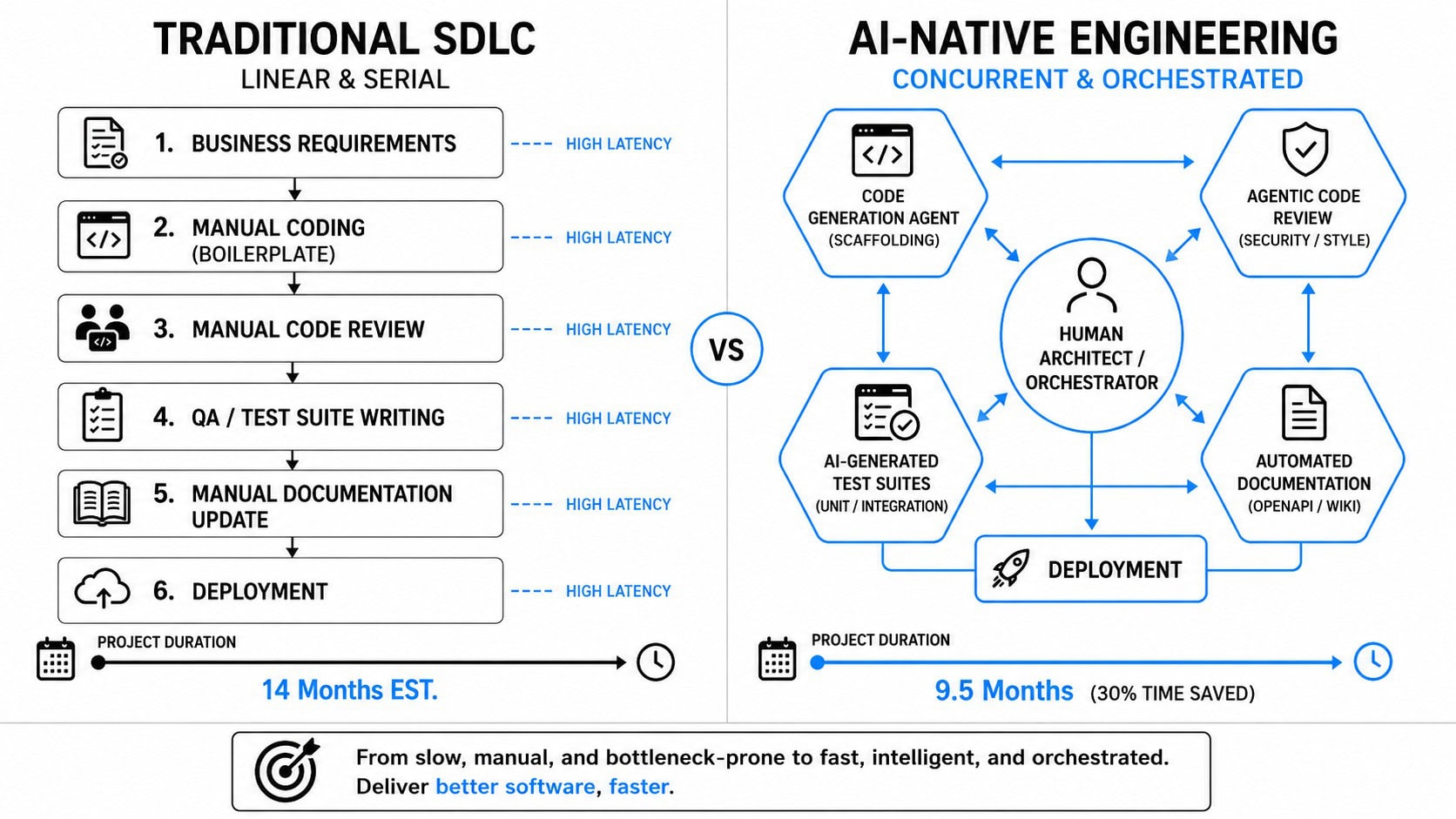
Estimating this project using standard agile methodologies yielded a 14-month timeline. The sheer volume of CRUD operations, message broker configurations, and database integrations required thousands of hours of manual labor. This timeline served as the baseline metric for this AI software development case study. We knew we had to rethink the delivery model entirely.
We could not compress a 14-month estimate into 10 months simply by adding more engineers. Brooks's Law dictates that adding human resources to a late or complex software project only delays it further. Instead, we implemented an AI-Native Engineering approach.
This method does not treat artificial intelligence as a simple autocomplete tool. It treats AI as a foundational layer in the CI/CD pipeline. By delegating deterministic, high-volume tasks to autonomous coding agents, our senior architects could focus entirely on domain-driven design and system security.
The traditional approach relies on linear progression. A developer writes the code, a peer reviews it, QA writes the tests, and technical writers build the documentation.
Our AI-native approach is concurrent. We utilize context-aware large language models (LLMs) to automate multiple stages simultaneously.
You can read more about how we structure these AI development solutions to understand the underlying infrastructure we use for our clients. To scale these operations effectively, we support our global engineering squads through dedicated regional delivery centers, which ensure round-the-clock co-engineering capabilities.
To achieve a 30% reduction in time-to-market, the technical core of this AI software development case study relied on a specific stack of automated tools. We integrated these directly into our GitHub repositories and deployment pipelines.
Writing and maintaining documentation is notoriously slow. We implemented an automated documentation pipeline using AI tools that dynamically update Swagger files and internal wikis every time code is committed. The models extract the business logic directly from the repository.
For code reviews, our agents performed the first pass. They flagged formatting errors, basic security flaws, and performance bottlenecks. This eliminated the asynchronous waiting period between developers, a recurring theme in any successful AI software development case study. Human architects only reviewed the final, optimized pull requests. The broader industry is validating this approach; research indicates that AI-assisted coding significantly improves developer velocity when implemented with strict governance.
Quality assurance is often the first casualty of accelerated timelines. We bypassed this risk by utilizing AI to generate comprehensive test suites.
Once a developer finished a module, an autonomous agent instantly generated unit tests, integration tests, and edge-case scenarios based on the expected input/output parameters. The AI consistently identified obscure null-pointer exceptions and concurrency issues that manual testing often misses. This robust validation is setting this AI software development case study apart from early architectural experiments, proving that speed does not require a sacrifice in stability.
Accelerating development speed frequently introduces technical debt. However, the data from this AI software development case study proves the opposite.
By enforcing AI-driven test coverage, we maintained a 94% test coverage rate across the entire codebase. The agentic workflows executed regression tests in parallel, identifying integration failures within seconds of a commit. This methodology aligns with the principles of continuous integration at scale, ensuring the main branch remains constantly deployable.
Our engineering team spent their sprints optimizing algorithms and refining the multimodal data ingestion pipelines, rather than hunting down syntax errors. We also utilized cloud-native architecture best practices to ensure the newly generated code was highly scalable and resilient.
Deploying sophisticated technology requires a vetted partner who understands the strict compliance and reliability mandates of global enterprises. Our capability to deliver advanced solutions under this delivery model is validated by deep industry partnerships. Opinov8 is officially recognized as a Microsoft Solutions Partner for Digital & App Innovation (Azure), which serves as independent verification of our technical proficiency in building cloud-native infrastructure.
Furthermore, this continuous commitment to delivery excellence has positioned our organization on the global stage. Opinov8 is ranked 6th worldwide among more than 7,300 firms on the Clutch Leaders Matrix for AI Consultants, establishing our framework as an industry benchmark for enterprise modernization.
The financial breakdown of this AI software development case study reveals significant operational efficiencies. We delivered the fully functional logistics platform in exactly 9.5 months.
Here are the concrete metrics from the deployment:
The economic implications of generative AI in software engineering are becoming impossible to ignore. Organizations integrating these tools are seeing massive productivity gains, echoing findings from major global economic analyses on generative AI.
For enterprise delivery teams, speed only matters when it comes with the right engineering capability, clear communication, and the confidence to scale without losing control. That is exactly what clients value in Opinov8’s approach. The CEO of a leading transportation enterprise highlighted this necessity in the review on the Opinov8 Clutch Profile:
"Their agility and speed of response are impressive." — CEO, Transportation Company
The feedback reflects a key part of Opinov8’s AI-native engineering model: helping clients move faster by combining senior engineering expertise, flexible team scaling, and delivery workflows built around real business outcomes.
When teams need to accelerate complex software initiatives, modernize platforms, or expand development capacity quickly, Opinov8 brings the engineering structure and responsiveness needed to turn ambitious plans into working solutions.
If this methodology resonates with your current architectural challenges, explore how Opinov8 has applied similar AI-driven and cloud-native frameworks across other enterprise projects:
If the results of this case study align with your current roadmap, Opinov8 can help implement these same efficiencies. Explore the full Opinov8 Portfolios to see how Opinov8 engineers the future. Ready to build leaner, faster, and smarter? Let's talk.