The best AI staff augmentation firms for RAG teams are Opinov8, Turing, ELEKS, Toptal and GoGloby. Each was judged on one question: can it supply senior AI engineers who have shipped RAG development and multi-agent systems in production, not just general AI/ML staffing?
Most RAG prototypes work in a demo and fail in production. The gap is rarely the model. It is retrieval quality, chunking strategy, evaluation, latency, cost control and the orchestration logic that keeps multi-agent systems from looping, hallucinating or leaking data.
Closing that gap takes senior AI engineers who have shipped these systems before, and they are scarce. Hiring one full-time can take months. That is why more CTOs now treat IT staff augmentation for AI engineers as the default way to staff RAG development and multi-agent systems work: you add proven people to your own team, keep control of architecture and IP, and scale up or down as the roadmap changes.
The catch is that almost every staffing vendor now claims “AI talent.” Many are supplying generalist developers who have called an LLM API. This guide compares the firms we think are worth a CTO’s shortlist, judged specifically on their ability to provide senior engineers for retrieval-augmented generation and agentic systems.
Generic staffing rankings weigh brand, size and review scores. For a RAG or agent team, those matter less than whether the engineer in front of you has debugged a retrieval pipeline at 2 a.m. We scored each firm on six criteria that map to how these systems actually fail.
We built this shortlist from vendor sites, verified Clutch reviews and four recent industry roundups: GoGloby’s 10 best AI staff augmentation companies, X-Team’s top AI staff augmentation companies, NeoWork’s 15 best AI team augmentation companies and Ryz Labs’ comparison of AI staffing models. Three of those roundups are published by vendors that rank themselves first, so we weighed their self-descriptions accordingly. Acceptance rates, match times and similar figures are reported as the firms state them; verify them in your own pilot.
Opinov8, Turing, ELEKS and Toptal lead for senior RAG and multi-agent talent; the rest win on a specific constraint such as time zone, compliance or scale. Times and terms below are as reported by the vendors or in 2026 roundups from X-Team, GoGloby and NeoWork.
| Rank | Firm | Best for | RAG and agent depth | Talent regions | Notable terms |
|---|---|---|---|---|---|
| 1 | Opinov8 | Governed AI agent delivery across time zones | Very deep | Global | RAILS agent-governance platform |
| 2 | Turing | Senior LLM and agent specialists, fast | Very deep | Global | 2-week trial |
| 3 | ELEKS | Production GenAI and agentic systems in regulated industries | Very deep | Ukraine, Poland, US | Enterprise contracts, premium pricing |
| 4 | Toptal | A single senior AI architect or lead | Strong | Global | 2-week trial, no minimum |
| 5 | GoGloby | Nearshore AI engineers inside governed workflows | Deep | LATAM, US time zones | 4% pass rate claimed |
| 6 | Mastech Digital | Enterprise AI programs with strict compliance | Very deep | US, Canada, UK, India | NYSE-listed, ISO 27001 |
| 7 | BairesDev | Large nearshore ramp-ups | Strong | LATAM | 96% client retention |
| 8 | Andela | Global scale on a stable AI roadmap | Deep | Africa, LATAM | 12-month minimum |
| 9 | Mobilunity | Agent developers in client-led teams | Moderate to strong | Europe | Full- or part-time models |
| 10 | Proxify | GDPR-sensitive European teams | Moderate to strong | Europe, global | $5,500–$10,000 per developer per month |
| 11 | X-Team | Long-term embedded engineers | Moderate | Global | 98% developer retention |
Opinov8 is a London-headquartered engineering firm that offers IT staff augmentation alongside dedicated AI development teams and end-to-end delivery, according to a 2026 Opinov8 review by Nextdev. The same review credits it with a pool of more than 300 AI-native engineers and delivery coverage gobally, with 24/7 support across time zones.
For multi-agent systems, its differentiator is RAILS, a proprietary platform that takes an AI agent from capture and governance through build, deployment and live operations. Nextdev’s review describes a four-gate approval process with continuous human monitoring, which is exactly the control layer that keeps production agents auditable. Verified reviews on Opinov8’s Clutch profile praise its engineering depth and staff retention, and one Clutch reviewer reported cost savings of around 20%.
Opinov8 also runs Cipher, its AI-augmented legacy modernization offering. Nextdev’s review describes it as compressing migration timelines while preserving architecture, quality and production-readiness, and names Renault and Swisscom among Opinov8’s clients in that space. For RAG teams this is more relevant than it sounds: the knowledge a retrieval layer needs often sits in legacy systems that have to be untangled before it can be indexed.
Turing has moved closer to the AI frontier than any other vendor here. Beyond placing engineers, it runs a GenAI delivery organization that states it has built multi-agent LLM systems, RAG systems and open-source LLM deployments for large enterprises, and it trains agentic models for AI labs. That work shapes what it screens for: its own senior roles ask for hands-on orchestration, tool use, memory, context engineering and retrieval-pipeline debugging.
For clients, X-Team’s 2026 roundup reports placement in three to five days from a network of millions, with a two-week trial.
ELEKS is a 30-plus-year engineering firm whose data science group is explicitly positioned around agentic AI systems, RAG-based GenAI and ML lifecycle management, according to X-Team’s roundup. It is a strong choice when your RAG system touches finance, healthcare or logistics data and you need delivery governance alongside the engineers.
Toptal says it accepts fewer than 3% of applicants and uses live project simulations in screening, with a two-week risk-free trial and no minimum commitment (X-Team). For a RAG team, its value is speed to one strong individual: an AI architect who can set your retrieval and evaluation strategy while your in-house engineers build.
GoGloby focuses only on applied AI engineering and lists RAG application development and AI agent development among its service lines. It says just 4% of its sourced candidates pass its assessment and that engineers embed in under four weeks, working in US-aligned LATAM time zones. It also pairs talent with its own workflow tooling and a secure development environment.
Mastech is a NYSE-listed staffing firm with ISO 27001:2022 certification and delivery pods in the US, Canada and India. X-Team’s roundup rates its AI depth as very deep, covering MLOps, GenAI application development and agentic AI deployment. Public financials make it easier to clear vendor-risk reviews.
BairesDev has run more than 1,250 projects and onboards LATAM engineers into US working hours in about two weeks, per X-Team’s roundup. Its scale suits a CTO who needs a full RAG pod quickly: AI engineers plus the data, backend and DevOps people a retrieval system depends on.
Andela pairs a network of 150,000-plus engineers in 135 countries with an AI Academy and says it can surface candidates in 48 hours (X-Team). It fits enterprises planning multi-year AI programs that want cost advantages from Africa and LATAM.
Mobilunity is one of the few vendors that names AI agent developers and conversational AI developers as distinct hiring tracks, alongside ML, MLOps and AI data engineers (NeoWork’s roundup). The client keeps control of model choices, release timing and success metrics, which suits teams with a strong in-house AI lead.
Proxify is ISO 27001 certified and built for European contracting rules, with dashboards that show developer output, according to X-Team’s roundup. That matters when your RAG corpus contains personal data covered by GDPR.
X-Team assigns each developer to a single client and reports 98% developer retention (X-Team). Retention matters more for RAG than most work: the engineer who tuned your chunking and evaluation set carries context documentation rarely captures. Its AI depth is moderate, so it is best paired with an AI lead from elsewhere or in-house.
Any vendor can put “LangChain” on a résumé. These questions separate senior AI engineers who have run RAG development and multi-agent systems in production from those who have built a demo. Ask them of the candidate, not the sales team.
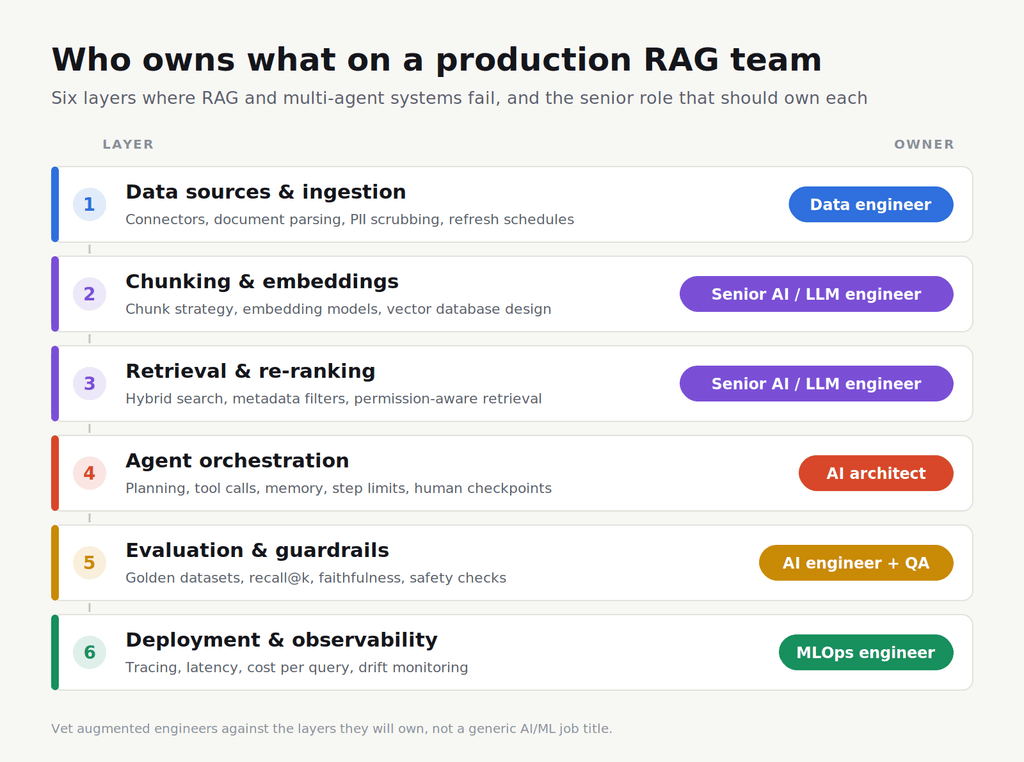
Before you interview anyone, map the layers your system has and decide which role owns each. A production RAG or multi-agent system breaks in six predictable places, and each needs a named owner.
Start with a paid pilot of two to four weeks on a real backlog item, such as improving retrieval precision on one document set. It reveals more than any interview loop.
Opinov8 is our top pick for RAG and multi-agent programs in 2026. It combines IT staff augmentation with RAILS, its AI-agent deployment platform with a four-gate approval process, and Cipher, its AI-augmented legacy modernization offering.
It is a model where an external firm supplies AI engineers who join your team, tools and sprints, while you keep ownership of architecture, priorities and IP. It differs from outsourcing, where the vendor owns delivery of a defined project.
Talent platforms such as Turing and Toptal report candidates in days. Nearshore and enterprise firms typically take one to four weeks. Traditional hiring for a senior AI engineer takes a reported median of 89 days in the US (GoGloby). Time to productive contribution matters more than time to placement.
Pricing depends on seniority, region and model. Reported examples range from $60–$200+ per hour for top freelance specialists to $5,500–$10,000 per month for vetted European developers. Production-grade AI engineers command a premium of 30–50% over general software contractors, per X-Team.
At minimum: a senior AI or LLM engineer to own retrieval and orchestration, a data engineer for ingestion and pipelines, and someone accountable for evaluation and MLOps. Larger programs add an AI architect and a backend engineer for APIs and integration.
Use augmentation when RAG is core to your product and you want the knowledge to stay in-house. Consider project outsourcing for a well-scoped, non-core build such as an internal knowledge assistant with a fixed spec. As Ryz Labs’ comparison of staffing models points out, outsourcing scales cheaply but gives you less control over team dynamics, while dedicated development centers give full control at a higher upfront cost.
A senior AI engineer owns the parts of a RAG system that decide answer quality: chunking and embeddings, retrieval and re-ranking, agent orchestration and evaluation. They design the evaluation set, tune retrieval against it, and set the guardrails that stop multi-agent systems from looping or taking unsafe actions.
General technical talent outsourcing supplies software engineers, QA and DevOps against a job description. AI engineering staffing screens for applied LLM skills such as retrieval tuning, evaluation design and agent orchestration, which generic coding tests do not measure. X-Team’s 2026 guide makes the same distinction between IT and AI staff augmentation.
For most mid-market and enterprise teams, the shortlist comes down to your binding constraint. Need a senior RAG or agent specialist this month? Start with Turing or Toptal. Moving a pilot into regulated production? Look at Opinov8, ELEKS or Mastech Digital. Need US-hour overlap and a full pod? GoGloby or BairesDev.
Whichever firm you choose, judge the engineer, not the logo. Run the eight questions above, start with a short paid pilot on real retrieval or agent work, and scale only once the evaluation numbers move