How to Assess AI Governance Consulting Firms: A Framework for Regulated Industries
AI Development, AI Native
Read more

Staff augmentation used to answer one question: how many people do we need? AI has changed the question to: what capability do we need, and how fast can we make it ours?
For most of the last two decades, IT staff augmentation was a capacity lever. A roadmap slipped, a key engineer resigned, or a migration needed six extra hands for nine months, so you called a partner and added seats. The economics were simple: hourly rates, headcount, and a deadline.
That logic is breaking down. AI is changing both sides of the equation at once. It changes how you find, assess, and onboard external talent. And it changes what that talent is expected to do once it arrives. The CFO, CTO, and CEO who still buy augmentation by the seat are paying for an operating model that is already out of date. AI-driven IT staff augmentation is the model replacing it.
This article explains how AI-driven IT staff augmentation works for the C-suite: what has shifted, which roles and team structures now create value, how to measure the return, where the new risks sit, and the 8 steps to put it into practice.
AI-driven IT staff augmentation turns external talent from a way to rent capacity into a way to import capability. The pressure is real: in the World Economic Forum's Future of Jobs Report 2025, 86% of employers said AI will transform their business by 2030, and two-thirds plan to hire for specific AI skills (Progressive Robot). Permanent hiring cannot move at the speed those tools change.
Four shifts matter most for executives:
| Dimension | The old model | The AI-era model |
|---|---|---|
| What you buy | Seats and hours | Capability tied to an outcome |
| How talent is found | CV keywords, recruiter networks | Skills-based matching with human validation |
| How talent is assessed | Interviews, memory tests | Real tasks done with approved AI tools |
| Team shape | One contractor per gap | Cross-functional pods of people and agents |
| Onboarding | Documents and shadowing | Curated knowledge bases and AI assistants |
| Success metric | Utilization and velocity | Accepted outcomes, quality, knowledge kept |
| Pricing | Hourly or daily rates | Retainers, pod pricing, milestones, outcome incentives |
The most valuable external profile is now hybrid: strong engineering fundamentals plus the judgment to direct and verify AI. A senior developer who knows your domain and can supervise coding agents often creates more value than a standalone model specialist.
| Role | Why it matters now | Augment or build in-house? |
|---|---|---|
| AI / ML engineer | Turns pilots into working products | Augment to start, transfer later |
| Data engineer | Builds governed data and retrieval pipelines AI depends on | Build long term; augment to accelerate |
| MLOps / platform engineer | Moves models into production safely and keeps them running | Augment early, then internalize |
| Evaluation engineer | Tests whether AI output is accurate, safe, and consistent | Augment; few companies have this skill |
| AI security specialist | Threat-models agents, prompts, and generated code | Fractional or augmented |
| AI governance lead | Sets policy, approvals, and standards | Fractional expert who trains an internal owner |
| Senior engineer fluent in AI tools | Delivers more scope and reviews machine output | Both; this is the new default profile |
The hiring question changes too. Instead of "how many developers do we need?", ask "what mix of human expertise and AI leverage delivers this outcome safely?" That question produces a very different team.
Assessments must change as well. Banning AI in technical tests is unrealistic. The better test lets candidates use approved tools on a real task, then asks them to explain decisions, catch the tool's mistakes, and flag security issues. That reveals judgment, which is what you are paying for.
The right structure depends on how much direction you can provide and who owns the outcome. Pick it deliberately; do not default to adding individual contractors.
| Model | Best when | Who owns direction | Typical pricing |
|---|---|---|---|
| Individual specialists | Internal leadership is strong and the gap is narrow | You | Time and materials |
| AI-enabled delivery pod (3–6 people plus AI tools) | Work crosses architecture, data, security, and product | You set priorities; the pod self-organizes | Pod or capacity retainer |
| Managed outcomes | The provider should own a defined service or deliverable | Provider, against agreed SLAs | Milestones or outcome-linked fees |
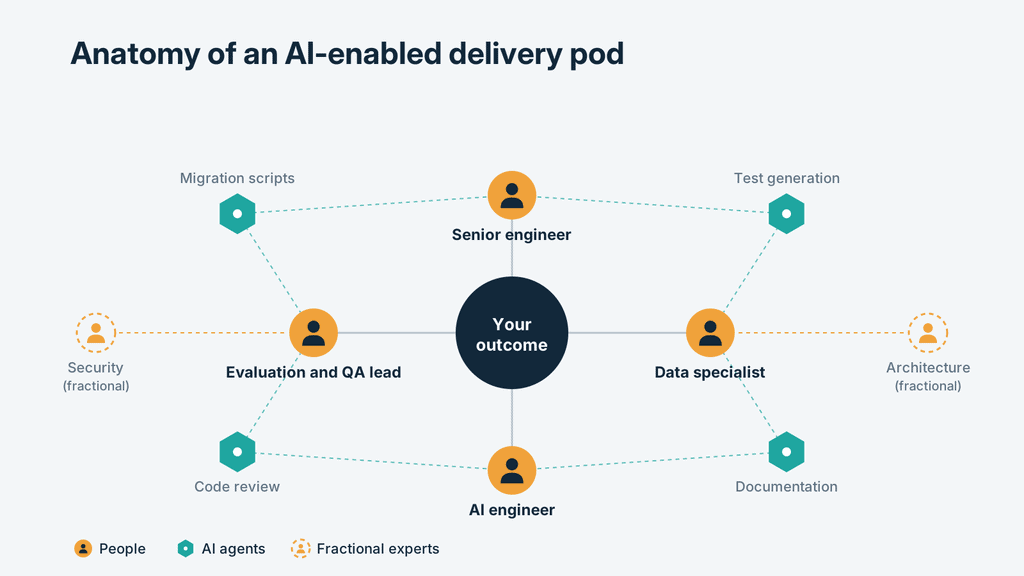
The pod is the model gaining the most ground. A typical pod pairs a senior engineer, a data specialist, an AI engineer, and an evaluation or QA lead, with fractional security and architecture support. You get one accountable unit instead of several disconnected contractors, and shared standards that stay behind when the pod leaves.
Human-agent teams
AI agents can now handle bounded work: generating tests, drafting documentation, summarizing incidents, preparing migration scripts. Microsoft's 2025 Work Trend Index found 81% of leaders expect agents to be moderately or extensively part of their AI strategy within 12–18 months (Progressive Robot).
That does not make augmented engineers optional. It moves their work toward specification, review, integration, and ownership. A useful rule: automate tasks that are repeatable, reversible, and easy to verify. Keep humans on ambiguous decisions, high-impact changes, and anything that needs business context.
AI raises individual output, but it does not automatically raise team performance. GitHub's experiments found developers using Copilot finished a coding task up to 55% faster. Yet Google's DORA research (2025) warns that individual speed gains do not translate on their own into better delivery throughput or stability (Progressive Robot).
For a CFO evaluating AI-driven IT staff augmentation, the implication is clear: be skeptical of any partner who says five AI-enabled engineers equal ten traditional ones. Real gains depend on code quality, test coverage, architecture, review discipline, and how much rework AI output creates.
Pricing is shifting accordingly. Hourly rates still fit uncertain work under your direction. Retainers, pod pricing, milestones, and outcome-linked incentives fit when scope and acceptance criteria are clear. Make sure contracts state who pays for AI tools, model usage, and cloud environments.
The scorecard below separates activity from value. Read the metrics together: faster delivery with more production defects is not progress.
| Metric | What it tells the executive team |
|---|---|
| Time to qualified shortlist | Whether AI-assisted sourcing actually saves time |
| Time to productive contribution | Whether onboarding and knowledge access work |
| Accepted delivery lead time | Whether useful throughput is rising |
| Escaped defect rate | Whether speed is costing quality |
| Rework percentage | Whether AI output is creating hidden cost |
| Security findings | Whether tool and data controls hold |
| Knowledge-transfer completion | Whether you keep the capability when the partner leaves |
| Cost per accepted outcome | Whether the model creates economic value |
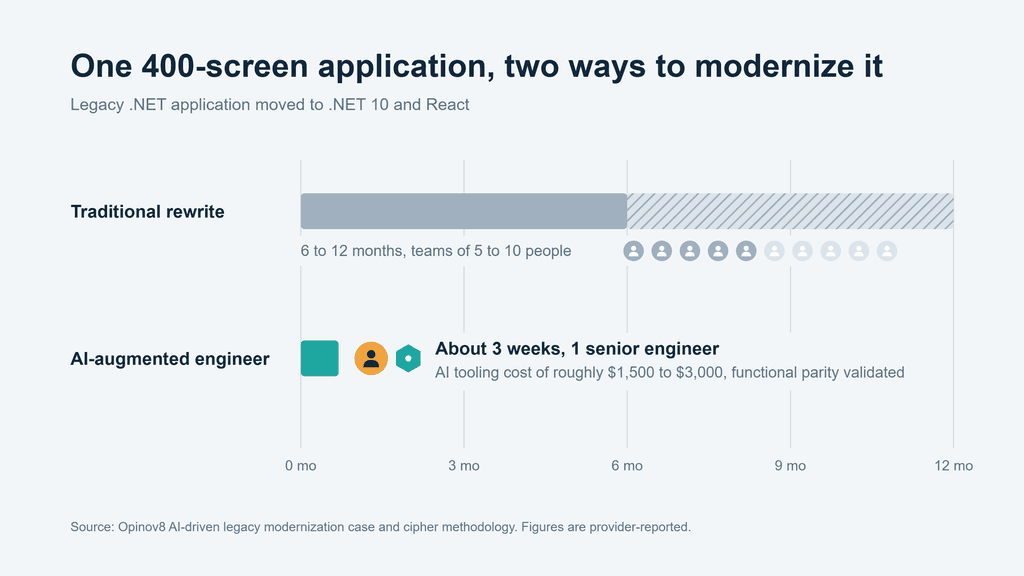
The clearest proof of AI-driven IT staff augmentation at work comes from legacy modernization, where AI changes team size, timeline, and cost at the same time. In a recent AI-driven legacy modernization by Opinov8, a UK enterprise in real estate software needed to move a business-critical application of more than 400 screens off an aging .NET stack. A conventional rewrite would have needed a larger team and several months.
Instead, a single AI-augmented senior engineer migrated the application to .NET 10 and React in about three weeks, with AI tooling costs of roughly $1,500–$3,000. Opinov8's cipher methodology frames the comparison: traditional modernization typically runs 6–12 months with teams of 5–10 people, and the firm reports savings of $300K–$500K, about 90%. These are provider-reported figures, but the pattern is what matters for executives.
Three design choices made the speed safe, and they mirror the governance points above:
Classic augmentation still has its place when the need is niche, senior skill. And modernization often lays the cloud foundation that later AI work depends on.
| Case | Challenge | Model | Reported result |
|---|---|---|---|
| AI-driven legacy modernization | 400+ screen legacy .NET application | One senior engineer plus AI tools, with guardrails and parity testing | ~3 weeks; AI tooling ~$1,500–$3,000 |
| Kubeshop | Scale teams with Kubernetes, Go, and React talent without long hiring cycles | 6–7 senior augmented engineers over nearly two years, scaled up or down | 20% cost savings, minimal supervision needed |
| Renault | Move an on-premises ERP to AWS securely | Cloud modernization with infrastructure as code and central monitoring | Infrastructure costs down an estimated 15–25% |
The lesson for the C-suite: for bounded, verifiable work, one expert directing AI can now do what used to require a full team. That is the core of AI-driven IT staff augmentation: the right question is capability, not headcount.
AI does not make augmented teams insecure; weak governance does. But AI adds exposure that ordinary contractor policies were never written for.
Your contracts should cover approved tools, data location and retention, model-training terms, IP ownership, subcontractors, breach notification, and data return or deletion at exit. Frameworks such as the NIST AI Risk Management Framework and OWASP's guidance on secure coding with AI are useful baselines (Progressive Robot); data privacy and algorithmic bias are the top risks flagged for AI-driven hiring (Infonative). Offboarding matters as much as onboarding: revoke access to code, cloud accounts, knowledge systems, and model endpoints the day an engagement ends.
When selecting an AI-driven IT staff augmentation partner, press for specifics. Ask how they source and assess talent, which AI tools their people use, how generated work is reviewed, how your data is protected, and which assets you will own at the end. Vague promises of "faster coding" or "intelligent recruiting" are not enough.
AI is not making staff augmentation obsolete. It is making it strategic, and AI-driven IT staff augmentation is how leading companies capture that value. The companies that win will stop counting seats and start designing the right mix of people, AI tools, and controls around the outcomes that matter. They will use external experts to bring in new capability fast, and they will insist that capability stays behind when the engagement ends.
The question for the C-suite is no longer "how many engineers can we add?" It is "how quickly can we build capability we own, without giving up control of our code, our data, or our quality?"
What is AI-driven IT staff augmentation?
It is the practice of adding external IT specialists who work with AI tools and agents, organized around a business outcome rather than billed hours. Your internal team keeps control of priorities, while the augmented experts bring new capability fast and transfer it to your people.
How is it different from traditional staff augmentation?
Traditional augmentation buys seats and hours to fill a gap. The AI-driven model buys capability tied to an outcome: talent is matched by skills, teams combine people and AI agents, and success is measured by accepted outcomes, quality, and knowledge kept.
Will AI reduce the need for augmented engineers?
It changes the mix more than the need. Repetitive work shifts to AI, while people move toward specification, review, integration, and security. New roles such as evaluation engineers, MLOps engineers, and AI security specialists are in high demand.
When should we use a pod instead of individual specialists?
Use individual specialists when your internal leadership is strong and the gap is narrow. Choose an AI-enabled pod when the work crosses architecture, data, security, and product. Choose managed outcomes when the provider should own a defined service.
How should we measure the return?
Track cost per accepted outcome, delivery lead time, escaped defects, rework, and knowledge-transfer completion. Avoid judging value by hours, lines of code, or story points, since AI can inflate activity without improving results.
What are the main risks, and how do we control them?
The main risks are data leakage, shadow AI, low-quality generated code, broad agent permissions, hiring bias, and dependence on the vendor. Control them with approved tools, clear contract terms on data and IP, mandatory code review, least-privilege access, and prompt offboarding.
How fast can an AI-augmented team deliver?
For bounded, verifiable work, the gains can be large. In one modernization case, a single AI-augmented engineer migrated a 400-screen application in about three weeks, against a typical 6–12 months for a traditional team. Results depend on code quality, guardrails, and validation.