
Software architecture now treats reasoning as a core compute primitive. Engineering teams are building systems that perceive environments, formulate execution plans, and take autonomous action. Scaling these systems from local prototypes to global enterprise operations requires specialized infrastructure. To handle this transition safely, organizations rely on an enterprise-grade AI agent deployment platform.
If your board is still asking, "What is an agent in artificial intelligence?", point them to this baseline: it is a software node connecting language comprehension directly with tool execution and memory.
Before tearing down existing infrastructure, technical leaders must clarify the true AI agent meaning. Understanding exactly what AI agents bring to the table requires looking beyond standard generative text. They read environment variables, authenticate against external APIs, and self-correct on the fly.
This forces a shift toward dynamic, goal-oriented execution states. We specify the operational boundaries. The model navigates the optimal path to completion. Utilizing a dedicated orchestration engine ensures these boundaries scale automatically across distributed environments.
To grasp what an AI agent can do, look at situational awareness in complex backend workflows. Raw cognition means nothing if the system cannot trigger a webhook, validate a schema, or update a database.
By leveraging a specialized AI agent development platform, engineering teams build nodes that synthesize financial data, provision cloud storage, or resolve technical tickets simultaneously. Consider a Fintech compliance (RegTech) scenario. Legacy systems flag thousands of false-positive transactions daily, requiring manual review.
An autonomous node deployed via a robust AI agent creation platform reads shifting global regulatory frameworks in real-time. It cross-references transaction histories and automatically updates underlying risk-assessment models without human intervention. This transitions compliance from a reactive bottleneck into a continuous, autonomous audit.
Building this cognitive scaffolding from scratch drains resources. Instead, teams accelerate roadmaps through custom software development partnerships, scaling their engineering capacity rapidly via global delivery hubs like our Lisbon center.
Building a single autonomous script locally is trivial. Pushing that logic into high-concurrency environments requires structural discipline.
Why these initiatives stall at the prototype phase usually comes down to infrastructure. You must handle hundreds of parallel requests while maintaining strict token usage and latency thresholds.
The explicit separation of cognition from execution is the defining architectural principle of modern agentic systems.
Your language model should never run in the same trusted environment where it executes the underlying code. Selecting the right foundation enforces this security layer automatically without bottlenecking performance.
To understand the necessity of this infrastructure, compare legacy robotic process automation (RPA) with modern autonomous execution.
| Feature | Static Automation (RPA/Pipelines) | Agentic Workflows |
| Execution Path | Linear, predefined sequential steps | Dynamic, goal-oriented routing |
| Error Handling | Fails immediately and alerts on exception | Self-corrects and retries alternative API paths |
| State Management | Stateless or highly rigid database entries | Context-aware via persistent vector memory |
| Adaptability | Breaks instantly when API schemas change | Interprets and adjusts to new JSON structures |
Routing tasks between specialized nodes demands a robust AI agent orchestration platform. Leveraging advanced open-source framework capabilities helps standardize these complex workflows.
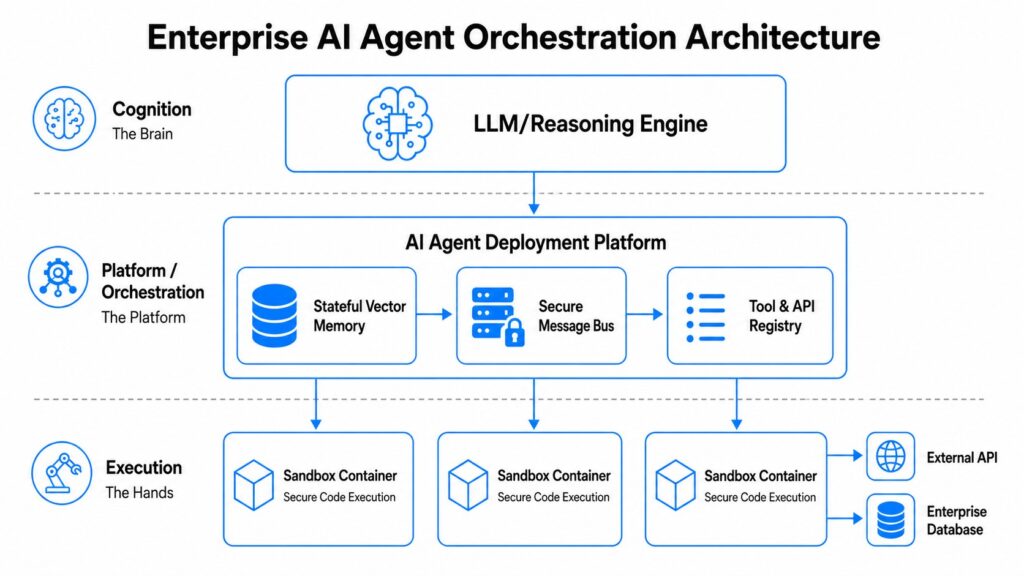
A competent deployment foundation enforces strict structural guarantees:
If you want to know how to create an AI agent that survives enterprise loads, look at strict environmental isolation. When you deploy AI using ephemeral container instances, you mitigate catastrophic risk.
We deploy AI agents this way so security policies act as physical network boundaries. A secure foundation isolates every execution step. If a model hallucinates and generates faulty code, the isolated sandbox terminates before it impacts the broader system.
Backend operations represent the most brutal, practical use case for this technology. Because traditional bash scripts cannot read a stack trace, static pipelines break immediately when deployment targets change.
Integrating an AI agent for DevOps shifts the operational baseline. The system reads complex underlying logs, understands the failure context, and rewrites configurations dynamically via your underlying infrastructure. This turns reactive system monitoring into proactive, autonomous infrastructure healing.
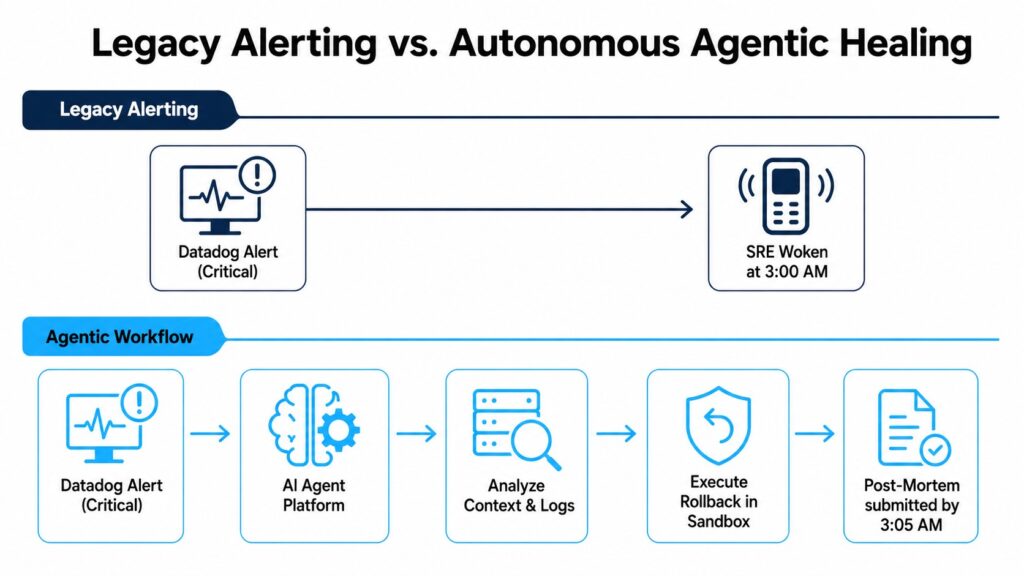
Consider the 3:00 AM late-night outage. Why an AI agent over a pager alert? Instead of waking a site reliability engineer for a memory leak in a Redis pod, the autonomous node reads the Datadog alert. It spins up a diagnostic sandbox, isolates the affected environment using secure ephemeral execution, rolls back the faulty deployment, and submits a post-mortem pull request by 3:05 AM. Organizations modernizing their infrastructure pair these models with advanced enterprise DevOps solutions to maximize cluster efficiency.
Skeptics frequently question: when will AI agents be available for standard corporate use? They are already managing mission-critical production workloads today.
Organizations face immense economic pressure to demonstrate ROI on escalating compute spend, a trend validated by recent enterprise AI adoption metrics. This infrastructure consolidates legacy automation into a highly observable control plane. We are witnessing compute expenditure shifting away from raw processing power toward highly optimized inference routing.
As a recognized Microsoft Solutions Partner in Digital & App Innovation (Azure) and one of the Top AI Consultants globally on Clutch, Opinov8 ensures technical teams can focus on building specialized domain models rather than troubleshooting vector database latency.
Adopting a centralized AI agent platform reduces the friction of integrating these isolated models into a cohesive backend strategy. Ultimately, investing in scalable reasoning architecture transforms how engineering organizations deliver software.
May interest you: Agent Sprawl: 7 Strategies to Govern AI Agents at Scale
Transitioning from static pipelines to an autonomous architecture requires more than just API access. It demands rigorous cloud infrastructure, secure orchestration, and deep engineering expertise.
At Opinov8, we don't just build isolated models; we engineer the hardened, scalable platforms that allow those models to operate safely in production. Whether you need to implement self-healing infrastructure, optimize complex backend routing, or build a custom domain-specific cognitive engine from the ground up, our team provides the necessary technical scaffolding.
Leverage our global delivery hubs and specialized Data & AI experts to bypass the trial-and-error phase of infrastructure design. Stop troubleshooting orchestration bottlenecks and start deploying systems that think, adapt, and execute.
Ready to modernize your backend architecture? Let's talk about your specific engineering constraints.