Best AI Staff Augmentation Firms for RAG Teams
AI Development, AI Native, IT Outsourcing & Delivery Models
Read more

Knowing how to assess AI governance consulting firms comes down to one test: does the firm leave you with evidence an auditor will accept, named owners for every AI decision, and model risk controls that run inside your delivery pipeline? Slide decks and maturity scores are not enough.
For banks, insurers, healthcare providers and other regulated organizations, AI has moved from pilot to production faster than governance has. Supervisors now ask how a model was approved, what data trained it, who can stop it, and how drift is caught. The EU AI Act, NIST AI RMF, ISO/IEC 42001 and the new US model risk guidance all point in the same direction: governance must be demonstrable, not declared. On 17 April 2026 the Federal Reserve, OCC and FDIC replaced SR 11-7 with SR 26-2, which ties model risk rigor to materiality and explicitly leaves generative and agentic AI to each bank's own governance framework.
That makes choosing among AI consulting firms a risk decision in its own right. This guide gives data, risk and transformation leaders a practical framework to compare firms on what matters in regulated settings: audit readiness, decision rights and model risk controls.
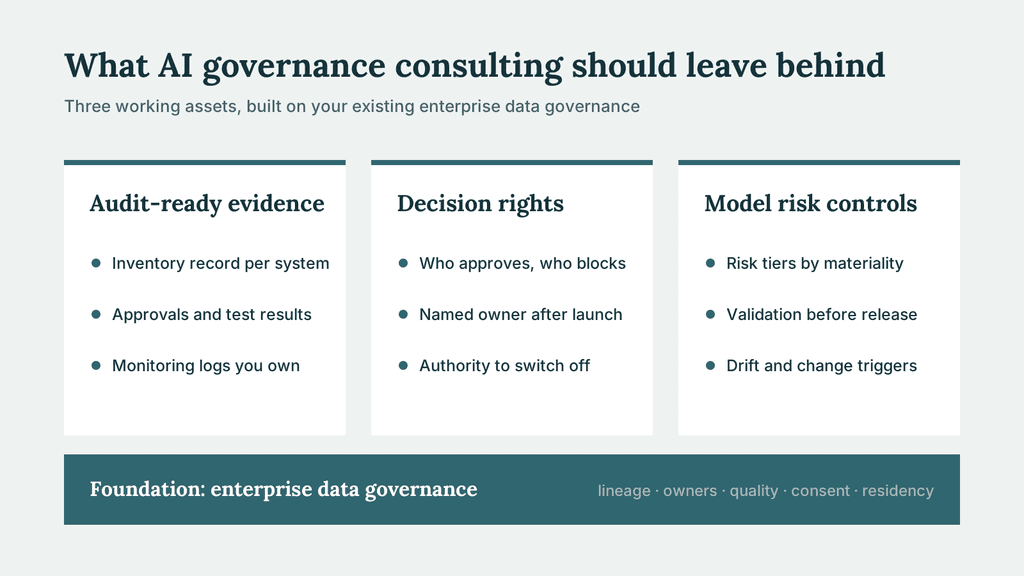
AI governance consulting should leave you with three working assets: audit-ready evidence, clear decision rights, and model risk controls tied to your data. Everything else, from maturity assessments to policy libraries, is a means to those ends.
The need is measurable. Grant Thornton's 2026 AI Impact Survey found that 78% of organizations lack strong confidence they could pass an independent AI governance audit, and 46% of executives name governance and compliance failures as the top cause of AI underperformance (GoGloby summary).
Audit-ready evidence. Every in-scope AI system has an inventory record, a risk tier, a documented approval, test results and monitoring logs. An examiner can trace a production decision back to the data, model version and sign-off behind it.
Decision rights. The operating model names who can approve a new AI use case, who can block it, who owns it after launch, and who can switch it off. This matters most when engineering, legal, security, risk and the business all touch the same system, and with agentic AI that acts without step-by-step human approval.
Model risk controls. Principles such as "AI must be explainable" become testable requirements: lineage for training and retrieval data, validation before release, drift and bias thresholds in production, and defined triggers for reassessment when a model, vendor or purpose changes.
Underneath all three sits enterprise data governance. AI risk usually starts as a data problem: unclear provenance, unfit training sets, or customer data flowing into a third-party model. A firm that treats AI governance as separate from your data governance strategy will build a parallel process your teams will route around.
Assess each firm on seven criteria, and ask for proof rather than claims. The criteria below combine the evaluation lenses used in recent buyer guides from Analytics Insight, GoGloby and Kriv AI, tuned for regulated buyers.
The firm should map your controls to the rules that actually apply to you, not a generic checklist. That means NIST AI RMF and ISO/IEC 42001, the EU AI Act's risk tiers and role-based obligations, and sector rules such as SR 26-2, HIPAA, DORA or insurance regulator guidance.
This is where many AI governance consulting firms are weakest. Most model risk starts as a data problem, so the firm should extend your existing enterprise data governance to cover training data, retrieval (RAG) sources, data lineage, consent and data residency.
Governance fails when responsibility is shared but no one decides. The firm should design a RACI covering intake, approval, exception handling, change and decommissioning, aligned to your three lines of defense.
Controls must be testable and proportionate to risk. A document summarizer does not need the review a credit or hiring model does. The firm should test the systems themselves, including bias, drift, robustness, prompt injection and data leakage, not only review documents.
The central question in every guide: does the engagement end at a framework document, or does the firm build controls into your MLOps pipelines, data platforms and approval workflows?
The test of any engagement is what exists after the consultants leave. Evidence should be generated by the process itself, stored in systems you own, and readable by internal audit and supervisors.
A firm that designs or builds your controls may face restrictions on later assuring them. Separately, check whether the recommended approach depends on one vendor's platform.
Score each shortlisted firm 1 to 5 per criterion, multiply by the weight, and sum to a score out of 5. The suggested weights favor what supervisors examine: evidence, data and controls. Adjust them to your situation, for example raising independence if you also need assurance.
| Criterion | Weight | Score 1: weak | Score 5: strong | Firm A (1–5) | Firm B (1–5) |
|---|---|---|---|---|---|
| Audit-ready evidence and handover | 20% | Evidence lives in consultant slides | Evidence auto-generated in client-owned systems | ||
| Model risk controls and testing | 20% | Document review only | Direct testing, tiered by materiality, with monitoring | ||
| Data governance depth | 15% | AI treated apart from data governance | End-to-end lineage, owners and quality thresholds | ||
| Implementation capability | 15% | Framework document only | Controls live in pipelines and workflows | ||
| Decision rights and operating model | 10% | Roles described in principle | Named owners, approval tiers, stop authority | ||
| Regulatory and framework fluency | 10% | Generic checklist | One control set mapped to your rules | ||
| Independence, neutrality and fit | 10% | Single-platform, unclear conflicts | Requirement-led tooling, clear boundaries | ||
| Weighted total | 100% |
A firm scoring below 3 on evidence or model risk controls should not reach the final round, whatever its total.
Most failed governance engagements show warning signs in the proposal. Walk away, or probe hard, when you see these:
AI consulting firms in this space fall into five broad types. Start from the problem you need solved, then shortlist by type.
| Firm type | Examples | Best fit | Watch for |
|---|---|---|---|
| Big Four and global advisory | Deloitte, PwC, EY, KPMG | Board-, regulator- and audit-facing programs across jurisdictions; independent assurance | Scope larger than the problem; independence limits if they also build |
| Global systems integrators | Accenture, IBM Consulting | Governance inside enterprise-wide AI transformation; multi-vendor estates | Ties to the firm's own platforms (e.g. watsonx.governance) |
| Mid-market and ERM-led firms | RSM, Crowe | Proportional programs; integrating AI into existing enterprise risk management | Smaller global delivery footprint |
| Governance platforms with services | Credo AI, Holistic AI, Saidot, ModelOp, Monitaur | A system of record for inventory, policy packs and monitoring | Software is not an operating model; implementation still needed |
| Engineering and data partners | Opinov8, GoGloby, Kriv AI and similar boutiques | Building controls into data platforms, MLOps pipelines and delivery workflows | Confirm regulatory depth and whether assurance must come from elsewhere |
Examples come from the three source guides (Analytics Insight, GoGloby, Kriv AI). Many regulated organizations combine types: an engineering partner to build, and a separate firm to provide independent assurance.
Opinov8 sits in the engineering and data partner category: it designs the governance model and builds it into the data platforms and AI systems it governs. Opinov8 is a London-headquartered digital and engineering firm founded in 2017, with 300+ professionals across Europe, the Americas and MENA and client work in financial services and healthcare (Clutch profile). Its AI-native engineering practice spans AI strategy, implementation and machine learning development (G2).
Mapped to the seven criteria, Opinov8's approach to AI governance consulting, led from the data and engineering side, works like this:
For regulated organizations that need independent assurance as well, Opinov8 can build the controls while a separate firm attests to them, which keeps independence clean.
A six-step process, run over roughly six to ten weeks, turns the framework into a defensible decision.
When you assess AI governance consulting firms, choose the one that can prove three things on a real use case: it can produce evidence an examiner accepts, name who decides, and run model risk controls inside your data and delivery pipelines. Reputation and service lists matter less than a working example. If you want to see how that looks in practice, talk to Opinov8 about governing one high-materiality AI system end to end.
What is AI governance consulting? It helps organizations decide how AI systems are approved, controlled and monitored: inventory, risk tiering, decision rights, model validation, monitoring and audit evidence, mapped to the regulations that apply.
What is the difference between AI governance and AI data governance consulting? AI governance consulting governs the AI system as a whole: whether a model should make a decision, who is accountable, and how it is validated and monitored. AI data governance consulting governs the data behind it: lineage, quality, consent, residency and ownership of training and retrieval data. Regulated organizations need both, because most model risk starts as a data problem.
How is it different from general data management consulting? Data management consulting focuses on how data is stored, integrated and kept accurate. AI governance adds model-specific risks such as bias, drift, explainability, third-party models and agentic behavior, and ties them to accountable owners.
Which frameworks should a firm know? At minimum NIST AI RMF, ISO/IEC 42001 and the EU AI Act, plus your sector rules. For US banks that now means SR 26-2, which leaves generative and agentic AI to the bank's own governance.
Should one firm both build and audit our controls? Usually not. A firm that designs or implements controls may face independence restrictions when assessing them. Many regulated organizations pair an implementation partner with a separate assurance provider.
Do we need a governance platform first? No. Define the operating model, risk appetite and decision rights first, then choose a platform that supports them.