

AI Transformation Consulting: How to Build an AI-Shaped Organization in 2027
AI, AI Development, AI Native
Read more

As enterprises accelerate their adoption of generative AI and autonomous systems, a new challenge is emerging: agent sprawl.
AI agents are transforming how organizations operate. They can automate repetitive tasks, write code, analyze data, support customer service, and even collaborate with other agents to complete complex workflows. But as more departments deploy their own AI solutions, many businesses are losing visibility into what agents exist, what they can access, and how they're being managed.
According to IBM, large enterprises could be operating more than 1,600 AI agents by the end of 2026. Without the right governance framework, that scale can quickly become a security, compliance, and operational challenge.
For CTOs and Heads of AI, the question is no longer whether to adopt AI agents: it's how to govern them effectively.
Agent sprawl is the uncontrolled growth of AI agents across an organization without centralized governance or visibility.
Different business units often build AI agents independently using different platforms, models, and data sources. While each initiative may solve a specific business problem, together they create an ecosystem that is difficult to monitor and control.
Unlike traditional software, AI agents don't just process information: they make decisions, interact with enterprise systems, execute workflows, and increasingly communicate with other AI agents. This makes governance significantly more important than in previous waves of digital transformation, as explored in Atlan's breakdown of agent and context sprawl.
As organizations expand their AI capabilities, agent sprawl introduces several critical challenges.
Every AI agent requires access to systems, applications, APIs, or sensitive business data. Without proper identity management and permission controls, organizations risk creating hundreds of new attack surfaces.
Treating AI agents as managed digital identities (with authentication, authorization, and least-privilege access) is becoming a core security requirement, a point Okta's identity research also emphasizes.
Without centralized oversight, multiple teams often build similar AI agents that perform nearly identical tasks.
The result is duplicated development, unnecessary infrastructure costs, increased LLM usage, and AI solutions that continue consuming resources long after they've stopped delivering business value.
As AI regulations evolve, organizations need to understand how AI systems make decisions, what data they access, and who is responsible for them.
Without an AI agent inventory and clear governance policies, demonstrating compliance becomes increasingly difficult.
Agent sprawl can also slow innovation. Disconnected agents, inconsistent prompts, duplicate workflows, and fragmented data create complexity that reduces the overall value of enterprise AI investments.
Consider a mid-sized financial services firm where four regional customer-service teams each built their own AI chatbot to handle account inquiries, none aware the others existed. Over 18 months, the firm ended up running more than 30 overlapping agents, each with its own credentials, data access rules, and LLM spend.
When a security audit finally surfaced the full picture, the firm discovered several agents had standing access to customer PII with no owner accountable for reviewing or revoking it.
This is the pattern that plays out across industries: agent sprawl rarely starts as a single bad decision, it accumulates quietly, one well-intentioned team at a time, until no one can say with confidence what's running or who's responsible for it.
Agent sprawl often develops before anyone notices it. A few warning signs tend to show up early:
If two or more of these sound familiar, agent sprawl is likely already underway.
Preventing agent sprawl doesn't mean slowing AI adoption. It means building the right governance foundation before AI scales across the enterprise.
Maintain a complete registry of every AI agent, including ownership, purpose, permissions, integrations, and lifecycle status. This AI agent inventory should be the single source of truth that any team, auditor, or security lead can consult to answer "what agents do we have, and who's responsible for them?"
A centralized AI control plane provides visibility into agent activity, performance, costs, and compliance while enabling consistent policy enforcement. Rather than governing each agent in isolation, a control plane lets organizations apply and monitor policy across the entire fleet from one place.
Every AI agent should have unique credentials, role-based permissions, and continuous monitoring to reduce security risks. Applying the same rigor to agent identity management that organizations already apply to human user accounts closes one of the largest gaps in AI security today.
Establish common architecture patterns, governance policies, security requirements, and deployment processes so every team builds AI consistently. Standardization reduces the odds that two departments unknowingly build the same agent twice.
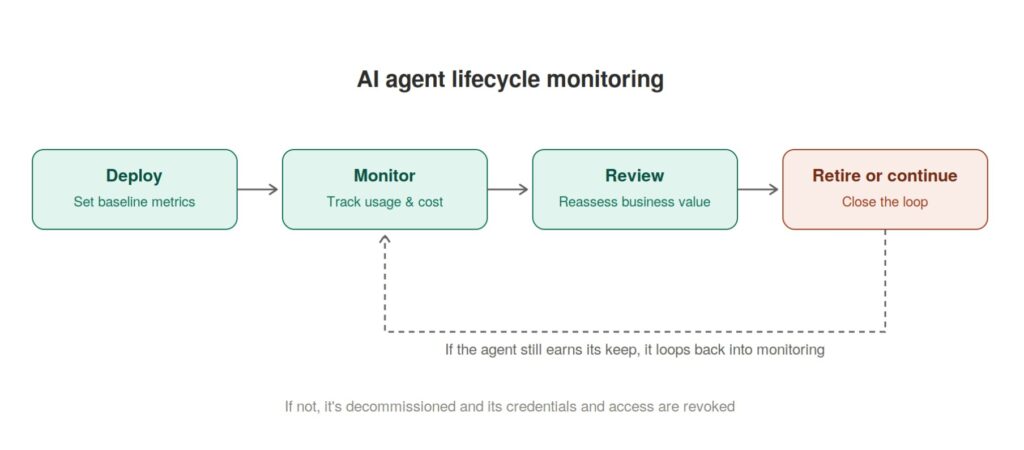
Governance doesn't stop after deployment. An agent that made sense a year ago may no longer justify its access, cost, or risk today, so treating every agent as a living asset, not a one-time launch, is essential. In practice, that means cycling through four stages continuously:
This cycle should live inside the AI control plane rather than a separate spreadsheet-driven process, that's what keeps lifecycle monitoring workable once agent count scales into the hundreds.
Agent sprawl isn't only about the number of AI agents: it's also about inconsistent knowledge. Ensuring agents share trusted business definitions and data reduces conflicting outputs and improves decision-making.
The organizations that succeed with agentic AI are embedding governance into their architecture from the beginning, rather than trying to regain control after hundreds of agents are already in production.
At Opinov8, we believe successful AI transformation starts with governance, not just implementation.
Our AI engineering teams help organizations design secure, scalable agent architectures by implementing governance frameworks, control planes, identity and access strategies, observability, and lifecycle management. This enables businesses to innovate with confidence while maintaining visibility, compliance, and operational control.
As enterprise AI continues to evolve, governance will become a competitive advantage. Organizations that can confidently manage their AI ecosystems will be better positioned to scale innovation, reduce risk, and maximize the value of their AI investments.
Ready to see where agent sprawl might already be creeping into your organization? Book a free AI governance assessment with Opinov8 →
Agent sprawl is rapidly becoming the AI equivalent of shadow IT: easy to create, difficult to manage, and increasingly expensive to ignore.
The future of enterprise AI isn't about deploying the most AI agents. It's about ensuring every agent is secure, governed, and aligned with business objectives.
Building AI at scale requires more than powerful models. It requires powerful governance.