
Most conversations about AI still start with the wrong question: which jobs will it replace? Leaders who ask that question tend to plan around headcount. Leaders who ask a better one, which work actually creates value, tend to get results.
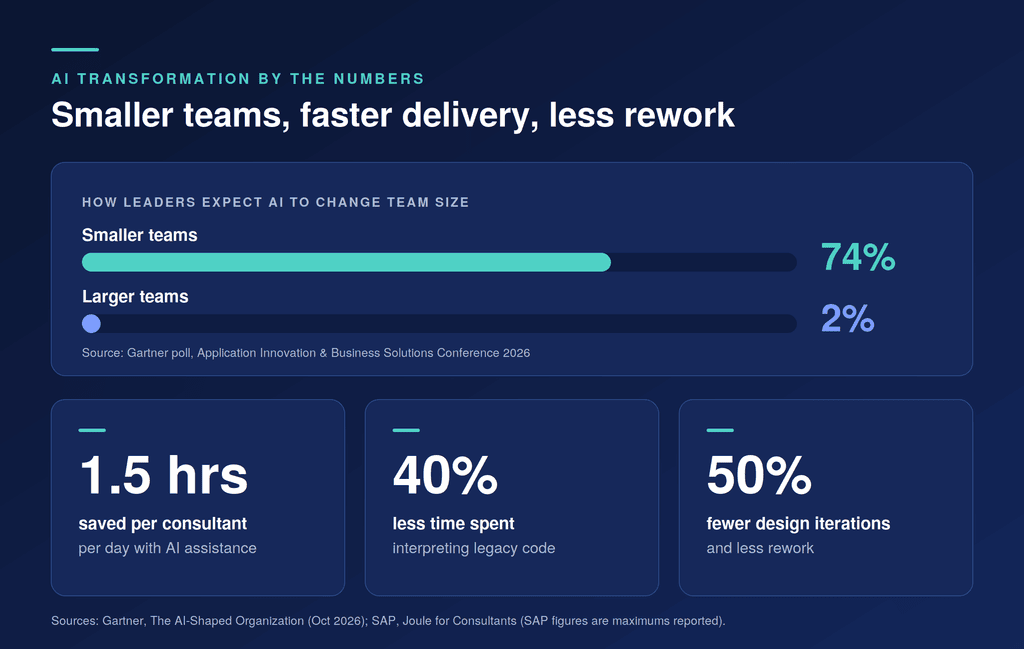
The shift is already visible. In a Gartner poll at its Application Innovation & Business Solutions Conference 2026, 74% of respondents said AI will lead to smaller teams, while only 2% expected larger ones. Teams are shrinking, but expectations are growing. Gartner's conclusion is clear: AI should not be retrofitted into an old structure. It should be the reason the organization becomes more adaptable and more focused on value.
That is the work of AI transformation consulting. It goes beyond picking tools or launching pilots. It helps companies redesign how work, roles and teams are organized, so AI delivers measurable outcomes instead of another stalled project.
This guide explains what an AI-shaped organization looks like, the 7 proven steps to build one, and what to look for in an AI transformation consulting partner as you plan for 2027.
AI transformation consulting helps organizations redesign their strategy, workflows, teams and technology so AI creates measurable business value at scale. It covers the full path from identifying where AI matters most, to proving it works, to building the operating model that keeps it working.
A good engagement usually combines four things: an AI strategy tied to business outcomes, a new AI operating model for teams and roles, the data and cloud foundations AI depends on, and hands-on engineering to deliver real solutions, not just recommendations.
AI-shaped vs AI-added organizations
Most companies today are AI-added. They bolt AI tools onto existing processes and hope for productivity gains. The org chart stays the same, the workflows stay the same, and the results are usually modest.
An AI-shaped organization works differently. Gartner describes it as one that shifts focus from who does the work to what work creates value, using adaptable structures, smaller teams, evolving roles and AI-enabled workflows.
| AI-added organization | AI-shaped organization | |
|---|---|---|
| Starting point | Tools and use cases | Business value drivers |
| Structure | Unchanged org chart | Small teams organized around outcomes |
| Roles | Fixed job titles | Skills-based, evolving roles |
| Managers | Pass information up and down | Coach teams and own outcomes |
| AI ownership | Scattered pilots | Platform teams that maintain and retire AI |
| Typical result | Pilots that never scale | Measurable, repeatable value |
These seven steps turn the AI-shaped organization from an idea into a plan. Each builds on the last, moving you from priorities to proof to a lasting new way of working.
The most common mistake in AI transformation is designing the future organization around projected headcount or assumptions about what AI might do. Gartner recommends the opposite: define the value drivers first, then design the work around them.
Choose the three business outcomes AI should improve next year, such as revenue growth, margin, customer retention, speed to market or risk reduction, and give each a measurable target. This changes the conversation with the board. Instead of "how many roles can AI remove?", leaders can answer "which outcomes will AI improve, and by how much?"
How to measure AI value in the enterprise
Measure AI against your value drivers, not against activity. Useful measures include revenue or cost impact per use case, cycle time for key processes, quality and error rates, customer satisfaction, and the share of AI pilots that reach production.
Most organizations already have AI and digital initiatives underway, and many are stuck between pilot and production. Before launching anything new, decide which projects to fix, which to fund further and which to stop.
Judge each one against the value drivers from Step 1. Rescuing a stalled project that targets the right outcome is often faster and cheaper than starting from scratch.
Pick one problem with a clear business impact and test AI against it in weeks, not quarters. Build on your real data, not sample data, and agree on success criteria before any work starts, so success is never a matter of opinion.
A quick, measurable win does more than validate the technology. It builds trust across the business and secures the budget for the steps that follow.
Once AI has proven its value, redesign the work around it. Take one important workflow and work through it in three moves:
The redesigned workflow becomes the template for the next one. Avoid simply bolting AI onto the old process; that is how organizations end up AI-added instead of AI-shaped.
Gartner finds that AI compresses some roles, expands others and combines responsibilities in new ways. Work is increasingly organized around skills and outcomes rather than job titles, and most leaders now expect smaller teams.
Smaller does not mean less ambitious. Form small teams around meaningful problems, give each one ownership of its outcome, and pair AI with human direction to create the smallest effective unit.
Pair technical experts with domain specialists
AI projects often fail because the people who understand the technology and the people who understand the business never work closely together. AI-native companies solve this with forward-deployed engineers: technical experts who sit inside the business team, learn its problems first-hand and build solutions with the people who will use them.
Every AI solution needs to be monitored, updated and eventually retired. Without clear ownership, organizations end up with a growing pile of unmaintained models and tools.
A dedicated platform team takes on this responsibility, along with AI governance. That frees the rest of the organization to focus on new opportunities instead of maintaining old ones.
AI can take on much of the tracking and administrative work that fills a manager's week. That frees managers to coach their people, help teams make trade-offs and hold them accountable for outcomes. The manager as a relay for information no longer works; small, high-agency teams need direct access to data and faster decisions.
At the same time, plan the skills your people will need as roles change, and invest in training early so your teams grow with the technology.
One final point: an AI-shaped organization is never finished. As Gartner notes, managing ongoing change, adapting roles and keeping work aligned with value are becoming permanent leadership responsibilities.
The right partner shortens the path from strategy to working AI. The wrong one leaves you with a polished roadmap and nothing in production. When comparing AI transformation consulting firms, ask these questions:
| Question to ask | Why it matters |
|---|---|
| Do they start with business value or with technology? | Value-first partners tie every project to an outcome you can measure. |
| Can they build, not just advise? | Strategy without engineering often stalls at the pilot stage. |
| Do they prove value before you commit big budgets? | A short, fixed-scope proof of concept reduces risk and builds internal support. |
| Do they understand data and cloud foundations? | AI is only as good as the data and infrastructure behind it. |
| Will they embed with your teams? | Working side by side transfers knowledge and builds your own capability. |
| Can they rescue projects that have stalled? | Most enterprises already have AI or digital initiatives that need fixing. |
| What partnerships and recognition do they hold? | Partnerships with major cloud and AI providers signal proven expertise. |
A partner that scores well on all seven can help you move from experiments to an AI-shaped organization, rather than adding one more pilot to the pile.
Look for a partner that uses AI in its own delivery
AI does not only change your organization. It also changes how transformation projects are delivered. Consulting firms that build AI into their own methods can move faster and with fewer mistakes.
SAP's experience with its consultant AI assistant shows the scale of the gain. SAP reports that consultants can save up to 1.5 hours a day and spend 40% less time interpreting legacy code (SAP News). It also reports up to 50% fewer design iterations and less rework (SAP).
For buyers, the lesson is simple: ask potential partners how they use AI to speed up research, design, coding and testing on your project. A partner that is AI-native in its own work is more likely to make your organization AI-native too.
Opinov8 is an AI-native engineering company that turns AI transformation from slides into working systems. Named Best AI Company in Europe at the 2025 Netty Awards, we combine AI consulting, data, cloud and custom software engineering in one team.
Our approach follows the value-first principles in this guide:
Planning your 2027 AI roadmap? Start with one problem worth solving. Our Co-CEO, Craig Wilson, would be happy to have a quick conversation about where AI can create the most value for your business. Get in touch with Opinov8.
What does an AI transformation consulting firm do?
An AI transformation consultant helps a company identify where AI creates the most value, prove it with real data, and redesign workflows, teams and technology so AI works at scale. The best consultants also build the solutions, rather than only recommending them.
How is AI transformation consulting different from AI implementation?
AI implementation delivers a specific tool or model. AI transformation consulting changes how the organization works around AI, including strategy, operating model, roles, data foundations and governance, so value keeps growing after the first project.
What is an AI operating model?
An AI operating model defines how an organization uses AI to create value: which outcomes it targets, how teams and roles are structured, who owns AI solutions, and how they are governed and measured over time.
How long does an AI transformation take?
Full transformation is ongoing, but results should come early. A focused proof of concept can show value in a few weeks, and a first redesigned workflow can be in production within months.