

AI Transformation Consulting: How to Build an AI-Shaped Organization in 2027
AI, AI Development, AI Native
Read more

Eighty percent of tech professionals actively deploying AI agents cite AI governance as their number one deployment challenge. That figure, from Gravitee's State of Agentic AI 2025 report, is not a surprise to anyone who has tried to scale an AI programme in a regulated business. What is surprising is how consistently the diagnosis is wrong.
Most organisations treat AI governance as a compliance problem. They assign it to a policy team, produce a framework document, and schedule a review after launch. The AI system goes live. The audit question arrives. And the answer, the data lineage, the model version history, the access logs, the rollback procedure, does not exist, because no one built it.
That is why governance fails. Not because organisations lack the will to govern their AI. Because the decisions that make AI governable are engineering decisions, made at architecture design time, and most engineering teams are not making them.
This article is written for the people who can change that: Heads of Data and AI, CIOs, and VPs of Engineering in regulated sectors who are tired of AI programmes that work technically and fail commercially. It is a practitioner's guide to the enterprise AI governance framework that turns ungovernable AI pilots into auditable, scalable production systems.
The numbers set the scene. Eurostat's 2025 data shows that only 17% of small EU enterprises have adopted AI, against 55% of large enterprises, and the gap widens with scale precisely because larger organisations hit the governance wall harder. Fifty-two percent of enterprises that have considered but not yet deployed AI cite legal uncertainty as the primary reason. Seventy percent cite lack of in-house expertise.
And inside organisations that have deployed: Microsoft's own research found that 71% of UK employees are already using unapproved AI tools at work, without oversight, audit trails, or any visibility from the teams nominally responsible for AI governance.
The regulatory environment is not waiting for organisations to catch up. The EU AI Act, fully applicable from August 2026, introduces mandatory obligations for AI systems used in consequential decisions — credit, hiring, medical triage, critical infrastructure. DORA, now live for financial entities across the EU, requires that AI-driven processes feeding into ICT risk management can be documented, tested, and recovered. The FDA's evolving framework for AI-enabled medical devices requires post-market surveillance of model behaviour at the pipeline level.
These are not policy requirements that sit above the engineering. They live inside it.
There is a structural reason why AI governance fails even in organisations that take it seriously. Governance is typically assigned to a compliance team, addressed after the technical build is complete, and delivered as a documentation exercise. By that point, the architecture decisions that determine whether the system is actually auditable have already been made — and made without governance in mind.
An obligation to demonstrate data lineage for a credit decision model cannot be retrofitted with a policy document. It has to be built into how data flows from ingestion to inference. An obligation to roll back a model version in response to observed performance drift is not a governance ceremony — it is a deployment architecture question.
CIMA's Future-Ready Finance Survey found that 88% of finance professionals expect AI to transform their field. The same survey makes clear that regulators are not waiting for firms to be ready. The engineering teams that understand this are building AI systems that earn regulatory confidence and scale. The teams that treat governance as a post-launch documentation exercise are building expensive pilots.
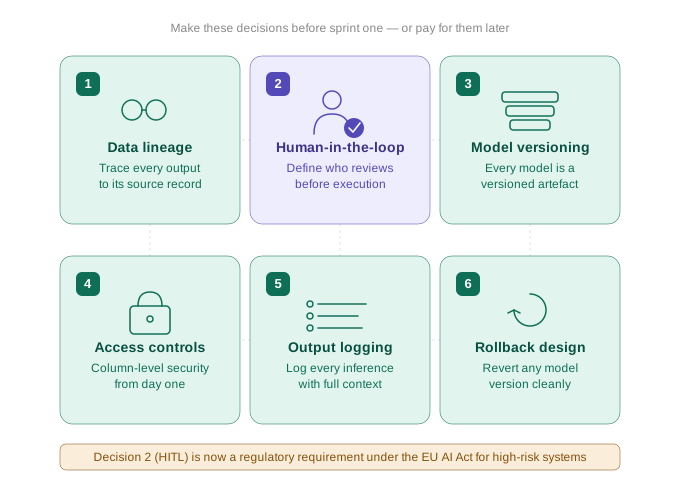
These are the decisions that need to be on the table before sprint one. Each one, deferred or made carelessly, creates a liability that compounds through every subsequent build phase.
1. Data lineage: Can you trace any model output back to the specific data record that produced it? Every transformation between raw ingestion and model input needs to be recorded, versioned, and queryable. Systems without lineage cannot explain anomalous outputs, cannot satisfy subject access requests under GDPR, and cannot demonstrate data quality compliance under DORA.
2. Human-in-the-loop design: Who is accountable when the agent makes a wrong call? HITL is not a safety net bolted on after deployment — it is an architecture decision. Before build begins, you need to define which decisions require human review before execution, what the escalation path looks like when an agent reaches a low-confidence threshold, and how human overrides are logged and fed back into model improvement. Regulated sectors increasingly treat the absence of a documented HITL design as a compliance gap in its own right. Under the EU AI Act, high-risk AI systems must be designed with meaningful human oversight — and "meaningful" means the oversight is active and auditable, not theoretical.
3. Model versioning: Are trained models treated as artefacts with provenance — tracked alongside the data they were trained on, the parameters used, and the evaluation runs that validated them? MLflow or an equivalent experiment tracking tool is not optional infrastructure. It is the audit trail. Without it, a model in production is a black box without a birth certificate.
4. Access controls: Who can read what data, at what stage of the pipeline, and under what conditions? Column-level security, row-level filtering, and workspace-level isolation need to be designed into the data platform from day one. Bolting them on when the DPO asks questions is expensive, unreliable, and usually incomplete.
5. Output logging: Every inference a production model makes should be logged with enough context to reconstruct the decision: input features, model version, timestamp, output. This is the record that makes an audit possible and the record that makes performance monitoring, drift detection, and incident response possible. Inference without logging is not production-ready AI.
6. Rollback design: When a model behaves unexpectedly in production — and it will — can you revert to the previous version cleanly? Model deployment needs to be treated like software deployment: versioned, tested in staging, and designed so the previous state is recoverable. Organisations that cannot roll back a model cannot respond to a regulator's instruction to stop using a system.
None of these are exotic requirements. All six are routinely skipped or deferred in the name of speed. The result is AI that cannot be scaled, audited, or defended.
One of the reasons Opinov8 builds on Databricks is that the medallion architecture — Bronze, Silver, Gold — is a governance pattern as much as a performance pattern.
In the medallion model, data flows through three explicitly separated layers. Bronze holds raw, unmodified ingested data. Silver holds validated, cleansed, and conformed data. Gold holds curated, aggregated data ready for analytics and ML workloads. Every transformation between layers is a discrete, logged, versioned operation. This gives you lineage by design. Because every record in Gold traces back through Silver to Bronze, every model output connects to its source data. Because transformations are code — notebooks, jobs, Delta Live Tables pipelines — they are version-controlled and replayable. Because Unity Catalog governs access across the entire lakehouse, access controls are consistent from raw ingestion to model serving.
Opinov8's Life Sciences Insights Platform demonstrates this at scale: more than 100 daily Databricks workflows processing hundreds of gigabytes per day, with Bronze ingesting raw clinical and operational data, Silver applying validation and harmonisation logic, and Gold producing analysis-ready datasets consumed by downstream ML models tracked in MLflow. Every model output is traceable, every transformation is auditable, every experiment is reproducible — not because governance was layered on afterwards, but because the architecture made it the default.
The compliance pressures vary by sector, but the engineering requirements converge.
What each sector shares is this: AI risk management engineering, the discipline of building risk controls into AI systems at the architecture level rather than the policy level, is no longer optional. It is the baseline expectation of regulators, auditors, and procurement teams in every regulated industry.
In financial services, the Digital Operational Resilience Act (DORA) requires that AI-driven processes feeding into Information and Communication Technology (ICT) risk management can be documented, tested under stressed conditions, and recovered after failure. This means deterministic pipelines, comprehensive logging, tested rollback procedures, and equivalent controls from third-party AI providers.
In life sciences, the Food Drug Administration (FDA) guidance on AI-enabled medical devices requires post-market surveillance of model performance against real-world data. Inference logging is not optional: it is a regulatory requirement. Models that make decisions without producing an auditable record cannot be used in regulated medical contexts regardless of their accuracy in development.
In commercial real estate and other high-volume document processing environments, the governance requirement is concrete: can you demonstrate that AI-driven decisions about lease terms, financial obligations, or property valuations are traceable to source documents? Opinov8's CRE Operations platform processes tens of millions of records, with AI-driven lease abstraction delivering around 80% faster processing. That performance is only deployable at enterprise scale because the underlying architecture supports auditability, every extracted data point is traceable to its source document, every transformation is logged, and every output can be reviewed and corrected without data loss.
Understanding why governance fails consistently requires being honest about the structural problem: governance is typically bolted on at the end, by a different team, with no connection to the engineers who made the original architecture decisions. The assessment firm delivers a report and leaves. A developer builds the agents. No one is accountable when something breaks. No platform, no monitoring, no audit trail.
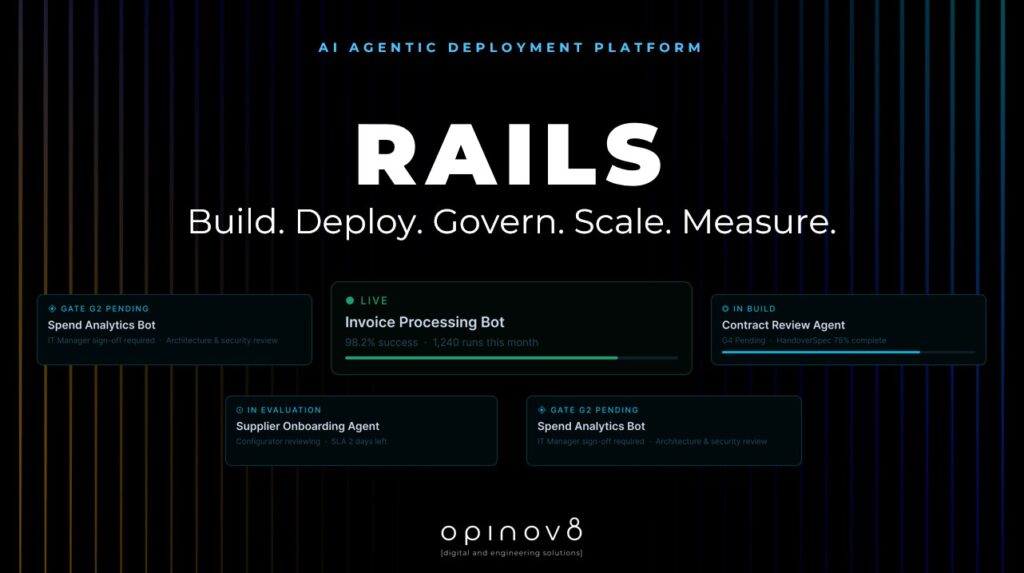
RAILS, Opinov8's AI Agentic Deployment Platform, is built around the opposite principle. The platform's core is a four-gate governance pipeline that every agent must pass before it reaches production. No exceptions.
Gate 1 is data and compliance review — DPO sign-off on data use, classification, and permissions, protecting against silent legal exposure from unpermissioned data access. Gate 2 is architecture review, validating the technical design against the client's stack before build begins. Gate 3 is prototype validation, where the business owner signs off on agent behaviour before full build. Gate 4 is the production release gate — human-in-the-loop controls active, monitoring live, ROI baseline set — so no agent goes live dark.
Each gate has a named owner, documented pass/fail criteria, and an audit record that is EU AI Act compliant from day one. Policy Signal Intelligence monitors the regulatory landscape continuously, so compliance gaps are caught before they become exposures. The result: 100% governance coverage, 0 compliance surprises.
Crucially, RAILS is not software you buy and implement yourself. Opinov8 is embedded as the delivery partner at every stage — the same team that built the platform builds and manages your agents on it. No translation layer, no third-party risk, no accountability gap. From first discovery call to first live agent in six to twelve weeks. Average ROI on the first agent build, within twelve months: 3×.
There is a predictable pattern in organisations where AI does not scale past pilot. The models work. The use case is validated. The business case is clear. What is missing is confidence that the system can be operated, explained, and defended at scale.
The organisational signals that predict this outcome are recognisable early: governance is a separate workstream from engineering, addressed after the technical build. The data team and the compliance team have not had a joint conversation about the system's architecture. There is no plan for unexpected model behaviour in production. No one has asked who owns the audit trail.
These are not cultural problems. They are architecture and delivery problems that manifest as cultural friction. The resolution is to treat governance infrastructure as part of the definition of done — not a review gate, not a documentation exercise, but a set of engineering decisions designed in from the start, with a delivery partner accountable for them end to end.
Organisations that make these decisions early — or choose a platform like RAILS where those decisions are already built in — build AI systems that earn stakeholder trust, satisfy regulatory scrutiny, and scale. Organisations that defer them build expensive pilots.
For engineering teams beginning a new AI build, these are the governance-critical questions to answer before committing to an architecture.
Data lineage
- Is every transformation between raw data and model input version-controlled and logged?
- Can you trace any model output back to the source record that produced it?
- Does your data platform support column-level and row-level access controls?
Human-in-the-loop design
- Have you defined which agent decisions require human review before execution?
- Is there a documented escalation path when an agent reaches a low-confidence threshold?
- Are human overrides logged and fed back into the model improvement cycle?
- Is your HITL design auditable — active and documented, not theoretical?
Model lifecycle
- Are trained models tracked as versioned artefacts with associated data, parameters, and evaluation results?
- Is MLflow or equivalent configured as standard infrastructure, not optional tooling?
- Do you have a defined process for promoting a model from development to staging to production?
Access controls
- Are data access permissions governed at the platform level, not managed manually per pipeline?
- Are workspace boundaries defined so development, staging, and production data are isolated?
- Is there an audit log of who accessed what data and when?
Output logging
- Is every model inference logged with input features, model version, timestamp, and output?
- Is that log queryable and retained in line with your sector's regulatory requirements?
- Does the logging infrastructure support drift detection and performance monitoring?
Rollback and recovery
- Can you revert to a previous model version in production without manual intervention?
- Is the rollback procedure tested as part of the deployment pipeline?
- Is there a defined incident response process for unexpected model behaviour?
Regulatory alignment
- Have you identified whether your AI system falls within EU AI Act high-risk categories?
- Have you mapped your governance architecture against DORA or FDA requirements if applicable?
- Have your engineering and compliance teams reviewed the architecture together?
- Does every agent have a named owner, documented pass/fail governance criteria, and a production release sign-off?
AI governance does not fail because organisations lack the will to govern. It fails because the decisions that make AI governable are engineering decisions, and they are being made too late or not at all.
The technical foundations are available. Databricks' medallion architecture, MLflow's experiment tracking, Unity Catalog's access governance, and platforms like RAILS provide the infrastructure for governance-native AI builds without significant overhead. What they require is the decision, made at architecture time, to build AI you can stand behind.