
Most enterprise AI programs don't fail because the model is wrong. They stall because the organization underneath isn't ready: data scattered across systems no one owns, governance that exists on paper but not in pipelines, and no clear accountability when AI gets it wrong.
The numbers bear this out. data.world's AI readiness survey put the average organization at 54.5%, and the same guide cites research that only 26% of companies can move AI beyond pilots to tangible value.
This guide is for enterprise modernization buyers and data and AI transformation leaders. Its argument: successful data strategy and AI implementation are the same program, sequenced correctly. It covers the five gaps that block enterprise AI transformation, a self-assessment, a pre-rollout roadmap and the KPIs that prove value.
Enterprise AI readiness is the ability to put AI into production repeatedly, safely and at a cost the business will keep funding. It rests on five dimensions, each depending on the ones before it.
| Dimension | The question it answers | What "ready" looks like |
|---|---|---|
| Data strategy alignment | Are we pursuing AI where the business value and the data actually exist? | A prioritized use-case portfolio tied to measurable outcomes and mapped to specific data domains |
| Data infrastructure | Can we deliver the right data to models reliably, at the speed the use case needs? | Integrated, cloud-scalable platforms with pipelines, feature and vector stores, and observability |
| Data governance | Can we trust, trace and lawfully use the data? | Named data owners, quality SLAs, lineage, access controls and privacy policies enforced in code |
| AI governance and risk | Can we oversee models and answer for their decisions? | A model inventory, risk tiering, approval gates, monitoring and clear accountability |
| Operating model and people | Will teams build, run and actually use AI? | Defined roles, cross-functional delivery teams, AI literacy and an adoption plan per use case |
Order matters: start with tooling and you build platforms nobody uses; start with models and you build systems you can't defend to an auditor.
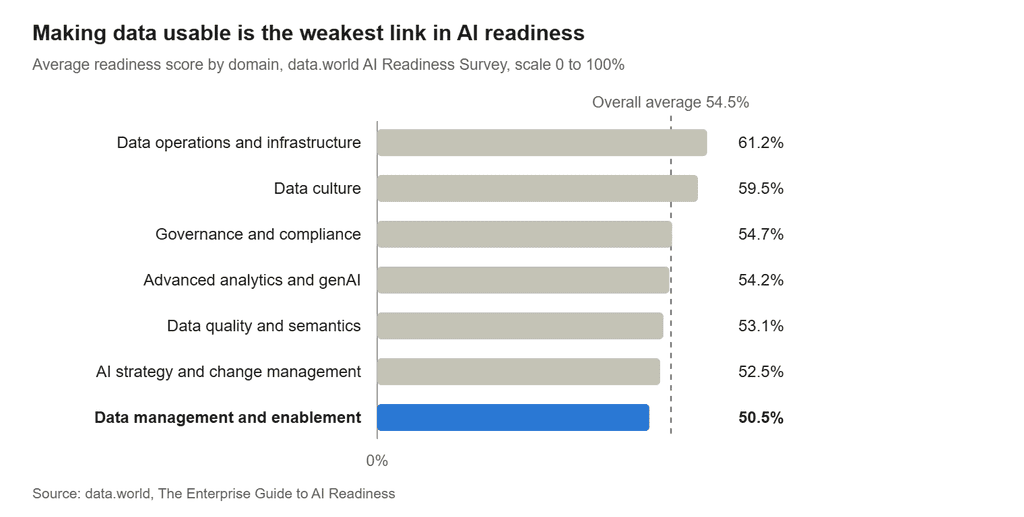
Enterprises score best on infrastructure and worst on making data discoverable and usable, which is why technical investment alone rarely produces AI readiness.
AI ambitions often float free of business outcomes and of the data that could support them: long use-case lists, each with a different sponsor, none ranked and few checked for data feasibility.
Warning signs: separate AI and data roadmaps, use cases justified by technology rather than a business metric, and data problems discovered mid-build.
How to close it
Most data infrastructure was built for reporting, not AI, which needs broad, granular, often real-time data plus unstructured content such as documents and transcripts. It is also where enterprises feel most prepared: infrastructure was the top-scoring domain in data.world's survey at 61.2%, which the authors warn can create a false sense of security
Warning signs: siloed sources with no integration layer, data scientists spending most of their time wrangling data, hand-built pipelines that break silently, and no governed way to index internal documents for generative AI.
How to close it
The test: can a new use case get governed, production-grade data in weeks rather than quarters?
AI amplifies whatever is in the data, including errors, bias and records you aren't permitted to use, so governance built for compliance reporting isn't enough. In data.world's survey, data management and enablement was the weakest domain at 50.5%, and data quality and semantics scored 53.1%.
Warning signs: no named owners for key data domains, quality checked after the fact, no lineage from model output back to source, and privacy rules no pipeline can enforce.
How to close it
AI governance covers the system itself: how models are approved, monitored and explained, and who answers for them. The EU AI Act, the NIST AI Risk Management Framework and ISO/IEC 42001 are raising expectations.
Warning signs: no complete AI inventory, the same review for every model, legal and risk consulted only at the end, and no monitoring after launch.
How to close it
Proportionate governance lets enterprises say yes to more use cases, not fewer.
AI creates no value until people change how they work. data.world's guide cites research that around 70% of AI implementation challenges stem from people and process rather than technology.
Warning signs: AI isolated in a central lab, key roles vacant, users meeting new tools only at launch, and success measured by deployment rather than usage.
How to close it
Before committing to a rollout, have a cross-functional group score each dimension 1, 3 or 5.
| Dimension | 1: Ad hoc | 3: Developing | 5: Ready to scale | Your score |
|---|---|---|---|---|
| Data strategy alignment | Use cases chosen by enthusiasm; separate AI and data roadmaps | Prioritized use-case list; partial link to business KPIs | One funded portfolio; every use case tied to a metric, an owner and named data products | |
| Data infrastructure | Siloed sources; manual extracts; no production-like environment | Central platform for some domains; some reusable pipelines | Unified platform for structured and unstructured data; feature and vector stores; observability | |
| Data governance | No clear owners; quality checked manually, if at all | Owners for some domains; catalog partly populated | Domain ownership, data products with SLAs, automated quality, lineage and policy enforcement | |
| AI governance and risk | No AI inventory; reviews ad hoc or missing | Policy drafted; some reviews; limited monitoring | Full inventory, risk tiering, approval gates, production monitoring and incident response | |
| Operating model and people | AI isolated in a lab; key roles missing | Some embedded teams; training for specialists | Hub-and-spoke model, staffed roles, broad AI literacy and adoption plans per use case |
Reading your results: fix any dimension scored 1 before scaling; mostly 3s means you're ready for a few lighthouse use cases; mostly 5s means you're ready to scale. The weakest dimension, not the average, sets your ceiling.
Close gaps in four phases, each ending in a gate with explicit criteria, so the program neither scales on hope nor polishes foundations forever.
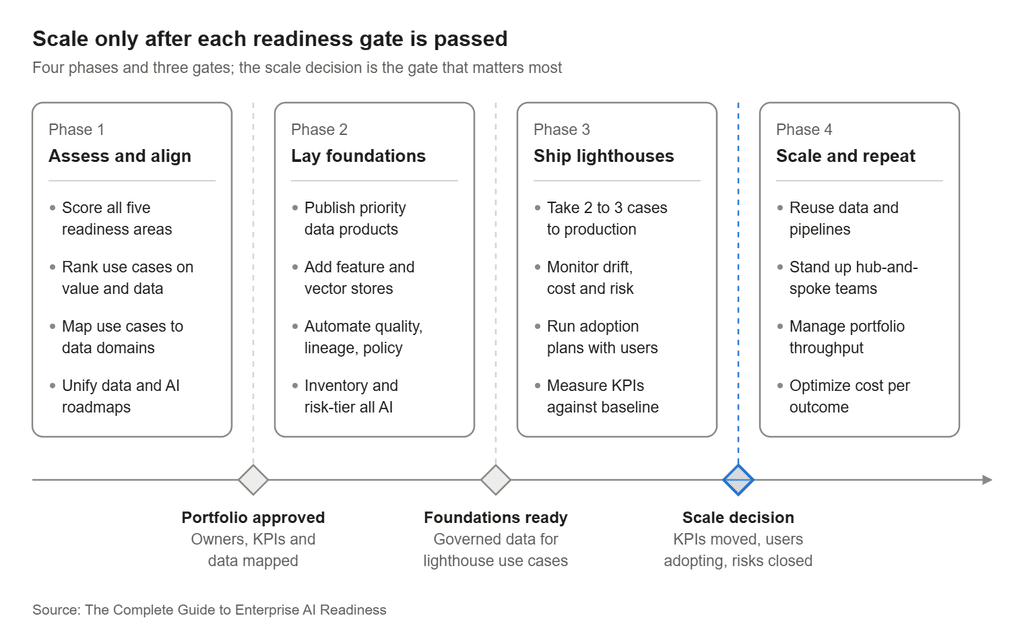
Each phase builds on the one before it, and the scale decision comes only after lighthouse use cases prove value in production.
Keep Phase 2 to the minimum foundation the next wave of use cases needs. As a planning reference, one commonly cited arc puts foundations in months 1 to 6, first deployments in months 7 to 18 and scaling from month 19.
Track readiness and value side by side: one shows the foundation is improving, the other that it's paying off.
| KPI | What it shows |
|---|---|
| Time from approved use case to production | Whether readiness is improving |
| Time to provision governed data for a new use case | Infrastructure and governance friction |
| Share of AI systems inventoried and risk-tiered | AI risk visibility |
| Active users per AI use case | Adoption, not just deployment |
| Business KPI movement against baseline | The value the program exists for |
| Cost per AI-assisted transaction | Whether scaling stays economical |
Add responsible AI measures such as human override rates, set every KPI before deployment, and review them quarterly like a capital allocation review.
Gartner reported that 63% of organizations lack, or are unsure they have, the right data management practices for AI, and predicts that through 2026 organizations will abandon 60% of AI projects unsupported by AI-ready data.
| Challenge | How to avoid it |
|---|---|
| Pilot purgatory | Define production criteria, owners and funding before the pilot starts |
| Data that isn't AI-ready | Assess data per use case; build on governed data products |
| Governance as a final gate | Involve legal, risk and security at intake, with tiered reviews |
| Platform before purpose | Let the use-case portfolio drive platform spend |
| Shadow AI | Offer approved tools and a clear acceptable-use policy |
| Low adoption | Co-design with users and redesign the workflow |
Enterprise AI stalls at the seams between strategy, data, governance and people. Closing them first is slower for the first use case and much faster for every one after it.
Start this quarter: run the assessment, fund your weakest dimension, pick two or three lighthouse use cases that share data domains, and put tiered governance in place before the next model ships. Treat data strategy and AI implementation as one program, and AI becomes an enterprise capability rather than a series of experiments.