

Logistics AI: Use Cases, Benefits, and How to Implement AI in Logistics
AI Development, AI Native
Read more

AI self-service has moved from a nice-to-have widget to a core part of enterprise support architecture. Customers expect instant, accurate answers at any hour, while support leaders face rising ticket volumes, flat budgets and pressure to prove the return on every AI investment.
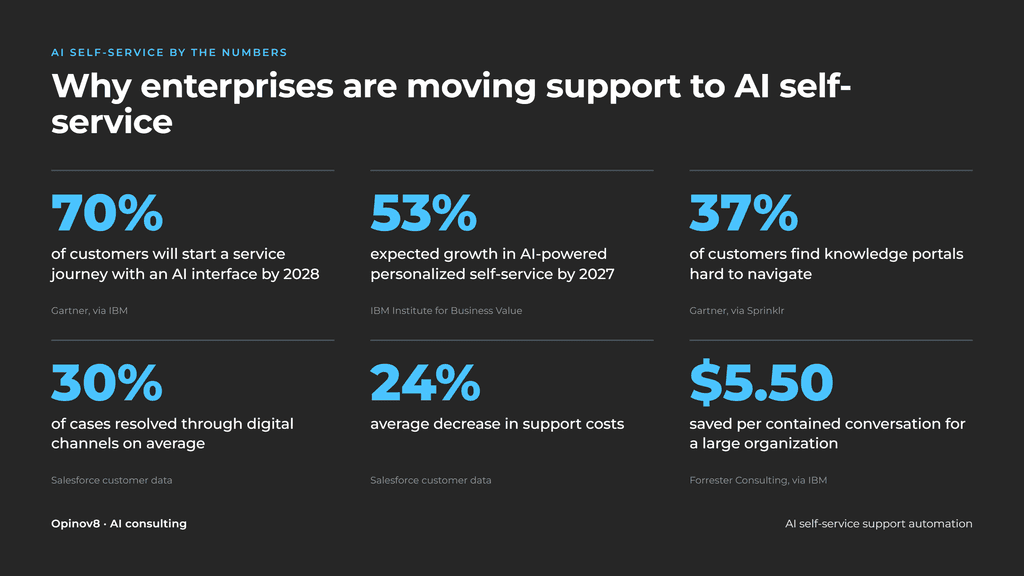
The shift is already under way. IBM's explainer AI self-service reports that Gartner predicts at least 70% of customers will begin a customer service journey through an AI interface by 2028, and that executives surveyed by the IBM Institute for Business Value expect a 53% increase in using AI for personalized self-service by 2027.
The gap between expectation and reality is rarely the technology itself. Most enterprises already have chatbots, help centers and FAQ pages. What they lack is a self-service layer that understands intent, draws on trusted knowledge, takes action in back-end systems and hands off to a human at the right moment.
This article explains what effective AI self-service looks like today, why many first attempts stall, and how Opinov8 AI consulting helps enterprise modernization and data and AI transformation teams design and implement AI-powered customer support that scales.
AI self-service is a customer support model in which conversational AI, automated knowledge retrieval and system integrations let customers find answers and complete tasks without waiting for a human agent. It runs 24/7 across web, mobile, messaging and voice, and escalates to people only when needed.
IBM's AI self-service extends the definition beyond customers to employees and third parties, covering use cases such as HR and IT support. Salesforce's guide What is AI Self-Service? Benefits and How It Works emphasizes what separates it from static FAQs: by connecting to customer data and business systems, AI self-service can personalize answers and complete transactions such as rescheduling an appointment or processing a return.
The difference from traditional self-service is significant:
| Capability | Traditional self-service | AI self-service |
| Understanding | Keywords and fixed menus | Natural language and intent across multiple turns |
| Knowledge | Static FAQ pages | Answers retrieved from governed, current sources with citations |
| Actions | Explains steps only | Completes tasks through secure integrations |
| Escalation | Customer starts over with an agent | Handoff with a full conversation summary |
| Improvement | Manual and infrequent | Continuous, driven by analytics and evaluation |
| Scaling | Rebuilt for each channel | Reusable components across channels and languages |
First-generation self-service tools were built on rigid decision trees and keyword matching. They work for a narrow set of scripted questions and break as soon as a customer phrases a request differently, combines two issues, or needs something done rather than explained.
The common failure patterns look similar across industries:
The result is low containment, frustrated customers and skepticism inside the organization about whether automated assistance can work at all.
Static knowledge portals on their own do not solve the problem either. Sprinklr's What is AI Self-Service: Benefits, KPIs and Features, citing Gartner research, notes that 37% of customers find branded knowledge portals hard to navigate and would rather call an agent than search for answers themselves.
Modern AI self-service combines conversational AI, knowledge base automation and system integration into one experience. Instead of matching keywords, it understands what the customer means, retrieves the right information from governed sources and completes the task where possible.
The core capabilities of today's self-service AI tools include:
When these pieces work together, AI-powered customer support stops being a deflection tool and becomes a resolution channel in its own right.
Scalable conversational flows are designed around customer intents and business outcomes, not around the bot's limitations. The goal is a structure that can grow from a handful of use cases to hundreds without becoming unmanageable.
Four design principles make the difference:
With this approach, adding a new channel such as a mobile app, WhatsApp or voice becomes a configuration task rather than a new project.
An AI assistant is only as reliable as the knowledge behind it. For most enterprises, the hardest part of AI self-service is not the model but the content: product documentation, policies, help articles and internal runbooks spread across CMS platforms, wikis, ticketing systems and shared drives.
Industry leaders agree on this point. IBM's AI self-service warns that poorly structured or incomplete knowledge bases produce inaccurate responses that erode user trust, and that successful organizations invest in data quality early with clear ownership. Salesforce's What is AI Self-Service? Benefits and How It Works adds that if information is unclear or undocumented, it simply will not appear in self-service, so consolidating knowledge into a single accessible source is essential.
Effective knowledge base integration addresses this in layers:
Treating knowledge as a governed data product, with owners and quality standards, is what turns a promising pilot into a dependable service.
Opinov8 is a digital engineering and AI consulting company that brings together AI strategy, data engineering, cloud and product design expertise to take AI self-service from strategy to production. Because self-service touches customer experience, data, security and legacy systems at once, the work is approached as a modernization program rather than a chatbot install.
A typical engagement moves through five phases:
Throughout, Opinov8 focuses on knowledge transfer so internal data and AI teams can own, extend and operate the platform rather than depend on an external black box.
AI self-service should be measured by resolved customer needs, not by how many conversations the bot handles. Defining these metrics before launch keeps the program focused on business value.
| Metric | What it shows |
| Resolution rate | Share of conversations fully resolved without a human |
| Containment with satisfaction | Contained conversations where the customer also rated the experience positively |
| Escalation quality | Whether handoffs reach the right team with enough context |
| Answer accuracy | Share of responses that are correct and grounded in approved sources |
| Average handling time | Effect on agent workload for cases that still need a human |
| Cost per contact | Total support cost divided by contacts across all channels |
| Knowledge coverage | Share of customer intents backed by current, approved content |
Tracked together, these metrics show whether automated assistance is genuinely improving the customer experience and freeing agents for higher-value work.
Published benchmarks show what is achievable. Salesforce's What is AI Self-Service? Benefits and How It Works reports, based on its own customer data, an average of 30% of cases resolved through digital channels and an average 24% decrease in support costs. IBM's AI self-service cites a Forrester Consulting study estimating that a large organization using virtual agents saves an average of USD 5.50 per contained conversation. For a simple starting framework, Sprinklr's What is AI Self-Service: Benefits, KPIs and Features recommends tracking self-service success rate, call deflection rate and CSAT.
What is the difference between a chatbot and AI self-service?
A traditional chatbot follows scripted decision trees and keyword rules. AI self-service uses conversational AI to understand intent, retrieves answers from a governed knowledge base and completes tasks through system integrations, so customers can actually resolve issues, not just read instructions.
Which support requests are best suited to AI self-service?
High-volume, repeatable requests deliver the fastest return: order and delivery status, account changes, password resets, billing questions, appointment booking and product how-to questions. Complex, emotional or high-risk cases should be routed to human agents with full context.
How long does it take to implement AI self-service in an enterprise?
A focused first release covering a handful of priority intents typically takes a few months, depending on knowledge readiness and integration complexity. Scaling to more intents, channels and languages then happens in iterative releases.
Does AI self-service replace human support agents?
No. AI self-service handles routine requests so agents can focus on complex, high-value conversations. Well-designed solutions also support agents directly with suggested answers, conversation summaries and knowledge search.
How do you keep AI-powered customer support accurate and compliant?
Accuracy comes from grounding answers in approved knowledge, enforcing access controls, applying guardrails on what the assistant can say and do, and testing responses against real customer questions before every release. Data accuracy is the starting point: if your knowledge and customer data are incomplete, outdated or inconsistent, no AI model will compensate for it. That is why Opinov8 offers a data and AI readiness assessment that evaluates the quality of your knowledge sources and data before you build. Contact us to request one.
Why work with an AI consulting partner like Opinov8?
AI self-service spans customer experience, data, security and legacy integration. Opinov8 combines AI consulting with data engineering, cloud and product design, so strategy, architecture and delivery are handled by one team that also transfers ownership to your internal teams.
The enterprises getting real value from AI self-service treat it as connected infrastructure: conversational AI on top, governed knowledge underneath and secure integrations that let the assistant act. Getting that architecture right from the start avoids costly rebuilds and the loss of trust that follows a failed pilot.
Whether you are replacing a legacy chatbot, scaling a successful proof of concept or building AI-powered customer support for the first time, Opinov8 can help you define the roadmap, prepare your knowledge and data, and deliver a solution your teams can grow with.
Ready to explore what AI self-service could do for your support operation? Contact Opinov8 to book a discovery session with our AI consulting team.