

AI Transformation Consulting: How to Build an AI-Shaped Organization in 2027
AI, AI Development, AI Native
Read more

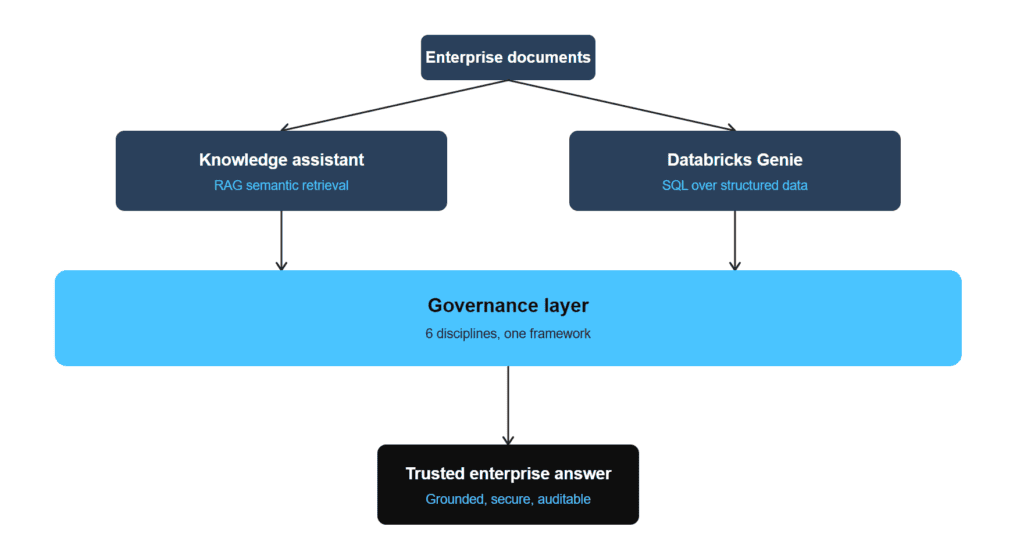
Read on for why these 6 matter more than model choice, how Databricks Genie, RAG and AI agents fit around them, and how to put each one into practice.
For the past two years, the conversation has largely centred on Retrieval-Augmented Generation (RAG). Organisations raced to connect large language models (LLMs) to internal knowledge bases, giving employees the ability to ask natural-language questions about documents, policies and technical information.
RAG transformed enterprise search. But it was never designed to solve every enterprise AI problem.
Increasingly, organisations want AI that does more than retrieve information. They want systems capable of understanding business context, executing analytical workflows, querying structured data, reasoning across multiple information sources, and producing answers that can be trusted in production.
This shift explains why a growing number of Databricks partners — including SoftServe and Aimpoint Digital — are now publishing around a common theme: "beyond RAG." Their work highlights how Databricks Genie, enterprise LLMs and intelligent agents combine to support more sophisticated AI experiences.
They're right to raise it.
But from an enterprise buyer's perspective, the most important story isn't actually beyond RAG. It's production LLM governance.
Because regardless of how advanced an AI architecture becomes, organisations ultimately ask the same questions:
Those are governance questions — not model questions.
The organisations creating lasting value with generative AI aren't simply deploying better LLMs. They're building governed production systems around the 6 proven ways summarised above — get these right, and the choice of model, retrieval method or orchestration layer becomes far less consequential. Get them wrong, and even the best-architected system will struggle to earn trust in production.
RAG represented the first practical step towards enterprise generative AI. Instead of relying solely on an LLM's training data, organisations could retrieve relevant company documents and provide them as context before generating a response.
The advantages were immediate:
For many use cases (knowledge management, customer support, document search) this remains the right architectural pattern.
However, enterprises quickly discovered an important limitation: documents contain far more than text.
Contracts include financial obligations. Invoices include calculations. Compliance reports contain metrics. Insurance policies reference tables. Financial statements require aggregation. Annual reports combine narrative with structured numerical information.
An LLM reading retrieved paragraphs cannot reliably calculate quarterly revenue, identify the supplier with the highest spend, or determine which business unit exceeded budget. Those questions require database operations, not semantic retrieval.
This distinction matters because enterprise users no longer ask isolated questions. They ask compound business questions, such as:
"Which supplier generated the highest spend last quarter, and what contractual clauses explain the increase?"
or
"Which customers have the highest renewal probability, and what risks are mentioned in their latest account reviews?"
Answering these requires several AI capabilities working together, not one.
One of the clearest examples comes from Databricks' own document intelligence architecture.
Imagine an organisation processing hundreds of thousands of invoices. A traditional RAG system performs extremely well when users ask:
These questions require semantic understanding.
Now consider a different set of questions:
These require SQL: not semantic similarity. A vector database cannot perform aggregations. Embeddings cannot execute arithmetic. LLMs cannot replace database engines.
As Databricks demonstrates through its unified document intelligence approach, qualitative and quantitative questions require fundamentally different execution paths. Rather than forcing RAG to solve analytical problems, Databricks combines multiple services that each specialise in a particular task: producing an architecture capable of handling enterprise complexity without compromising reliability.
Modern enterprise AI increasingly combines several complementary technologies, each with a distinct role.
Retrieval-Augmented Generation handles semantic search, document understanding, contextual retrieval, grounded responses and citations.
Databricks Genie translates natural language into SQL, queries governed enterprise data, analyses structured datasets, and produces mathematically correct answers.
AI Agents decompose complex requests, orchestrate workflows, invoke specialised tools, chain reasoning steps, and coordinate across multiple AI systems.
Enterprise Governance covers security, permissions, monitoring, evaluation, compliance, lineage, observability and auditing.
That final layer is often overlooked, yet it determines whether an AI proof of concept ever becomes a production platform.
Enterprise buyers rarely struggle to build demonstrations. They struggle to operationalise them. The gap between an impressive chatbot demo and a reliable enterprise AI platform is significant, and production introduces challenges that pilots never surface. Each of these challenges maps directly onto one of the 6 proven ways introduced earlier. Here's why each one matters in practice.
1. Data Governance. Enterprise AI frequently accesses confidential contracts, HR records, financial data, customer information and intellectual property. Without governance, an AI assistant can end up exposing information a user was never meant to see. Strong governance ensures every response respects existing identity, access control and data classification policies: AI should inherit enterprise permissions automatically, not create a parallel set of rules.
2. Model Governance. Foundation models are updated and swapped out constantly, often without much visibility into what changed. Without a clear answer to "why is this model running in production today," organisations lose the ability to explain, or roll back, a change in behaviour after the fact.
3. Prompt Governance. Even the right model, on governed data, can produce inconsistent results if the instructions driving it live in scattered notebooks or hard-coded strings. Without prompt version control and testing, quality drifts every time someone tweaks a prompt to fix one problem and quietly introduces another.
4. Evaluation Governance. Even grounded AI systems occasionally hallucinate. Business leaders increasingly ask "where did this answer come from?", and without continuous evaluation, benchmarking and citation tracking, organisations have no reliable way to answer that question or catch quality regressions before users do.
5. Operational Governance. Traditional infrastructure monitoring focuses on uptime; LLM operations require watching an entirely different set of signals: hallucination rates, retrieval quality, latency, token consumption, model drift and user satisfaction. Without this operational layer, organisations cannot systematically improve AI performance after launch.
6. Responsible AI Governance. Even a technically sound system can create legal and reputational exposure if privacy, bias and human oversight aren't designed in from the start. Enterprise AI should augment decision-making: not obscure it or operate outside existing compliance frameworks.
Many organisations still ask, "Should we use GPT-4, Claude, or another foundation model?" Model selection matters, but experience shows it's rarely the primary determinant of enterprise success. Two organisations can deploy the same model and achieve dramatically different outcomes. The difference is almost always governance, architecture and operational maturity: not the model itself.
One of the biggest misconceptions in enterprise AI is that a single model, or even a single architecture, can solve every business problem. In reality, production-ready AI is a collection of specialised capabilities working together under a common governance framework.
Databricks' approach reflects this philosophy. Rather than positioning RAG, SQL generation and AI agents as competing technologies, the platform enables them to complement one another. At a high level, the architecture consists of four components.
Everything begins with enterprise content: contracts, invoices, financial reports, policies, technical documentation and emails. Using Databricks' document parsing capabilities, organisations can extract both unstructured text and structured attributes from the same document, creating two representations of every document:
Instead of treating documents as flat text, organisations build a richer data foundation that supports multiple AI workflows.
The unstructured content follows a familiar RAG pipeline. Documents are chunked, embedded and indexed in a vector database, enabling semantic retrieval based on the user's question rather than simple keyword matching.
When an employee asks, "What are the payment terms in Supplier X's contract?", the retrieval system identifies the most relevant sections of the document and provides them to the LLM as grounded context. This remains the fastest and most reliable way to answer qualitative questions that depend on meaning, nuance and natural language.
The structured representation follows an entirely different path. Instead of vector search, Databricks Genie translates natural-language questions into SQL against governed enterprise datasets.
For a question like "Which supplier generated the highest spend during Q1?", Genie generates an appropriate SQL query against the underlying data rather than asking an LLM to estimate the answer.
Semantic search retrieves relevant information. SQL executes calculations. Enterprise AI needs both.
The final piece is orchestration. Enterprise users don't naturally separate qualitative and quantitative questions — they ask business questions, such as: "Which customer generated the highest revenue last year, and what renewal risks are mentioned in their latest account review?"
This request involves multiple steps: calculating revenue across structured data, identifying the highest-value customer, retrieving the latest account documentation, summarising renewal risks, and combining both outputs into a coherent response.
Rather than forcing a single model to perform every task, an orchestration layer delegates each step to the most appropriate service before assembling the final answer. From the user's perspective, the experience feels like a single conversation. Behind the scenes, several specialised systems collaborate.
None of this architecture is trustworthy on its own, though. Document intelligence, vector search, Genie and orchestration all need to sit on top of the same 6 governance disciplines: a Genie query is only safe if it respects Data Governance (#1), an agent's routing decision is only auditable if Model Governance (#2) and Evaluation Governance (#4) are in place, and none of it satisfies a regulator without Responsible AI Governance (#6).
One of the most valuable lessons from Databricks' architecture is that RAG hasn't become obsolete. It has become specialised.
RAG remains one of the best approaches for grounding LLMs in enterprise knowledge and reducing hallucinations when answering document-based questions. The limitation arises only when organisations try to use semantic retrieval for problems that require structured computation.
Instead of replacing RAG, mature enterprise AI architectures extend it:
| Enterprise Requirement | Best Technology |
|---|---|
| Explain a contract clause | RAG |
| Summarise a report | RAG |
| Count invoices | SQL / Genie |
| Calculate quarterly revenue | SQL / Genie |
| Compare two contracts | RAG |
| Retrieve customer policy after identifying the highest-value account | AI Agent + RAG + SQL |
The winning architecture isn't the one with the largest model. It's the one that consistently routes work to the right capability.
Technology alone doesn't create trustworthy AI. Production governance provides the operating model that enables organisations to deploy AI safely, consistently and at scale. Based on enterprise implementations, that governance breaks down into 6 proven, practical disciplines.
Every AI response is only as trustworthy as the data it accesses. This includes governed data sources, metadata management, lineage, classification, access controls and lifecycle management. Platforms such as Unity Catalog help ensure AI applications inherit existing governance policies instead of creating new security silos.
Foundation models evolve rapidly. Production teams need clear processes for model selection, version control, evaluation, approval, rollback and performance monitoring. Governance should answer a simple question: "Why is this model running in production today?"
Prompt engineering often becomes tribal knowledge hidden inside notebooks or application code. Production environments require reusable prompt templates, version history, testing, approval workflows and documentation. Prompts should be treated as production assets, not experiments.
Accuracy should be measured continuously rather than assumed. Enterprise teams increasingly establish benchmark datasets that test AI systems against representative business scenarios, tracking factual accuracy, groundedness, citation quality, latency, completeness and user satisfaction. Without systematic evaluation, AI quality gradually degrades as business data evolves.
Production AI introduces operational concerns beyond model performance. Teams should monitor response latency, API reliability, infrastructure costs, token consumption, workload scaling and failure rates. Reliable AI depends as much on operational excellence as on model capability.
Finally, organisations must address privacy, regulatory compliance, bias, transparency, auditability and human oversight. Enterprise AI should augment decision-making, not obscure it.
Many AI initiatives stall after successful pilots because organisations underestimate the complexity of operationalising generative AI. Some of the most common pitfalls, and the governance way each one violates:
The organisations seeing the strongest return on investment are those that design for all 6 governance ways from day one rather than retrofitting controls later.
The conversation around enterprise AI is evolving rapidly. As more Databricks partners publish "beyond RAG" architectures, the differentiator will no longer be whether an organisation can connect an LLM to enterprise data: that capability is quickly becoming table stakes.
The real competitive advantage lies in helping organisations move from isolated AI pilots to governed, production-ready platforms that deliver measurable business value. For Opinov8, that means focusing on three principles:
As a Databricks Select/Premier Partner, Opinov8's role is not just to implement AI technologies, but to help organisations build sustainable capabilities that can evolve alongside changing business requirements and the rapidly advancing AI landscape.
Production LLM governance is the framework of policies, processes and technical controls that ensure enterprise AI systems are secure, reliable, explainable and compliant when deployed at scale.
Data governance, model governance, prompt governance, evaluation governance, operational governance, and responsible AI governance. Together they ensure enterprise AI is secure, explainable, continuously monitored and compliant at scale, regardless of which model or architecture sits underneath.
No. Genie complements RAG by translating natural-language questions into SQL for structured analytics, while RAG remains the preferred approach for semantic document retrieval and qualitative understanding.
RAG excels at retrieving and summarising information from documents but cannot reliably perform aggregations, calculations or complex analytical queries across structured datasets.
AI agents orchestrate multiple tools and services, decomposing complex business questions into smaller tasks and routing each to the most appropriate capability: retrieval, SQL execution, or external systems.
The same foundation model can deliver very different business outcomes depending on how well it's governed. Security, data quality, evaluation, observability and operational processes often have a greater impact on enterprise success than the underlying model itself.
Moving beyond proofs of concept requires more than connecting an LLM to enterprise data. It requires an architecture that combines semantic retrieval, structured analytics and intelligent orchestration governed by the 6 proven ways: data, model, prompt, evaluation, operational and responsible AI governance.
Organisations that invest in all 6 today will be better positioned to scale AI confidently, meet evolving regulatory expectations, and deliver measurable business value.
Whether you're modernising document intelligence, deploying Databricks Genie, or designing a multi-agent AI platform, the goal should remain the same: build AI systems that enterprise users can trust — not just experiment with.
Ready to move your AI initiatives from pilot to production? Talk to Opinov8 about a governance-first Databricks AI strategy.