

AI Transformation Consulting: How to Build an AI-Shaped Organization in 2027
AI, AI Development, AI Native
Read more

Quick answer: Phased legacy modernization for regulated enterprises is a migration strategy that replaces outdated IT systems in controlled, independently validated increments (rather than all at once) so compliance, auditability, and business continuity are never put at risk. It's the safest path to digital transformation for financial services, healthcare, insurance, and government organizations, where a failed cutover can mean regulatory penalties or reportable incidents.
For enterprises in regulated industries, modernizing core systems is no longer optional. Legacy platforms are expensive to maintain, hard to secure, and increasingly incompatible with the pace of change customers and regulators expect. The real challenge isn't whether to modernize; it's how to execute phased legacy modernization for regulated enterprises without breaking the business you're trying to transform.
Phased modernization is an approach to upgrading aging software, applications, and IT infrastructure in discrete, sequenced stages (with each phase independently tested, validated, and reversible) rather than replacing an entire system in a single event. It typically involves some combination of:
For regulated enterprises, all of the above must happen without compromising compliance, auditability, or business continuity: which is why phased sequencing, not just technology choice, is what actually determines success.
The traditional model (build the new system in parallel, then cut over in a single event) has intuitive appeal but a poor risk profile. Big bang migrations concentrate risk into one point of failure: compliance validation gets compressed into a pre-launch scramble, and any defect discovered at cutover has no fallback path.
For regulated organizations, where a failed transaction or a compliance gap can trigger regulatory penalties or reportable incidents, that risk is difficult to justify to a board or an auditor. Independent industry analysis backs this up, as outlined in Calvanta's phased migration framework for regulated enterprises, the larger and more monolithic the migration event, the higher the probability of overrun, failure, or rollback.
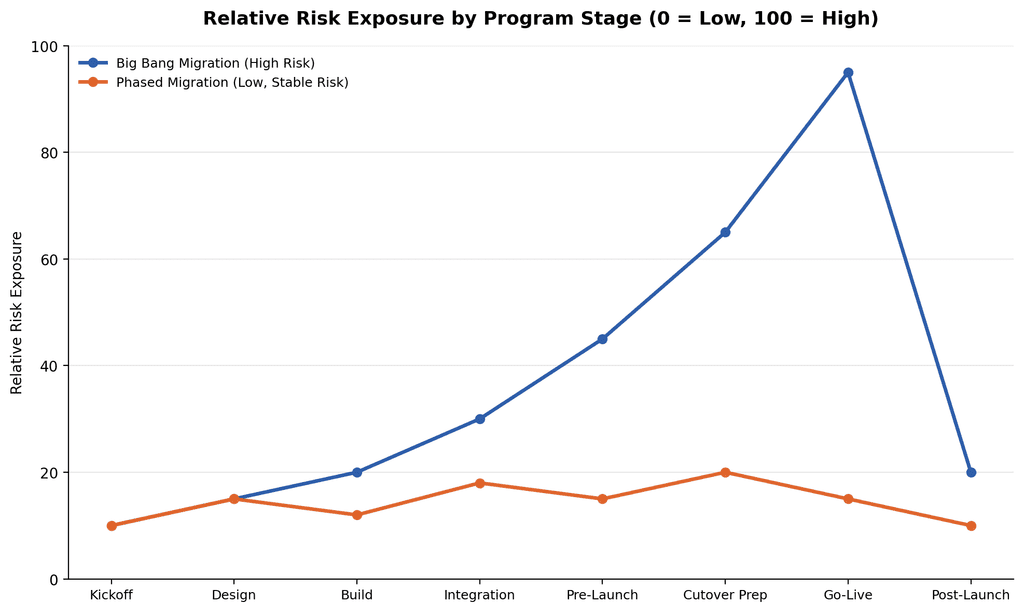
Phased modernization migrates functionality, data, and workloads in controlled increments, with the old environment and the new architecture running side by side until each phase is validated. This changes the risk equation in several concrete ways:
Continuous compliance validation. Each phase can be assessed against regulatory requirements (data residency, audit trails, access controls) before it goes live, rather than validating an entire new system in one pass at the end. Go-Togaf's overview of phased legacy modernization strategy frames this as a way to adapt to market and regulatory change while keeping core services running smoothly.
Contained blast radius. If an issue surfaces in one phase, only that increment is affected: the business keeps operating on stable legacy or already-migrated components while it's resolved.
Demonstrable governance checkpoints. Executive sponsors, risk committees, and regulators see real evidence of controlled progress at each stage, not a black box that resolves only at the end.
Flexibility to adjust course. Requirements evolve and regulations shift. A phased plan absorbs that change; a big bang plan generally cannot without significant rework.
Executing phased legacy modernization for regulated enterprises well requires three capabilities working together, as detailed in MHC Automation's guide to legacy system modernization for regulated enterprises:
Most vendors are strong in one or two of these areas. Few combine all three, and fewer still apply them consistently across a multi-year program.
Opinov8 partners with regulated enterprises on exactly this problem: legacy software migration and IT modernization programs where compliance cannot be an afterthought and operational continuity cannot be compromised.
The approach is built around the phased model above: assessing the legacy estate, sequencing modernization into discrete, independently deliverable phases, and pairing deep cloud and software engineering expertise with the compliance rigor regulated industries require.
At the center of this is Cipher, Opinov8's AI-augmented legacy modernization service. Rather than the traditional 6–12 month migration run by teams of five to ten engineers, Cipher embeds AI into every stage of the process (codebase assessment, migration, and quality assurance) to compress delivery timelines while keeping risk contained. Critically for regulated environments, Cipher's methodology makes zero changes to the underlying schema; only the data access layer is modernized, meaning the legacy system remains a viable rollback option at every stage: a direct, practical expression of the phased, risk-contained approach outlined above.
Modernization success cases:
Rather than promising a single transformative leap, Opinov8's engagements, whether AI-accelerated through Cipher or delivered through infrastructure-led modernization, provide validated, governed progress at every stage, so stakeholders and regulators can verify the transformation as it happens.
What is phased legacy modernization for regulated enterprises?
It's an approach to modernizing outdated IT systems in sequenced, independently validated stages, rather than a single cutover event, so regulated organizations can maintain compliance, auditability, and operational continuity throughout the transformation.
What is the difference between phased and big bang modernization?
Phased modernization migrates systems incrementally, validating and testing each stage before moving to the next, with old and new systems running in parallel. Big bang modernization replaces the entire system in a single cutover event, concentrating risk and compressing compliance validation into a short pre-launch window.
Why is a phased approach better for regulated industries?
It allows continuous compliance validation, contains the impact of any issues to a single increment, and gives regulators and risk committees visibility into progress at every stage, rather than requiring trust in an unverified system that goes live all at once.
How long does a phased modernization program typically take?
Timelines vary by system complexity and regulatory scope, but phased programs are typically sequenced over multiple quarters or years, with each phase delivering independently validated, production-ready progress rather than waiting for a single end date.
Which industries need this approach most?
Financial services, healthcare, insurance, and government agencies (sectors with strict compliance, audit, and data-residency requirements) benefit most, since each increment can be validated against regulatory obligations before going live.
Modernizing core systems in a regulated environment is fundamentally a risk management problem that requires serious engineering depth to solve. Enterprises that get this right treat phased legacy modernization for regulated enterprises as a sustained program rather than a single project with a finish line, and they choose partners capable of holding cloud engineering expertise and regulatory discipline together, not just one or the other.