
Logistics AI helps transportation, warehousing, and fleet operations move from reacting to problems to predicting and preventing them. But it only works when the data behind it is reliable and connected.
This guide covers what logistics AI is, where it delivers value, how to implement it, and how Opinov8 has applied it for logistics clients.
Logistics AI is the use of artificial intelligence and machine learning to improve logistics processes and decisions, including transportation, warehousing, fleet management, inventory, and shipment visibility. It is not one technology but a set of capabilities:
| Technology | What it does in logistics |
|---|---|
| Machine learning and predictive analytics | Forecasts demand, arrival times, and equipment failures |
| Optimization algorithms | Plans routes, loads, schedules, and warehouse slotting |
| Computer vision | Inspects goods, reads labels, and counts inventory |
| Document processing and NLP | Extracts data from invoices, bills of lading, and emails |
| Generative AI and agents | Answers questions in plain language and executes defined tasks |
AI is important for logistics because it shifts operations from reacting to problems to anticipating them. It predicts delays, demand, and equipment failures, and recommends action before customers or costs are affected. The result is lower costs, higher productivity, more reliable delivery, and better use of vehicles and warehouse space.
Shippers now expect it. In a January 2026 BCG and Alpega survey of more than 180 logistics leaders, over 40% of shippers said they consider a provider's AI capabilities when choosing partners. Yet only about one in ten providers has embedded AI into core operations at scale, which leaves a clear opening for those who move first.
AI is used in logistics for eight main tasks. Shippers and providers in the BCG and Alpega survey ranked transport planning, forecasting, and shipment visibility as the most important.
AI demand forecasting predicts future volumes from historical orders, seasonality, promotions, and external events, so teams can plan inventory, capacity, and staffing in advance.
AI route optimization calculates efficient delivery routes from traffic, delivery windows, vehicle capacity, and weather, and adjusts them as conditions change. It was the most adopted AI use case among logistics providers in BCG's survey, at 64%.
AI ETA prediction estimates when a shipment will actually arrive, not just where it is, by combining live location with historical delivery patterns and known delays.
AI predictive maintenance analyzes sensor and usage data to flag vehicles, vessels, and equipment likely to fail, so maintenance is planned instead of reactive.
AI warehouse intelligence optimizes slotting, picking, and labor allocation. McKinsey estimates AI tools can unlock 7% to 15% additional capacity in warehouse networks.
Intelligent document processing reads invoices, bills of lading, and customs forms and feeds the data straight into business systems, removing manual entry.
A logistics AI assistant lets teams ask questions like "Which deliveries will miss today's window?" in plain language. Its value depends on live access to operational systems, not on the text it writes.
AI exception management detects delays, capacity limits, and disruptions early, ranks them by impact, and recommends a response, leaving people to make the judgment calls.
Automation follows fixed rules, while AI learns from data to predict outcomes and recommend actions.
| Automation | Logistics AI | |
|---|---|---|
| How it works | "If X happens, do Y" | "Based on X, Y, and Z, this is likely" |
| Example | Assign every order to the default carrier | Predict late orders and suggest another carrier |
| When conditions change | A person rewrites the rules | It adapts as new data arrives |
The two work best together: automation handles routine steps like validation and notifications, AI handles prediction and recommendation, and people approve the decisions that matter.
The Logistics AI Maturity Path is Opinov8's six-stage framework for adopting AI in logistics. Each stage builds the foundation the next one needs:
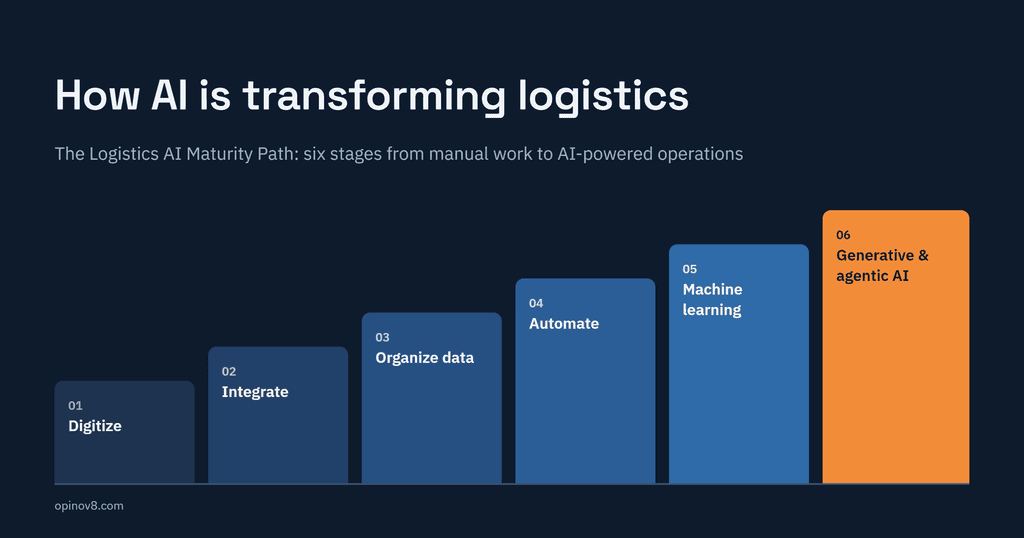
Skipping the early stages is the most common reason AI pilots fail to scale. AI is the next stage of logistics digital transformation, not a replacement for it.
Logistics AI needs reliable data from the systems that run the operation, connected through APIs so AI can read from them and act on them. That data is usually spread across TMS, WMS, ERP, telematics, IoT devices, customer portals, and spreadsheets.
Replacing those systems is rarely necessary. Integration connects them into one flow: operational systems → APIs → data platform → machine learning → AI application → operational workflow. BCG found that integrating AI into existing systems is the top investment priority for roughly 60% of logistics providers.
The biggest challenges are unclear ROI and missing internal capabilities, not the technology. Roughly 40% of respondents in the BCG and Alpega survey named these as their top barriers.
| Challenge | How to address it |
|---|---|
| Unclear ROI | Set a baseline metric, such as cost per shipment or on-time rate, before building |
| Fragmented data | Digitize and integrate first (Maturity Path stages 1 to 3) |
| Legacy systems | Wrap them with APIs, then modernize in phases |
| Pilots that never scale | Redesign the workflow around the AI output instead of bolting AI on |
Start with one costly problem, confirm the data to solve it is accessible, and prove results before scaling.
Opinov8 is a London-based technology services company that helps logistics operators and logistics software companies build, modernize, and integrate the platforms AI depends on. Four recent projects show the Maturity Path at work:
| Client | Challenge | What Opinov8 built | Result |
|---|---|---|---|
| Maritime operator | Fragmented data after multiple acquisitions | Real-time fleet analytics platform on Azure and Databricks, unifying 50,000+ vessels and 7M+ daily sensor readings | 15% lower fuel consumption, 30% better vessel performance metrics |
| Tier-one logistics enterprise | Legacy routing monolith that could not reroute freight in real time | Event-driven microservices platform that analyzes shipping manifests and satellite feeds to reroute freight, built with AI-native engineering | Delivered in 9.5 months instead of 14, at 22% lower cost and with 40% fewer post-release bugs |
| Air cargo charter venture | Urgent charter requests handled through email and manual data entry | Platform with AI-assisted intake that extracts request details from text, PDF, and Excel, plus structured quote comparison | Faster request-to-quote cycle and less back-and-forth between forwarders and operators |
| Large US logistics provider | Mission-critical, legacy-heavy transportation management ecosystem | Production support, migrations, and new integrations across order, dispatch, tracking, and invoicing workflows | Modernization without disrupting daily operations |
Want to find your first high-value AI use case? Talk to Opinov8's logistics team.
Agentic AI uses AI agents that plan and carry out defined tasks across systems, such as rebooking a delayed shipment, within limits set by people. Traditional AI only predicts or recommends.
In the near term, AI is more likely to change jobs than eliminate them. In BCG's 2026 survey, about 50% of providers expected reskilling needs, while fewer than 30% expected imminent AI-led headcount cuts.
Cost depends mostly on data readiness and integration complexity, not the AI model. A focused use case on clean, connected data costs far less than one that first requires modernizing legacy systems.
Yes. API integration can connect legacy TMS, WMS, and ERP systems to modern data platforms and AI, so core systems do not have to be replaced first.