Quick answer: AI for MVP development helps companies launch an MVP faster and with higher quality by speeding up market research, prototyping, coding and testing. Teams that pair AI tools with experienced engineers can cut initial development time by up to 40% and reduce critical post-launch bugs by about 25%. In practice, Opinov8's AI-augmented approach has delivered in about three weeks what traditionally takes 6–12 months.
| Area | How AI helps | Reported impact |
|---|---|---|
| Feature prioritisation | Analyses market and user data to rank features | 15–20% less scope creep |
| Prototyping and coding | Generates code, UI drafts and data models | Up to 40% less initial development time |
| Testing and QA | Writes tests and scans for vulnerabilities | About 25% fewer critical post-launch bugs |
| Feedback analysis | Groups reviews and tickets into themes | Iteration cycles cut from weeks to days |
| Deployment | Automates infrastructure and CI/CD pipelines | About 30% better deployment frequency and stability |
| MVP budget | Less repetitive work, smaller teams | 30–40% lower cost; typical AI MVP at $10K–$20K |
| Delivery time | AI-augmented engineering with reusable skills | About 3 weeks vs 6–12 months for a 400+ screen app |
| Team size | One engineer guided by AI rules and playbooks | 1 engineer vs a traditional team of 5–10 |
| Cost | Less manual effort, AI tooling under $3K | About 90% lower cost ($300K–$500K saved) |
Figures reported by Coders.dev from its own projects, ND Labs for typical AI MVP budgets, and Opinov8 for a full enterprise application migrated with cipher.
For years, traditional MVP development meant choosing between speed and quality. Move fast and accept bugs, or polish carefully and risk launching too late. AI is rewriting that trade-off.
Used well, AI speeds up every stage of MVP development: validating the idea, prioritising features, designing the experience, writing and testing code, and learning from the first users. The same tools that save time also catch errors earlier, so teams can ship sooner and ship better.
The key word is "well." AI is an accelerator, not an autopilot. This guide to AI MVP development walks through where AI adds the most value across the MVP lifecycle, and where experienced people still need to stay in control.
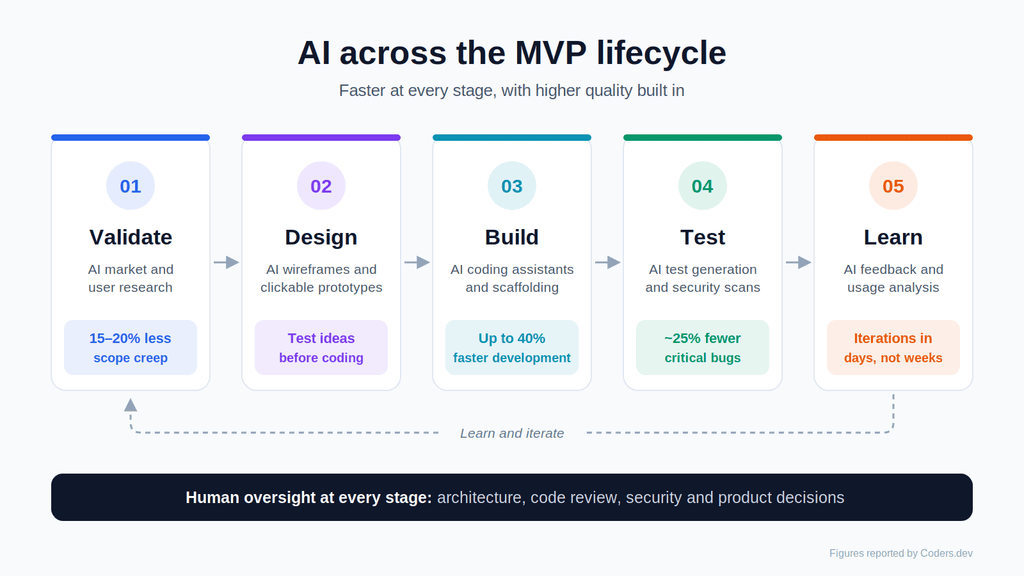
The biggest risk for any MVP is building something nobody wants. AI turns market research from weeks of manual work into a fast, data-driven exercise.
The outcome is a tighter scope for your AI-powered MVP. A smaller, sharper MVP is faster to build and easier to learn from.
AI design tools turn a text description or a rough sketch into wireframes, high-fidelity mockups and clickable prototypes. Tools such as Uizard, Stitch (formerly Galileo AI), Framer AI and Figma's AI features let teams explore several layouts in the time it once took to draw one (Leanware).
This matters for quality as much as speed. When a prototype is cheap to change, teams test it with real users earlier and more often. Confusing flows get caught on a screen, not after they are coded.
AI also helps with the words on the screen. It drafts onboarding text, microcopy and placeholder content, so prototypes feel real enough for users to give honest feedback.
A practical rule: let AI produce the options, and let designers make the choices. Brand consistency, accessibility and the overall product feel still need a human eye.
Generative AI is the biggest speed lever when you build an MVP with AI. Coding assistants such as GitHub Copilot, Cursor, Claude Code and Amazon Q Developer can draft boilerplate, data models, API endpoints, front-end components and documentation from plain-language requirements.
The gains are real. Coders.dev reports that AI-augmented teams cut initial development time by up to 40%. The time saved goes where it matters: the business logic and user experience that make the product different.
AI also speeds up the plumbing around the code. Infrastructure-as-code assistants help set up cloud environments and CI/CD pipelines, so every change can reach users quickly and safely.
But speed only counts if the code holds up. The most effective teams follow an AI-human hybrid model:
In short, AI multiplies a strong engineering team rather than replacing one. That balance is the core of successful AI MVP development.
cipher, Opinov8's AI-powered legacy modernisation service, shows what the AI-human hybrid model can achieve. Using a proven playbook, a reusable library of encoded building blocks and built-in parity checks, a single AI-augmented engineer migrated a 400-screen enterprise application in about three weeks.
Traditional approaches typically take 6–12 months and a team of 5–10 people. Opinov8 reports savings of $300K–$500K, roughly 90% less than the traditional route. The same principles of reusable components, clear AI rules and human oversight apply directly to building new MVPs.
Yes. In AI MVP development, the same technology that speeds up coding also makes thorough testing far cheaper, which is where AI flips the old speed-versus-quality trade-off.
The impact is measurable. Coders.dev reports that AI-driven QA cuts critical post-launch bugs by about 25% in its projects. Fewer bugs mean better first impressions, higher retention and cleaner feedback from early users.
An MVP exists to generate learning, and AI for MVP development shortens the loop between feedback and the next release.
The faster a team learns, the faster it reaches product-market fit.
To know whether an AI-built MVP is working, track a few metrics that reflect both speed and learning: time to market, cost per iteration, user engagement and retention, conversion rate and churn.
An AI-powered MVP usually reaches users in days to weeks rather than months, at a lower cost, because AI removes much of the repetitive design, coding and testing work.
| Traditional MVP | AI-powered MVP | |
|---|---|---|
| Typical timeline | Several weeks to months | Days to weeks, depending on scope |
| Cost | Higher, with more manual work | Typically 30–40% lower |
| Team | Full design, development and QA team | Smaller team supported by AI tools |
| Validation | Manual feedback and interviews | AI analytics combined with real user testing |
| Best for | Simple products with straightforward flows | Products where speed and fast iteration matter |
Comparison adapted from ND Labs.
In regulated or high-stakes fields such as fintech and healthcare, AI still speeds up delivery, but security, architecture and compliance need even closer engineering oversight.
When you build an MVP with AI, it is easy to move fast in the wrong direction. These are the most common traps:
What is an AI-powered MVP?
An AI-powered MVP is a minimum viable product built with the help of AI tools, such as coding assistants, design generators and automated testing, or one that includes AI features like chat or recommendations. Either way, the goal is the same: test a core idea with real users as quickly as possible.
How much faster can AI make MVP development?
Coders.dev reports that AI-augmented teams cut initial development time by up to 40%. Actual gains depend on scope, team experience and how well AI tools fit into the workflow.
Can AI replace developers when building an MVP?
No. AI drafts code and automates repetitive tasks, but experienced engineers are still needed for architecture, security, complex integrations and business logic. The best results come from an AI-human hybrid model.
Which AI tools help build an MVP?
Common choices include GitHub Copilot, Cursor and Claude Code for coding; Uizard, Stitch and Figma AI for design; and Testim, Mabl and Applitools for testing. Start with one or two tools that remove your biggest bottleneck.
How do you keep quality high when using AI?
Review all AI-generated code, run automated tests on every change, scan for security issues before release, and let senior engineers own the architecture. AI raises quality when it is paired with human oversight.
How can Opinov8 help build an AI-powered MVP?
Opinov8 is a London-headquartered digital engineering company that embeds AI across the engineering lifecycle. Its teams combine AI-assisted delivery with senior engineering, cloud expertise as an AWS Advanced Partner and built-in QA to launch MVPs quickly without compromising quality.
AI has turned the MVP trade-off into a false choice. It validates ideas faster, compresses design and development, strengthens testing and shortens the learning loop after launch. The winning formula is AI for acceleration plus experienced people for judgment, architecture and accountability.
Opinov8, a London-headquartered digital engineering company founded in 2017, takes exactly this approach. It embeds AI across the entire engineering lifecycle, is an AWS Advanced Partner and was named Best AI Company at the Netty Awards. Its senior engineers pair AI-assisted delivery with ownership of quality from day one, so MVPs reach users quickly and are built to grow.
Ready to put AI to work on your next product? Talk to Opinov8 about launching your MVP faster, without compromising on quality.