

AI Transformation Consulting: How to Build an AI-Shaped Organization in 2027
AI, AI Development, AI Native
Read more

Artificial intelligence has become a strategic priority across industries. Gartner forecasts worldwide AI spending will reach $2.59 trillion in 2026, up 47 percent year-over-year, though by Gartner's own account, enterprises have yet to fully flex their AI spending potential, with most of that growth still driven by vendors and hyperscalers rather than internal deployment.
Yet the results haven't caught up with the investment. McKinsey found only 7 percent of companies have fully scaled AI, with two-thirds of high performers naming data (not talent or model quality) as their top obstacle.
Gartner predicts organizations will abandon 60 percent of AI projects unsupported by AI-ready data. Deloitte's 2026 survey of 3,235 leaders found only 25 percent have moved 40 percent or more of their AI pilots into production. And MIT's Project NANDA reported that the large majority of enterprise generative AI pilots in its 2025 report, "The GenAI Divide: State of AI in Business 2025," never reached production or delivered measurable return: a widely cited figure that has also drawn some methodological scrutiny.
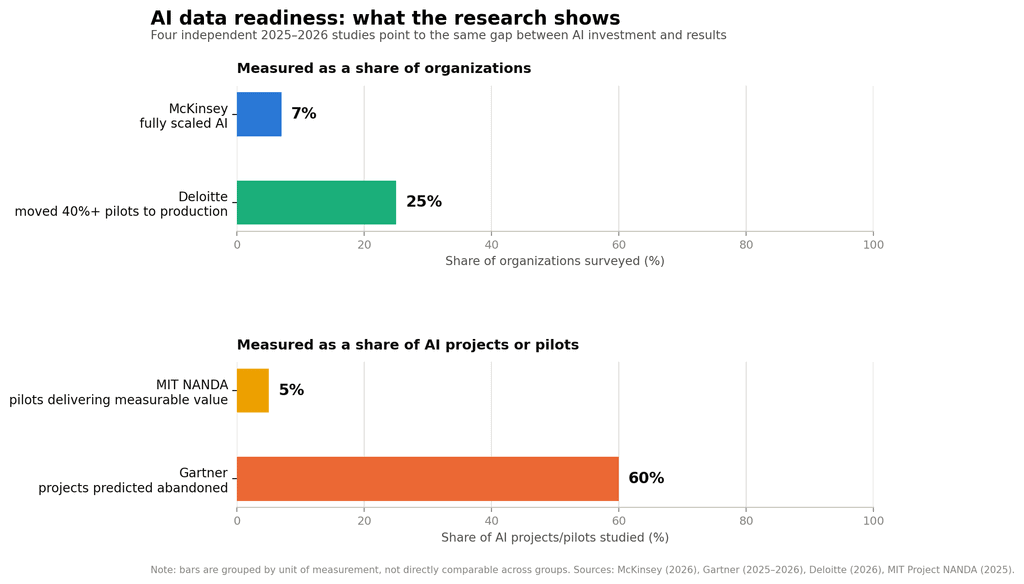
Different methodologies, the same pattern: AI ambition is outrunning data readiness.
It's rarely one technology problem. It's a combination of disconnected strategies, unresolved data quality issues, legacy architecture, weak governance, unclear ownership, and the difficulty of turning prototypes into production systems.
1. Data strategy was built for analytics, not AI
Most data strategies were designed to modernize warehouses, improve governance, and support reporting: not to combine structured and unstructured data, support real-time retrieval, or run continuous feedback loops. When a strategy doesn't anticipate these needs, the resulting platform is still hard to use for AI. It was built for analytics; the business is now asking it to support AI.
2. Data and AI strategy develop in isolation
Data teams are usually led by a chief data officer; AI initiatives are often sponsored separately by business leaders and delivered by innovation teams. Each group optimizes for something different (governance, speed, experimentation, risk) and without a shared roadmap connecting business objective to data requirements to production, organizations invest heavily without building what their highest-value use cases actually need.
3. Poor data quality, and AI redefines what "quality" means
AI amplifies the risk of poor data quality rather than reducing its importance, per McKinsey's research. The goal isn't perfect data, but a clear definition of "good enough" for each use case: data that's current, traceable, correctly extracted, properly chunked, and governed by sensitivity. This matters most for RAG systems, where a fully accurate document can still produce a wrong answer if the wrong fragment is retrieved. Gartner's data backs the scale of the problem: 63 percent of data leaders say they lack, or aren't sure they have, the right practices for AI.
4. Unstructured data is an untapped asset
Contracts, transcripts, emails, and internal documents hold enormous value, but digitizing and indexing them isn't the same as making them AI-ready: searchability doesn't equal usability, per McKinsey. Reliable AI inputs require metadata, versioning, lineage, and links back to structured business entities. Gartner research found fewer than one in eight organizations report high metadata maturity, despite metadata being what gives AI systems the context to use unstructured content safely.
5. Legacy architecture slows adoption
AI applications typically need to draw on data spread across ERP, CRM, warehouses, SaaS tools, and spreadsheets at once. Where the architecture wasn't built for interoperability or real-time access, this gets complicated fast. The fix isn't replacing every legacy system, it's building the integration a prioritized use case needs while modernizing progressively, rather than standing up a new data ecosystem per project.
6. Governance hasn't caught up to AI
Traditional governance controls access at the storage layer. AI moves the real risk downstream, to the point where content is retrieved and assembled. McKinsey notes that a properly access-restricted contract can still leak fragments into a model's output if retrieval doesn't enforce policy at the embedding and prompt layer. Gartner found that organizations with low governance maturity are far more likely to fail at realizing AI value, and only about one in four build culture and communication into governance at all.
7. The prototype-to-production gap
A proof of concept only needs to show a model can generate useful output. Production requires reliable pipelines, integration, security, monitoring, cost controls, and human oversight. Deloitte found that even as AI access expanded 50 percent year-over-year, only 25 percent of organizations converted 40 percent or more of pilots into production. McKinsey ties this to fragmentation: when business units build AI applications in parallel without shared infrastructure, the same source content is processed differently across teams: so the same input produces different outputs depending on who built the application.
8. Fragmented ownership slows everything
No single team can own AI readiness alone, but without end-to-end accountability, projects stall at organizational boundaries: a data team hands off a dataset and considers its job done; an AI team builds a model with no authority over upstream data; a business team expects production without accounting for the engineering behind it. The fix is shared accountability tied to a business outcome, not a model.
McKinsey documented a financial-services company that replaced one-off AI pipelines with a single reusable pattern for parsing, extracting, and enriching unstructured data: delivering an estimated $10 million to $20 million in cost avoidance as use cases multiplied. That distinction, governed and reusable infrastructure versus rebuilding per project, is largely what separates the organizations reaching production from those still stuck in pilots.
Opinov8 encountered a similar pattern with a fintech client managing payment risk for financial institutions. The client's legacy Delphi-based system couldn't process new data formats or support BI, AI, or ML applications at all, the data strategy hadn't just fallen behind AI, it structurally blocked it.
Opinov8 migrated the client to a cloud-based platform built on Databricks and Apache Spark, using a medallion architecture (bronze, silver, gold layers) to structure data flow, with CI/CD pipelines automating provisioning and deployment. The result was a system that could finally support AI-driven insights on top of a scalable, compliant foundation — the same shift from ad hoc infrastructure to governed, reusable platform that McKinsey's research identifies as the differentiator between organizations stuck in pilots and those reaching production
Closing this gap takes data engineering and AI engineering working together: connecting business strategy, data strategy, and execution. This is where organizations like Opinov8 help bridge planning and implementation, building the data foundations and integrations that make AI reliably useful in production, not just in a demo.
The organizations that succeed with AI won't necessarily be the ones adopting the newest models first. They'll be the ones treating data as a core enterprise asset, with the reusable infrastructure that makes AI outcomes repeatable regardless of where in the business an application gets built.
What causes gaps between data strategy and AI implementation? A combination of data strategies built for analytics rather than AI, unresolved data quality gaps, legacy architecture, weak AI-specific governance, and fragmented ownership.
How many AI projects fail to reach production? Estimates vary: Deloitte found 25 percent of organizations have moved 40 percent or more of pilots to production; Gartner predicts 60 percent of AI projects lacking AI-ready data will be abandoned; MIT's Project NANDA reported an even higher failure rate for custom enterprise generative AI pilots, though that figure has faced some scrutiny. The consistent theme: production lags pilot activity substantially.
How does AI change data quality requirements? Quality controls need to extend beyond ingestion into extraction, chunking, retrieval, and generation — a document can be accurate in full and still produce a wrong answer if the retrieved fragment is incomplete.
Who should own AI data readiness? No single team can own it alone. McKinsey points to an expanding chief data officer mandate to set standards and reusable infrastructure that other teams build on top of.