

Best AI Staff Augmentation Firms for RAG Teams
AI Development, AI Native, IT Outsourcing & Delivery Models
Read more

Software architecture is undergoing a foundational rewrite driven by shifting user expectations. Modern users demand applications that anticipate their cognitive intent rather than passively wait for rigid, explicit commands. To meet this demand, enterprise infrastructure must evolve at the absolute root level.
Building an AI native business means designing systems where machine learning models act as the primary engine of value creation. It requires moving past bolted-on chat interfaces and embedding intelligence deeply into the core computation layer. We are transitioning toward treating intelligence as the foundational operating system of the enterprise.
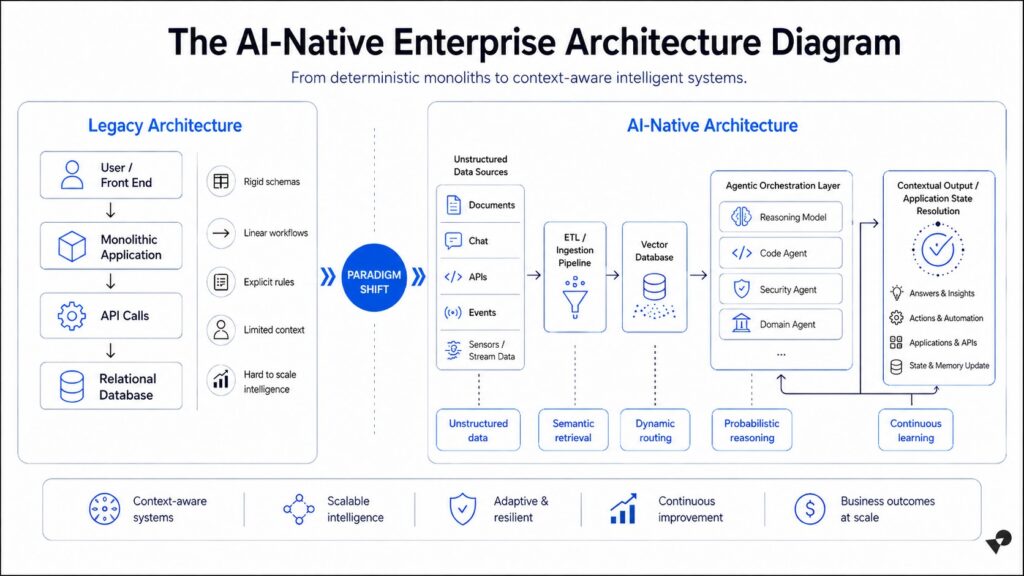
For decades, engineering teams built software around deterministic logic. We wrote explicit rules, defined rigid database schemas, and expected perfectly predictable outputs. That approach falters immediately when dealing with ambiguous, unstructured data on a global scale.
The definitive paradigm shift is the transition from deterministic, rules-based logic to probabilistic, intent-driven reasoning. Instead of writing thousands of conditional statements, engineers now orchestrate foundation models to interpret context and route actions dynamically.
Every successful AI native business requires an entirely different technology stack that prioritizes vector embeddings over relational tables and agentic reasoning over linear code execution. Recent architectural studies on reimagining tech infrastructure from McKinsey & Company indicate that redesigning the core technology stack around probabilistic reasoning is the single highest predictor of enterprise scaling success.
Let’s break down the technical workflow of a modern intelligent system:
Legacy codebases treat intelligence as a localized afterthought. Companies often build a standard monolithic web application and attempt to inject a language model via an API call at the very end of the development cycle.
This superficial approach creates immense latency and introduces severe security vulnerabilities. True AI in software development demands that models sit at the infrastructure level.
Sustainable scaling requires decoupling cognitive processing tasks from standard application state management. By isolating the reasoning engine, developers can update foundation models without breaking the core user interface or corrupting database transactions.
Leading academic institutions like MIT Sloan frequently highlight that modern technical debt now includes legacy data silos that machine learning models simply cannot access or interpret. Transitioning to an AI native business demands tearing down those silos immediately.
To successfully engineer an intelligent platform, an organization must treat data as a continuous, dynamic asset rather than static storage. Every single user interaction must feed back into the system to refine the underlying embeddings and improve retrieval accuracy over time.
This requires robust data governance and automated synchronization. You cannot manually update data lakes when your application relies on real-time market signals or live sensor data. Structuring these pipelines effectively requires specialized data engineering solutions that ensure clean, real-time ingestion. Operating as a true AI native business means your data is always in motion.
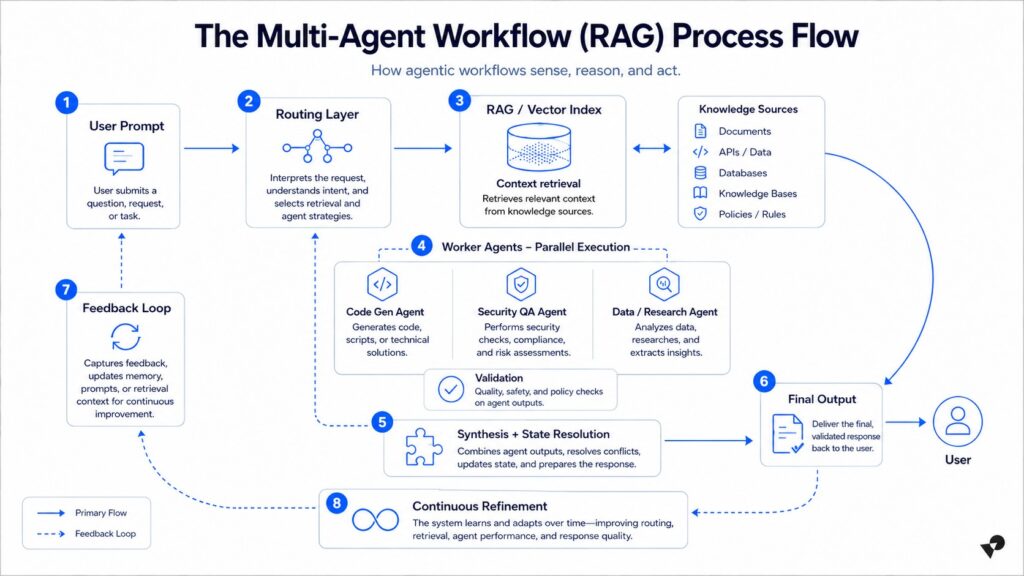
Single-model applications are already becoming obsolete in enterprise environments. The current standard relies heavily on multi-agent frameworks where distinct, specialized models collaborate to solve complex problems.
One agent might handle complex code generation while another specializes exclusively in security auditing and penetration testing. Distributing cognitive load across specialized, smaller models reduces compute costs significantly and dramatically lowers system latency.
Frameworks like LangChain and LlamaIndex have matured into enterprise-grade orchestrators. They allow engineers to build resilient systems that autonomously evaluate and correct their own logical errors before ever returning an output to the end user.
Abstract architecture only matters when it solves physical problems. Moving to an intelligent foundation radically alters operational efficiency across heavily regulated and complex verticals. Building an AI native business requires domain-specific model tuning and expert execution capability.
Enterprise decision-makers must treat multi-cloud architecture as a prerequisite for intelligent systems. Relying on a single cloud provider for model inference introduces unacceptable single points of failure. As outlined by the AWS Well-Architected Framework guidelines, decoupling workloads across distinct environments maximizes uptime.
For an AI native business, downtime means a total loss of cognitive reasoning capabilities. Engineers mitigate this risk by deploying containerized microservices across AWS, Azure, or GCP concurrently.
Disaster recovery for intelligent systems goes far beyond backing up relational databases. Infrastructure teams must continuously back up vector embeddings and prompt version histories alongside traditional data.
If a primary availability zone fails, the system must instantly reroute traffic to a secondary cluster without losing the user's conversational context or agentic state. We help clients engineer this exact level of redundancy through our specialized cloud engineering solutions.
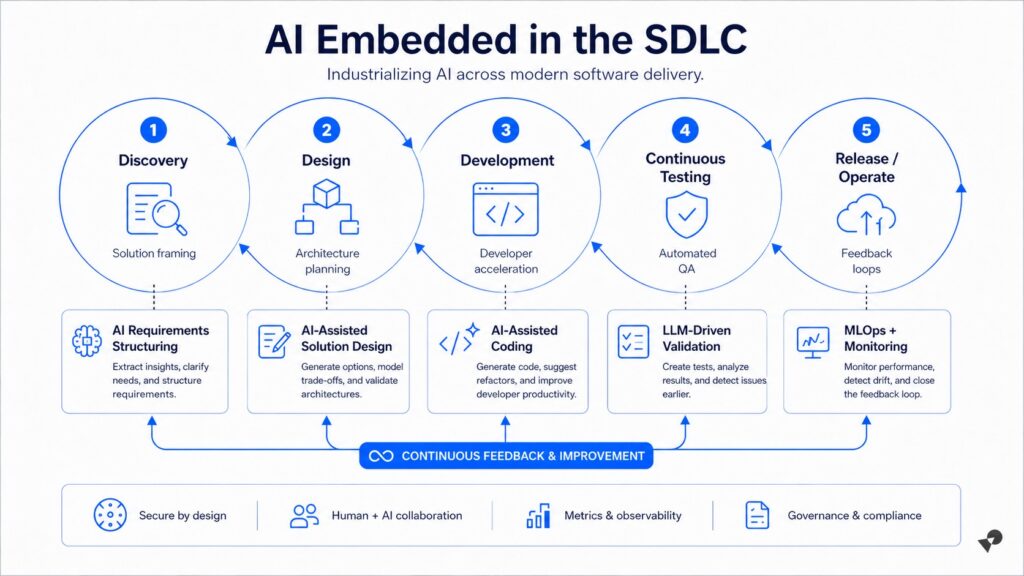
A modern cloud transformation requires rethinking the entire engineering process. You cannot build probabilistic systems using rigid, linear deployment methodologies. To operate as an AI native business, organizations must move past theoretical experimentation and embed real engineering execution directly into their workflows.
At Opinov8, we do not just build intelligent systems for clients; we industrialize these practices internally. Our engineering teams utilize AI across the full SDLC, ensuring that intelligence removes friction and accelerates repetitive tasks rather than replacing core engineering discipline or critical thinking.
This operationalized approach embeds machine learning natively from initial discovery through continuous deployment:
"The conversation has evolved from 'Can AI help us code faster?' to 'How do we industrialise high-quality AI native engineering practices across teams?' The winners won’t simply be companies that 'use AI'. They’ll be the organizations that operationalise AI effectively across delivery, engineering, quality, product thinking, and customer value creation."
Craig Wilson, Co-CEO | Co-Founder | Commercial, Opinov8
Scaling an AI native business requires treating model updates and AI-assisted workflows with the exact same rigor and oversight as core software updates. By standardizing governance, automating reviews, and running hands-on prototype workshops, we ensure our delivery practices remain scalable, repeatable, and commercially valuable.
Transitioning from legacy monoliths to probabilistic, agentic systems demands battle-tested engineering capability. You need an architecture capable of handling complex multi-cloud environments, modernizing rigid data silos, and orchestrating specialized foundation models without latency.
Opinov8 brings exactly this execution layer to the table. Recognized globally among Clutch’s Top 1,000 companies and holding Microsoft Solutions Partner designations, we bridge the gap between legacy constraints and future-proof systems. Our teams do not just advise on transformation; we actively build the scalable architectures and custom generative pipelines required to run a true AI native business.
Stop experimenting with isolated chat interfaces. Talk to our engineering team about your AI native readiness, and let's architect your next-generation infrastructure today.