

AI Transformation Consulting: How to Build an AI-Shaped Organization in 2027
AI, AI Development, AI Native
Read more

AI roadmaps for business goals are strategic plans that link an organization's business objectives to specific AI use cases, the data and technology needed to deliver them, the governance controls that manage their risk, and the metrics used to prove their value. Their purpose is to replace disconnected AI pilots with a prioritized, measurable portfolio.
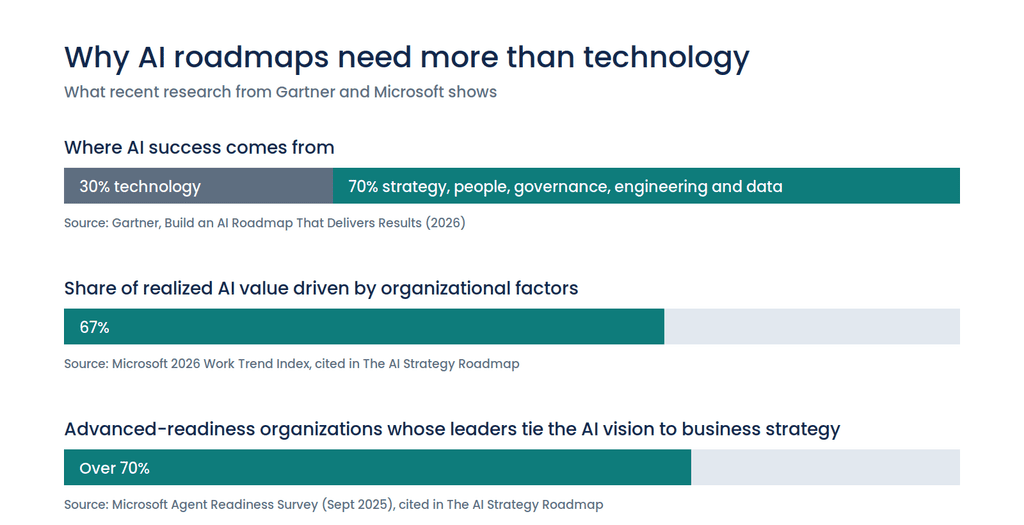
For most enterprises, the hard part is no longer knowing what AI can do. It's deciding where to apply it, how to connect it to existing data and technology, and how to prove it creates business value. As Gartner analyst Leinar Ramos puts it, "AI is 30% technology and 70% something else." According to Gartner, the leaders who drive value at scale are the ones who invest in long-term foundations such as strategy, value management, organization, talent, governance, engineering, and data, rather than tools alone.
This 6-step guide to AI roadmaps for business goals shows you how to build those foundations, from your first readiness assessment to measurable results in production.
An AI roadmap defines how an organization will use artificial intelligence to achieve specific business objectives over time. Gartner describes it as a strategic plan setting out the activities, timelines, and responsibilities for implementing and scaling AI, so that initiatives stay aligned with business goals and resources go to the right priorities. Mindpath adds that a good roadmap also helps teams set manageable goals, choose the best use cases, allocate resources, and plan timelines.
The difference between an AI roadmap and an AI strategy is simple. The AI strategy defines why and where you'll use AI. The AI roadmap defines what you'll build, in what order, with what resources, and how you'll measure success.
Example: A company wants to reduce customer churn. Its roadmap identifies predictive customer analytics as the opportunity, defines the customer data required, sets privacy controls, builds a churn prediction model, feeds its risk scores into the customer success team's workflow, and tracks the change in retention rate. The AI is a means to an end, not the end itself.
Most enterprise AI programs fail at the same point: the gap between experimentation and strategy. Teams launch chatbots, predictive models, or generative AI pilots because the technology is exciting. Without a link to a measurable business priority, those pilots struggle to prove value, win funding, or reach production.
The research backs this up. In Microsoft's AI Strategy Roadmap report, which draws on interviews with 70 business and IT decision-makers, 15% of organizations that struggled with AI execution named missing executive buy-in and strategic alignment as a barrier. By contrast, more than 70% of organizations with advanced strategy and execution readiness say their leadership communicates an AI vision clearly tied to business strategy.
Business goal alignment changes the starting question from "Where can we use AI?" to "Which business outcomes could AI materially improve?" Those outcomes might be higher revenue, lower operating costs, better retention, shorter cycle times, reduced risk, more accurate forecasts, higher productivity, faster decisions, or new products and services.
That shift is the foundation of all 6 steps below.
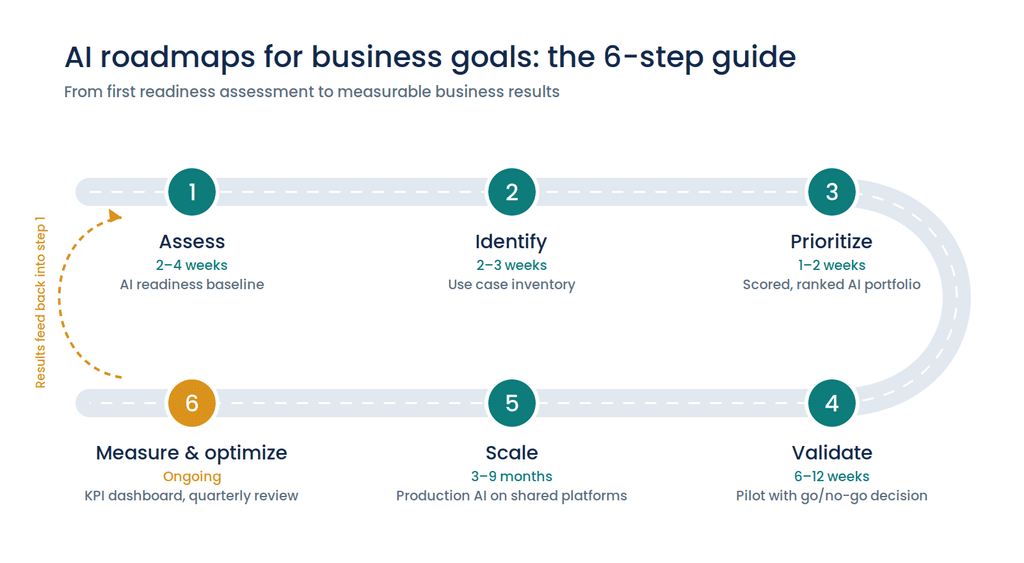
| Step | Goal | Typical duration | Key output |
|---|---|---|---|
| 1. Assess | Understand your starting point | 2–4 weeks | AI readiness baseline |
| 2. Identify | Find AI opportunities tied to business goals | 2–3 weeks | Use case inventory |
| 3. Prioritize | Decide where to invest first | 1–2 weeks | Scored, ranked AI portfolio |
| 4. Validate | Prove business value before scaling | 6–12 weeks | Tested pilot with go/no-go decision |
| 5. Scale | Move winners into production | 3–9 months | Production AI on reusable platforms |
| 6. Measure and optimize | Track value and refine the roadmap | Ongoing | KPI dashboard and quarterly roadmap review |
Durations are typical ranges and vary with organizational size and data maturity.
Goal: Build an honest baseline of where your organization stands today before committing to any AI investment.
Key activities:
Find your AI readiness stage. Microsoft's research describes five stages of AI readiness: Microsoft
| Stage | What it looks like |
|---|---|
| Exploring | Low-stakes tests and isolated pilots with no central effort |
| Planning | Prioritizing use cases, defining success criteria, and setting initial guardrails |
| Implementing | A few prioritized use cases in production with clear ownership and measurement |
| Scaling | Repeatable, governed delivery on shared platforms across the enterprise |
| Realizing | AI embedded as a core capability, with value measured and improved continually |
Data readiness checklist:
Output: An AI readiness baseline that scores your maturity across business strategy, data and technology, governance, people and culture, and skills.
Pro tip: Microsoft found that successful organizations treat data readiness as the critical path and address data quality, access controls, and governance before expanding AI. Your most important first investment may not be a model at all. Microsoft
Goal: Build a list of AI opportunities, each one mapped to a specific business objective and expected outcome.
Key activities:
Map every opportunity from goal to metric:
| Element | Example |
|---|---|
| Business objective | Reduce supply chain disruption |
| Target outcome | Improve demand forecasting and detect supply risks earlier |
| Candidate AI capabilities | Demand forecasting, anomaly detection, intelligent alerts |
| Success metric | Reduce stockouts by [X]% and forecast error by [X]% |
Where to look first. Microsoft notes that AI value concentrates in work that is repetitive, time-intensive, and rules-based but still needs judgment. Common examples by function: Microsoft
| Function | Example AI use cases | Example metrics |
|---|---|---|
| Customer service | Self-service assistants, always-on problem resolution | Lower call volume, faster resolution |
| Sales | Lead generation, RFP response automation | More cross-sell and upsell |
| HR | Employee self-service, AI-enabled candidate search | Lower cost per hire, fewer onboarding hours |
| Legal | Compliance and contract management | Less document review time |
| IT | Helpdesk agents, app modernization | Less unplanned downtime, faster issue resolution |
Match the business need to the right AI capability:
| Business need | Appropriate AI capability |
|---|---|
| Anticipate demand, churn, or risk | Predictive analytics, machine learning, forecasting |
| Understand or generate text | Natural language processing, generative AI |
| Automate multistep work | AI agents, intelligent automation |
| Personalize offers or content | Recommendation systems |
| Inspect images or video | Computer vision |
| Flag unusual activity | Anomaly detection |
Output: A use case inventory where every idea is tied to a business objective, an expected outcome, and a candidate AI capability.
Pro tip: Let the requirement choose the technology. A simple forecasting model often delivers more value than a complex generative AI system if forecasting is what the business needs.
Goal: Turn a long list of ideas into a focused, ranked portfolio so you invest in the right initiatives first.
Key activities:
Use case scoring model:
| Criterion | Question to ask | Example weight |
|---|---|---|
| Business value | What is the impact on revenue, cost, productivity, customer experience, or risk? | 30% |
| Feasibility | Do we have the data, technology, skills, and process maturity? | 20% |
| Time to value | Can it show measurable results within 6 months? | 15% |
| Risk | What regulatory, security, privacy, reputational, or model risk is involved? | 15% |
| Scalability | Can it be reused across departments, markets, or products? | 10% |
| Strategic relevance | Does it support a top organizational priority? | 10% |
Score each use case from 1 to 5 on every criterion, apply the weights, and rank the results. If you'd rather use an established framework, Microsoft's Business, Experience, Technology (BXT) framework scores use cases on business impact, user experience, and technical feasibility.
Start with one use case. Microsoft's research found that successful organizations converge on a single achievable, measurable use case to move from experimentation to execution, rather than launching a large-scale plan right away. Every selected use case should meet a few tests: it addresses one business challenge, its risk is manageable, it fits strategic priorities, success can be validated before expanding, and funding, staffing, and executive sponsorship are available.
Decide whether to buy, extend, or build. Successful organizations buy what doesn't need to be unique, extend platforms they already trust, and build custom solutions only where the return justifies the cost. Early in your journey, buying or extending proven tools is usually the fastest path to value.
Make data dependencies explicit. For example, a financial services company that wants real-time personalized recommendations will need integrated customer profiles, transaction and behavioral data, consent management, real-time pipelines, data quality controls, secure APIs, and model monitoring. Listing these up front keeps you from committing to a use case you can't yet deliver.
Output: A ranked AI portfolio with one lead use case, supported by a mix of quick wins and foundational data and platform initiatives.
Pro tip: Focus on 3–5 high-priority initiatives at most. Spreading investment across too many pilots is one of the fastest ways to stall an AI program.
Goal: Prove that your top use cases deliver the intended business outcome, not just that the technology works, before you invest in scaling.
Key activities:
Build governance in from the start. Gartner advises identifying key risks early, then setting principles, policies, and enforcement processes, formalizing decision rights, and creating cross-functional governance boards. Your controls should cover data privacy, security, access, model risk, explainability, human oversight, bias and fairness, intellectual property, regulatory compliance, monitoring, and third-party AI providers.
Established frameworks and regulations to reference include:
Output: A validated pilot with a clear go, adjust, or stop decision based on measured business results.
Pro tip: Scale governance to the risk of the use case. An internal knowledge assistant needs much lighter controls than a system that influences lending, hiring, or pricing decisions. Microsoft recommends making "the safe path the easy path" by building security and responsible AI controls into the tools people already use, so governance speeds innovation up instead of slowing it down.
Goal: Move successful pilots into production in a way that makes every future AI project faster and cheaper to deliver.
Key activities:
Don't underestimate the people side. Microsoft's 2026 Work Trend Index found that organizational factors drive 67% of the value realized from AI, twice the impact of individual behavior. Gartner recommends starting with a workforce plan to find talent gaps, then running AI literacy programs backed by champion roles. Mindpath makes a similar point: a roadmap only works with the right team behind it, combining engineers, strategists, and domain experts.
Output: AI solutions running in production on reusable platforms, with teams trained and supported to use them.
Pro tip: Adoption is the real test of scale. A technically successful model that people don't use delivers no business value. Clear messaging that agents are there to remove repetitive work, not replace people, is one of the most effective ways to reduce resistance.
Goal: Prove the business value of every AI solution and use the results to improve the roadmap over time.
Key activities:
Measure the full value chain:
| Level | Example metrics |
|---|---|
| AI performance | Model accuracy, latency, reliability, uptime |
| Operational impact | Hours saved, processing time, error rates, employee adoption |
| Business outcome | Revenue generated, costs avoided, customer retention, risk reduction |
Gartner recommends measuring success against three things: progress toward adoption goals, the business value delivered, and the maturity of your foundations across strategy, value, organization, people, governance, engineering, and data. Microsoft also advises looking beyond ROI to include adoption, trust, system quality, risk exposure, and operational efficiency, using a small number of well-chosen KPIs.
When to update your roadmap: after a maturity assessment, after finalizing your AI strategy, when scaling AI across the organization, or whenever your AI vision or strategy changes.
Output: A KPI dashboard that links AI performance to business results, plus an updated roadmap that feeds back into Step 1.
Pro tip: Over time, shift from one-off projects to a portfolio approach focused on ongoing value creation. That's what turns your AI roadmap into an investment management tool instead of just a technology plan.
AI transformation is a continuous cycle, not a one-time project. Once Step 6 is running, it feeds new insights back into Step 1.
Many enterprises have strong internal teams but still bring in AI consulting partners to move faster or fill specialized gaps. Microsoft's research suggests partners are most useful for initial platform design, governance setup, and complex integrations, while ownership of decisions, governance, risk, and accountability should stay in-house.
A consulting partner can support every step of this guide:
The best consulting engagement leaves you with more than prototypes. It should deliver reusable capabilities, decision frameworks, governance practices, and internal skills your teams can keep using long after the engagement ends.
What are AI roadmaps for business goals?
AI roadmaps for business goals are plans that start with measurable business objectives, such as reducing churn or cutting operating costs, and work backward to the AI use cases, data, governance, and metrics needed to achieve them. This keeps every AI investment tied to a clear business outcome.
What are the 6 steps to build an AI roadmap?
The 6 steps are: assess your current AI readiness, identify AI opportunities tied to business goals, prioritize use cases with a scoring model, validate top initiatives through pilots with governance built in, scale successful solutions into production, and measure and optimize results over time.
How long does it take to build an AI roadmap?
Most enterprises can complete the first 3 steps (assess, identify, and prioritize) in 6–10 weeks. Validation and scaling then run over several months, depending on data maturity and the complexity of the chosen use cases.
Which step is the most important?
Step 1, the assessment, has the biggest impact on success. Most AI projects that fail do so because of data gaps or unclear business goals that a proper assessment would have revealed.
When should you update your AI roadmap?
Update it after a maturity assessment, after finalizing your AI strategy, when scaling AI across the organization, or whenever your AI vision or strategy changes. Most organizations also review it quarterly.
How do you measure the ROI of AI initiatives?
Link AI performance metrics (such as model accuracy) to operational metrics (hours saved, error rates, cycle time), and then to financial outcomes (costs avoided, revenue generated, customer retention). Also track adoption, trust, and the maturity of your AI foundations.
How many AI use cases should be on a roadmap?
Start with one narrow, measurable use case, and then expand to 3–5 high-priority initiatives at a time, with a mix of quick wins and foundational projects.
Who should own the AI roadmap?
Ownership is usually shared. A senior executive sponsor, such as a CDO, CIO, or Chief AI Officer, owns the roadmap, while business unit leaders own individual use cases and their outcomes.
Opinov8 helps enterprises put this 6-step guide into practice, designing AI roadmaps for business goals that turn strategy into prioritized, measurable AI programs: Book an AI readiness assessment