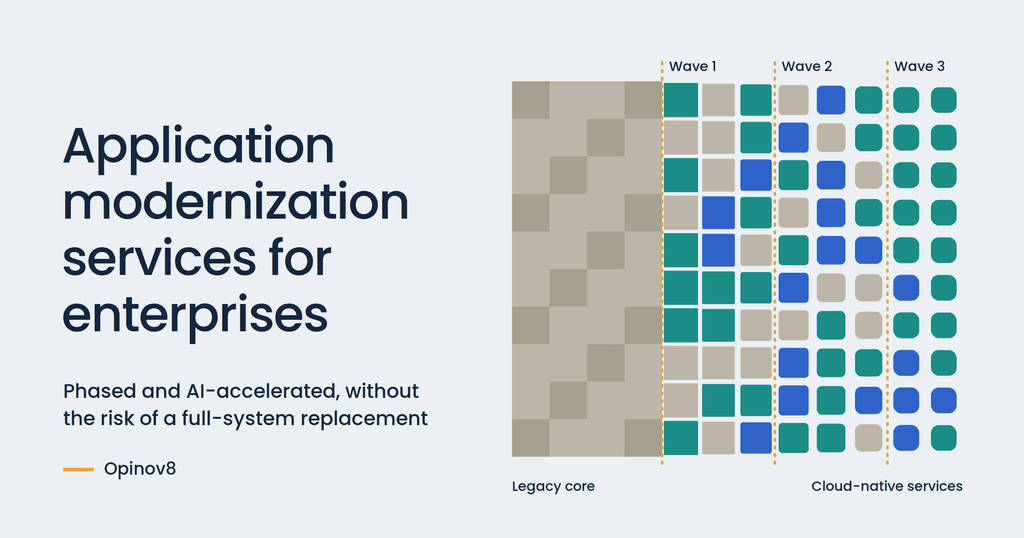
Opinov8 application modernization services help enterprises upgrade legacy applications in phases, reducing technical debt and enabling cloud and AI adoption without the risk of a full-system replacement. One team covers the full journey: portfolio assessment, roadmap, cloud migration, refactoring and rearchitecture, data migration, and ongoing optimization.
The services are built for enterprise modernization buyers who need results they can defend to the board: lower run costs, faster releases, stronger security, and systems ready for AI. Each phase is scoped to deliver measurable value before the next begins, so budget and risk stay under control.
For legacy applications that need to move fast, Opinov8 adds cipher, its AI-native legacy migration accelerator. Cipher compresses migrations that traditionally take quarters into weeks, at a fraction of the usual cost.
Key takeaway: Choose a modernization partner that assesses first, modernizes in waves, and commits to business KPIs. That is how Opinov8 delivers application modernization.
Signs you need application modernization services
If two or more of these apply, a structured modernization program will likely pay for itself:
Maintenance eats the budget. Most IT spend keeps legacy systems running, leaving little for new capabilities. Older apps often depend on costly hardware, licenses, and niche skills (Microsoft Azure).
Releases are slow and risky. Small changes need long test cycles because a monolithic codebase ties everything together.
AI initiatives stall on legacy data. Teams cannot expose data or functions through APIs, so AI and analytics projects never reach production.
Security and compliance gaps keep growing. Old frameworks lack modern identity, encryption, and patch support.
Key knowledge sits with a few people. Critical business rules live in code that only a shrinking group understands.
A data center exit or contract renewal is coming. A fixed deadline forces a cloud migration decision.
Modernization is now a strategic priority across the C-suite: an IBM Institute for Business Value survey found that 83% of executives see modernizing apps and data as central to business strategy (IBM).
The stakes of choosing the right partner are high. Code District cites industry research suggesting roughly 79% of application modernization projects fail, mostly through weak planning and underestimated legacy complexity, and points to a McKinsey example of a European bank spending over 70% of its IT capacity on legacy maintenance (Code District).
Opinov8 application modernization services
Opinov8 covers every modernization approach, from rehost to rebuild, so each application gets the strategy it needs rather than the one a vendor happens to sell.
Service
What it delivers
Typical fit
Modernization assessment and roadmap
Portfolio scoring, technical debt analysis, phased plan with a business case per wave
Every program's starting point
Cloud migration
Rehost and replatform to AWS, Azure, or Google Cloud; hybrid and multicloud setups
Data center exits, fast cost wins
Legacy system upgrade and refactoring
Language and framework upgrades, code cleanup, automated testing
Stable apps held back by aging code
Rearchitecture and cloud-native development
Monolith to microservices, containers, serverless, API layers
Core platforms that must scale and integrate with AI
Rebuild and application transformation
New applications on a modern stack that preserve proven business logic
Systems that no longer fit the business
Data migration and integration
Secure, validated data moves with backup, encryption, and minimal downtime
Any move that touches business data
DevOps enablement and managed services
CI/CD pipelines, observability, cost and performance optimization after go-live
Sustaining speed after modernization
AI-assisted engineering runs across these services. Code translation and development account for almost a third of legacy modernization costs, according to IBM research (IBM), and AI tooling can shorten code analysis, conversion, and test creation.
cipher: AI-native legacy system migration
cipher is Opinov8's AI-driven offering for migrating legacy applications in weeks rather than quarters, without sacrificing architecture or production readiness. It is built for CRUD-heavy enterprise applications on aging stacks such as .NET, Visual Basic, and older Angular (Opinov8).
Traditional migrations of this kind often take 6 to 12 months with teams of five to ten engineers. cipher changes the economics through three design choices:
A proven playbook. Bootstrap configuration, architectural standards, and refined AI rules built up through real delivery.
A reusable skill library. Common patterns such as CRUD screens, forms, reports, and dashboards are already encoded, so clients do not pay to solve them again.
Contained risk. The database schema stays unchanged and only the data access layer is modernized, so the legacy system remains a rollback option.
Each cipher engagement runs in four steps:
Assess and bootstrap. Audit the codebase, select the target stack, and configure the migration.
AI-driven migration. Apply reusable skills and iteratively refined rules, with engineers overseeing every step.
Quality assurance. Run functional parity checks and automated tests agreed upfront.
Handover and roadmap. Deliver a codebase ready for user and integration testing, with optional UX improvements.
In one Opinov8 delivery, a single AI-augmented engineer migrated an enterprise application of more than 400 screens in about three weeks. Opinov8 reports savings of $300,000 to $500,000, roughly 90% versus a traditional approach, with AI tooling costs under $3,000 plus the engagement fee.
How a phased Opinov8 engagement works
Every engagement runs in waves with a decision gate after each one, so you approve the next investment only after seeing results.
Discovery and assessment (typically weeks). Inventory applications, map dependencies and data, score business value against technical debt and risk, and pick the first candidates.
Roadmap and business case. Assign an approach to each application, sequence the waves, and set baseline KPIs for cost, release speed, uptime, and security.
Pilot wave. Modernize one lower-risk, high-visibility component. Legacy and modern parts run side by side, connected through APIs, using the strangler pattern.
Scale-out waves. Apply the proven pattern to the next applications in priority order, retiring legacy functions as replacements prove themselves.
Run and optimize. Monitor performance and cost, tune infrastructure, and hand over knowledge so your teams own the result.
This approach follows the guidance of major platform providers. IBM recommends breaking complex modernization into manageable phases and refining the approach between them (IBM), and Azure notes that service-by-service transformation reduces risk (Microsoft Azure).
Outcomes you can expect, and how they are measured
Opinov8 agrees on baseline metrics during assessment and reports against them after every wave.
Outcome
How it is measured
Lower operating cost
Infrastructure, licensing, and maintenance spend per application
Faster delivery
Release frequency, lead time for changes
Higher reliability
Uptime, incident count, mean time to recovery
Reduced technical debt
Code quality scores, share of unsupported components
Published case studies show what this looks like in practice. In one IBM example, a telecom operator that replatformed onto a hybrid cloud cut capital expenditure by 30% (IBM). On Opinov8's own side, a cipher migration of a 400-plus-screen enterprise application cut cost by roughly 90% versus a traditional approach.
How to evaluate an application modernization services partner
The right partner fills your skill gaps and keeps business and IT aligned. IBM lists skill gaps among the top modernization challenges (IBM), and Cloudflare notes that many efforts fail because of fragmented ownership across leadership (Cloudflare). Use this checklist in your RFP:
Starts with a portfolio assessment instead of one approach for every app
Delivers every approach, from rehost to rebuild, in-house
Modernizes in phases, with decision gates and early, measurable wins
Has hands-on engineering depth in cloud, microservices, data, and DevOps
Builds data migration and security into the plan from day one
Uses AI-assisted engineering to cut analysis, conversion, and testing time
Transfers knowledge so your teams can run and extend the result
Commits to business KPIs and reports against them each wave
Opinov8 is designed to meet each of these criteria.
FAQs About Application Modernization Services
What do application modernization services include?
They typically cover portfolio assessment, roadmap planning, cloud migration, code refactoring, rearchitecture, data migration, testing, and post-launch optimization. Opinov8 delivers all of these with one team.
How much do application modernization services cost?
Cost depends on the number and complexity of applications and the approaches chosen. Industry estimates put smaller projects at roughly $25,000 to $100,000 and large enterprise transformations above $500,000. Rehosting costs least; rearchitecting and rebuilding cost more but return more over time. An Opinov8 assessment produces a fixed estimate and business case for each wave.
How long does a modernization engagement take?
An assessment usually takes a few weeks and a pilot wave a few months. Single systems typically take 3 to 6 months, while estates of interconnected applications often need 12 to 24 months or more. Each wave delivers value on its own.
Can you modernize without disrupting operations?
Yes. Phased modernization runs legacy and modern components side by side and shifts traffic gradually, so users and processes keep working throughout.
Which engagement models are available?
Opinov8 offers fixed-scope assessments, project-based delivery for individual waves, and dedicated teams for long-running programs.
Do you work with our existing cloud provider?
Yes. Opinov8 works across AWS, Microsoft Azure, and Google Cloud, as well as hybrid and multicloud environments. Also Opinov8 helps enterprises to migrate from legacy to the cloud.
What is Opinov8 cipher?
cipher is Opinov8's AI-native legacy system migration service. It uses a proven playbook, a reusable skill library, and engineer oversight to migrate CRUD-heavy applications on stacks like .NET, VB, and Angular in weeks, while keeping the database schema intact so the legacy system remains a rollback option.