Between October 31 and December 31, 2026, three of the most widely used software platforms stop receiving security fixes: Python 3.10, .NET 8 (together with .NET 9) and PHP 8.2. Those ten weeks overlap almost exactly with Black Friday, Cyber Monday and the holiday sales peak.
That timing turns a technical maintenance task into a business risk. Legacy software rarely fails on a quiet Tuesday. It fails when traffic spikes, when attackers are most active, and when your team is in a code freeze and can least afford to touch it.
This article explains the main risks of legacy software, the 2026 end-of-life deadlines you should check today, and a practical checklist to get through peak season safely.
Legacy software is not just old code. It is any system that has fallen behind its platform, its dependencies or the people who know how to maintain it. As Quest Technology Management points out, these systems often do just enough to keep daily operations running, while security gaps, maintenance costs and inflexibility quietly grow in the background. These are the five risks that matter most to the business.
None of these risks shows up on a dashboard until something breaks. That is what makes legacy software dangerous: the cost is invisible right up to the moment it isn’t.
End of life is the most visible risk of legacy software, because it comes with a date. Three major platforms reach it before the end of 2026.
| Platform | End of security support | Upgrade to |
|---|---|---|
| Python 3.10 | October 31, 2026 | Python 3.13 or 3.14 |
| .NET 8 and .NET 9 | November 10, 2026 | .NET 10 (LTS, supported to November 2028) |
| PHP 8.2 | December 31, 2026 | PHP 8.3 or 8.4 |
Python 3.10: October 31, 2026
Python 3.10 has received security fixes only since April 2023, and those stop at the end of October. It is common in data pipelines, internal tools and backend services. Many cloud platforms and container base images drop support shortly after the upstream end of life.
.NET 8 and .NET 9: November 10, 2026
Microsoft ends support for both versions on the same day. After that date, it will no longer provide servicing updates, security fixes or technical support for them. The surprise for many teams: .NET 8 is a Long Term Support release, but in .NET, “long term” means three years. Microsoft recommends moving to .NET 10.
PHP 8.2: December 31, 2026
After December 31, the PHP project stops publishing security fixes for the 8.2 branch. The exposure is large. According to WordPress.org statistics retrieved in September 2026, about 62% of WordPress installations run PHP 8.2 or older, and 16.7% still run PHP 7.4, which has had no security fixes since November 2022.
What “end of life” does and doesn’t mean
Your application will not stop working on the deadline. It keeps running exactly as before. What changes is that every vulnerability discovered afterwards stays open, so the risk grows with each passing month. That makes end of life easy to ignore, and dangerous to ignore for long.
Peak season amplifies every weakness in a legacy system at the same time. Three things happen together.
The result: the period when legacy software is most likely to fail is also the period when you can least afford it, and when it is hardest to fix.
The cost of downtime is easier to calculate for your own business than to look up. Industry averages vary widely, so use your own numbers. A simple estimate of the direct revenue lost per hour of downtime:
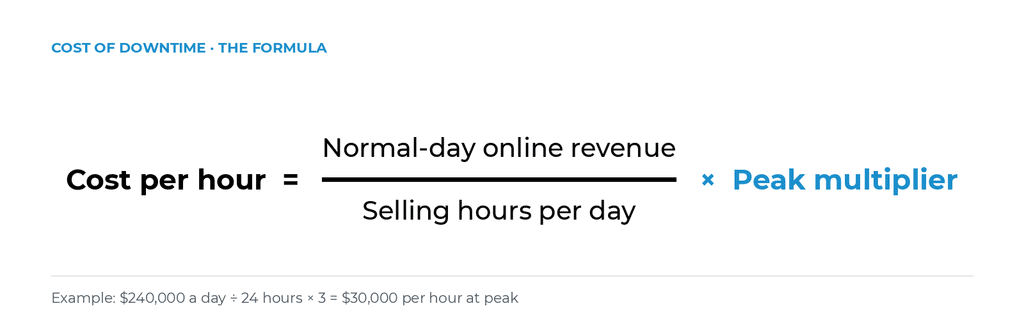
For example, a store that sells $240,000 online on a normal day, over 24 hours, makes $10,000 an hour. If Black Friday traffic is three times normal, one hour offline on that day costs around $30,000 in direct sales.
The direct loss is only part of it. Add the indirect costs, which are harder to measure but often larger:
Compare that figure with the cost of checking your stack before peak season. For most businesses, one avoided hour of downtime pays for the review many times over.
Use this checklist with your technical team before code freeze. Every unchecked item is a risk worth discussing.
Don’t start a major migration two weeks before Black Friday. The goal before code freeze is stability, not transformation. Split the work in two.
| Before code freeze (now) | After peak season (Q1 2027) |
|---|---|
| Apply the latest security patches to every version you run | Upgrade to supported versions: Python 3.13+, .NET 10, PHP 8.3+ |
| Load-test checkout and fix the worst bottlenecks | Replace or refactor the components that failed under load |
| Set up monitoring, alerts and on-call coverage | Modernize fragile legacy modules instead of patching them again |
| Document and test a rollback plan | Build automated tests so future upgrades are routine |
| Add caching, bot and DDoS protection where it is missing | Create a lifecycle calendar so the next deadline is never a surprise |
The .NET 8 and 9 deadline falls two weeks before Black Friday, and the PHP 8.2 deadline in the middle of most code freezes. If you can’t upgrade in time, patch and stabilize first, then schedule the upgrade for early January, so the window without security fixes is as short as possible.
Opinov8 helps companies find the risks in their legacy software and modernize it without putting the business on hold.
What are the hidden risks of legacy software?
The five main risks are unpatched security vulnerabilities, downtime under heavy load, rising maintenance costs, a shrinking pool of engineers who can maintain it, and compliance or insurance exposure.
Will my application stop working after end of life?
No. It keeps running as before. The difference is that newly discovered vulnerabilities are no longer fixed, so the security risk grows over time.
Can I keep running .NET 8 after November 10, 2026?
Your application will still run, but Microsoft will no longer provide security fixes or technical support. Microsoft recommends upgrading to .NET 10, which is supported until November 2028.
Should I upgrade PHP 8.2 before Black Friday?
Only if you can test the upgrade properly before your code freeze. If not, apply the latest PHP 8.2 security release now and schedule the move to PHP 8.3 or 8.4 for early January, before or shortly after the December 31 deadline.
How long does legacy modernization take?
It depends on the size of the system. A traditional rewrite often takes 6 to 12 months. AI-assisted approaches can shorten that to weeks for many applications, especially those with standard forms, reports and data operations.
How do I know if my stack is at risk?
Start with three questions: Is every component still supported? Can your site handle peak traffic? Would you know within minutes if something broke at 2 a.m.? If any answer is “not sure,” it’s time for a review.
Tell us in one sentence what your application is built on and what worries you. One of our engineers will reply within one business day with a first view of your risks and what to do before peak season.