When PHP2Shell broke on October 21, the most common defense was not a patch. It was an off switch. Organizations that couldn’t update in time took their own websites and services offline, and every hour offline had a price.
This article explains, in plain language, what PHP is, what that downtime likely cost, and how Cipher, Opinov8’s AI-native modernization accelerator, helps companies move off outdated systems in weeks instead of months, so the next urgent fix doesn’t mean closing the doors.
Think of a website as a restaurant. The dining room is what visitors see: the pages, buttons and images. PHP is the kitchen. Every time someone opens a page, logs in or places an order, PHP is the cook in the back that takes the request, pulls what’s needed from the pantry (the company’s database) and sends the finished page out to the table.
You rarely see PHP, but it is everywhere. It runs behind WordPress, Drupal and Joomla, and behind many online stores, customer portals, intranets and government sites. By common estimates it powers about 70% of websites (Fortune).
Three terms help make sense of the rest of this article:
PHP2Shell is a pair of critical flaws in PHP that let attackers run code on web servers without logging in. Exploitation started before the patch and is now broad (AWS Security Blog). CISA told organizations to take PHP-based systems offline until updated, and the UK NCSC told them to consider it (Brandefense).
For teams on a supported PHP version, this was a short maintenance window. For the roughly 884,000 internet-facing hosts advertising end-of-life PHP versions, there was no official patch at all (The Hacker News). Their choice was between two kinds of downtime: planned, while they scrambled to upgrade, or unplanned, after an attacker got in first.
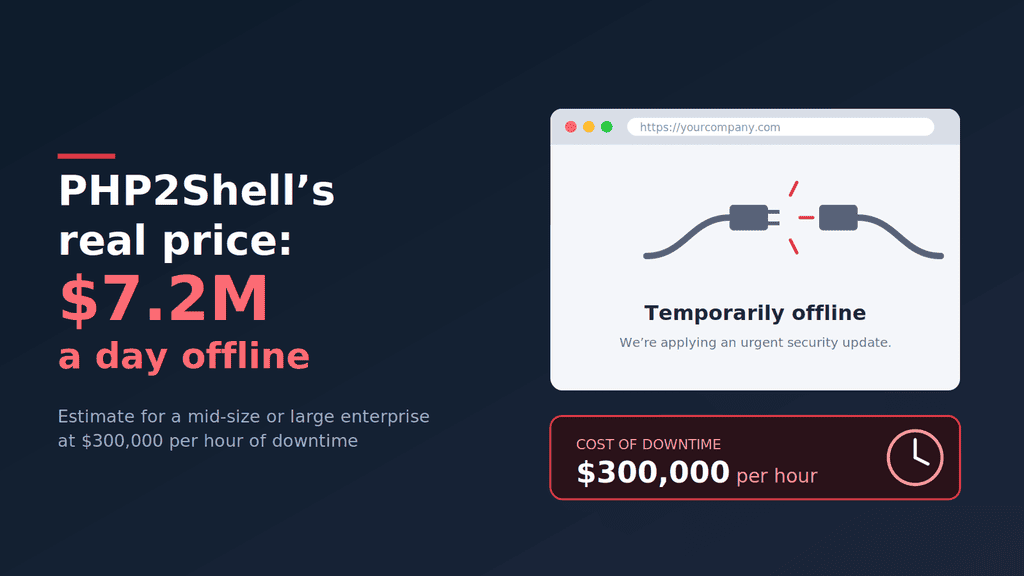
For most large enterprises, one hour offline costs more than $300,000, and for many it costs over $1 million. The main benchmarks agree on the scale:
| Benchmark | Figure | Source |
|---|---|---|
| Global 2000 companies, all downtime | $600 billion a year in total; $300 million per company, over $900,000 per hour | Splunk, 2026 |
| High-impact outages | $2 million per hour, median | New Relic, 2025, via Quash |
| Mid-size and large enterprises | Over $300,000 per hour for 90%+ of firms; $1M to $5M+ for 41% | ITIC, 2024, via Dotcom-Monitor |
| Small businesses under 25 staff | About $100,000 per hour | ITIC, via Dotcom-Monitor |
The shutdowns were real and wide. Hundreds, if not thousands, of organizations took sites or services offline, including government services in six European countries, Dutch hospitals and the Port of Rotterdam (Metacurity). Companies such as Nintendo also pulled services (The Record), and HR platform BambooHR took its app offline across three regions (FindCheapBroadband). Monitoring firm UptimeRobot saw about 11 times more downtime alerts than a normal day on October 21 (UptimeRobot).
No one has published a total cost for the event yet. But each business can estimate its own bill by multiplying its hourly downtime cost by the hours offline. Using the benchmarks above:
| Company profile | Hourly cost used | 4 hours (same-day patch) | 1 day (rushed upgrade) | 3 days (emergency migration) |
|---|---|---|---|---|
| Small business | $100,000 | $0.4M | $2.4M | $7.2M |
| Mid-size or large enterprise | $300,000 | $1.2M | $7.2M | $21.6M |
| Global 2000 company | $900,000 | $3.6M | $21.6M | $64.8M |
These are illustrations built from published averages, not measured losses, and they leave out fines, brand damage and the cost of a breach. The pattern is what matters: a company on a supported version lands in the first column, while one on end-of-life PHP risks the last.
This is where Cipher changes the math. Instead of a multi-month rebuild that keeps getting postponed, Cipher has modernized a 400-screen business application in about three weeks, so companies can move to supported, patchable software before the next incident forces them into the right-hand columns of this table.
Lost revenue is only the first line. Splunk’s 2026 survey of 2,000 Global 2000 executives found the damage continues long after systems come back (Splunk):
Investors increasingly read downtime as a sign of outdated infrastructure and weak risk governance, not bad luck. A breach through an unpatched legacy system makes that reading hard to argue with.
What would one day offline cost your business? If the answer is more than a modernization project, it’s time to talk. Book a free PHP exposure check with Opinov8.
On a modern stack, a critical patch is a deployment. On a legacy stack, it becomes a project, and projects take systems offline.
Each of these turns a security event into a business outage. And none of them is caused by the vulnerability itself. They are caused by years of deferred modernization.
The business case for modernization used to be speed and new features. PHP2Shell adds a simpler one: a modern platform lets you take a critical fix without going offline.
| On October 21… | A legacy system | A modernized system |
|---|---|---|
| Was there an official fix? | No, the version was too old | Yes, installed the same day |
| Did customers notice? | Site closed while the team worked | Update rolled out with the site still open |
| Did the team know what was exposed? | No, so they shut everything down | Yes, within minutes |
| How long to recover from an attack? | Days of investigation | Hours, by rebuilding from a clean copy |
Modernization is not free, but it is a one-time, planned cost. Downtime is a recurring, unplanned one, and AI tools that find and exploit old flaws in hours mean the next incident will arrive faster. Compared with a single multi-day outage, a modernization program often pays for itself.
The usual objection to modernization is that the migration itself causes disruption. Cipher, Opinov8’s AI-native modernization accelerator, is built around keeping the business running:
Your business keeps running throughout: the old system stays available as a fallback until the new one is proven. On one enterprise application, Cipher rebuilt more than 400 screens in about three weeks, at an estimated saving of $300K to $500K compared with a traditional approach.
A PHP platform built to stay online. A Netherlands-based marketing insights company ran its platform on an old PHP application on standalone servers, with no automatic scaling, no self-repair, no automated releases and no central monitoring. That combination meant higher running costs and a constant risk to uptime. Opinov8 moved it to a modern AWS setup that scales automatically during traffic spikes, repairs itself when something fails, and releases updates through automated pipelines. The results: much better uptime and availability, fewer failed releases, faster detection of incidents, and a targeted 35% cut in operating costs (Opinov8).
A 400-screen application rebuilt in about three weeks. A UK enterprise in real estate software depended on a business-critical application built on an aging stack. A conventional rebuild would have taken a larger team several months. With Cipher, a single AI-augmented developer moved all 400+ screens to a modern platform in about three weeks, for roughly $1,500 to $3,000 in AI tooling. The database stayed as it was, and the new system was checked against the old one’s records, operations and reports before switching over (Opinov8).
For a non-technical reader, the takeaway is simple: modernization no longer has to mean a year-long, budget-draining project. It can be faster than the outage you’re trying to avoid.