PHP2Shell went from leak to broad exploitation in less than a week. For organizations on a supported PHP version, the fix was a routine update. For hundreds of thousands of others, it was a modernization task they had been putting off for years.
Two critical flaws in PHP itself, CVE-2026-109618 and CVE-2026-109619, let an unauthenticated attacker run code on a web server. Amazon's honeypots recorded an exploitation attempt on October 17, four days before the official patch. Once the fix shipped on October 21, new exploits appeared within hours, and Amazon now describes the flaws as broadly exploited (AWS Security Blog).
Governments moved fast. CISA told organizations to take PHP-based systems offline until updated, the UK NCSC said to consider it, and CERT-EU advised isolating anything that could not be patched (Brandefense). Public bodies in several countries pulled their own websites.
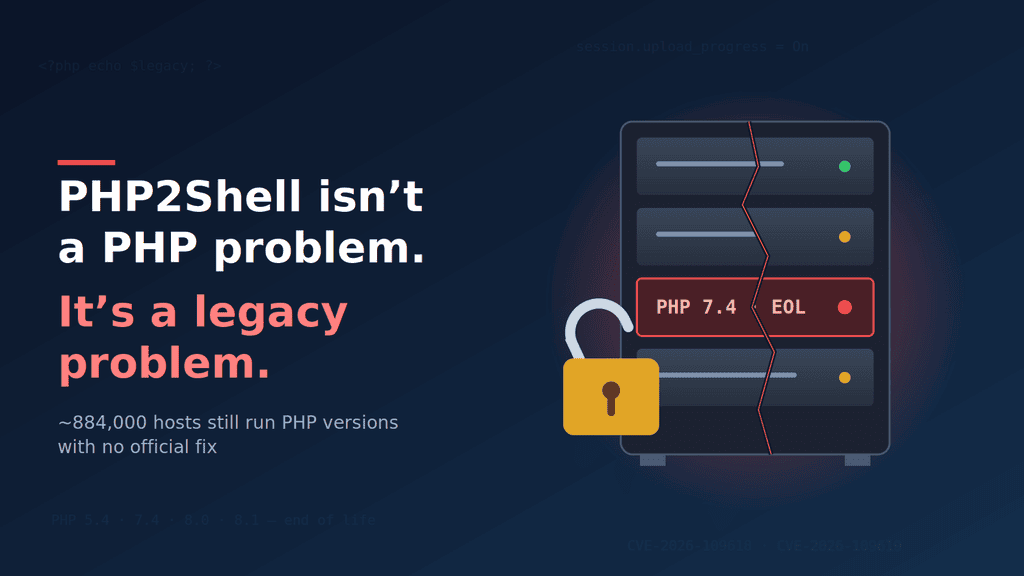
Patching is easy on a supported version. PHP fixed only branches 8.2 to 8.5. Versions 8.1, 8.0, 7.x and 5.x get nothing from php.net. On October 20, security firm Mallory counted roughly 884,000 internet-facing hosts advertising one of those versions, about 59% of hosts that showed a version at all (TuxCare, The Hacker News). For those teams, “just update” means a major-version migration in the middle of an active attack.
This isn’t really about PHP. Every stack has its own PHP2Shell waiting: old .NET Framework apps, Java 8 services, Python 2 scripts and abandoned frameworks. The question is not whether the next critical flaw lands, but whether you can take the fix when it does.
Nobody chooses to run end-of-life software. It happens one reasonable deferral at a time.
The result is deferred risk that compounds. Every year of delay makes the eventual jump bigger, and PHP2Shell made that jump due overnight.
We’ve been doing this work recently. We modernized a legacy PHP application for a marketing insights leader, moving it to a scalable, cloud-native architecture on AWS and cutting operations and maintenance costs by 30%. We modernized the platform of a logistics tech provider, enabling its AI features. And we just migrated a 400+ screen, business-critical application from old .NET to modern .NET and React with the Cipher accelerator (see the case study below).
Four lessons hold across every engagement:
In a week like this one, that foundation is what turns a critical runtime update into a routine deployment instead of a weekend outage.
AI coding agents can now read, map and rewrite legacy code far faster than manual teams. That makes modernizations viable that were “uneconomical” a year ago.
The irony is worth naming. The same class of AI tools found PHP2Shell: Wiz, Calif and OpenAI used frontier models to surface flaws hidden in PHP for more than a decade (Wiz). After hearing only that something was coming, Chainguard rediscovered the same bugs in one evening with a basic prompt (The Register). Attackers will find the next one faster too, so the window for leaving legacy alone is shrinking.
But speed without verification just produces new legacy faster: code that compiles, looks clean and quietly behaves differently from the system it replaced.
The real success test for AI-driven modernization is behavioral equivalence. The new system must do what the old one did, including the edge cases nobody documented. Five practices get you there:
Cipher is Opinov8’s AI-native modernization accelerator. It works across PHP, .NET, Java, Python and more, in four stages:
The whole process is governed by RAILS, Opinov8’s guardrail framework for AI agents. Cipher is also engine-agnostic: the method and skill library are the IP, and the underlying AI models are swappable.
Source: Opinov8 case study
The challenge. A UK-based enterprise in real estate and enterprise software relied on a business-critical application built on a legacy SPX/.NET stack, spanning more than 400 screens. Maintenance was getting harder and risk was rising, but a conventional migration would have needed a larger team and several months.
The approach. Using the Cipher accelerator, the migration ran on a bootstrap setup with architectural standards, reusable migration skills and iteratively refined rules, driven through Cursor with Codex. The target stack was .NET 10, React and Entity Framework. The existing database schema was preserved and only the data access layer was modernized, avoiding disruption to the data model. Functionality was validated against matching records, create-read-update-delete operations and report outputs.
The results (Opinov8):
| Measure | Result |
|---|---|
| Scope | 400+ screens, business-critical application |
| Delivery window | About 3 weeks |
| Team | A single developer, AI-augmented |
| AI tooling cost | About $1,500 to $3,000 |
| Quality | Functional parity validated on records, data operations and reports |
Opinov8 estimates this approach saves $200K to $500K, roughly 90%, compared with a traditional rewrite (Cipher). For an organization sitting on end-of-life PHP, that is the difference between a modernization task that waits for next year’s budget and one that finishes before the next disclosure.
If PHP2Shell sent your team searching for what’s still running on unsupported versions, that inventory is step one of a Cipher assessment. Book a free PHP exposure check with Opinov8.