
Quick answer: App modernization means updating a legacy application's code, architecture, or infrastructure so it meets current business, security, and performance needs: most commonly by moving it from on-premises infrastructure to the cloud and from a monolithic structure toward microservices (Cloudflare). Traditional approaches typically run 6–12 months with a 5–10 person team; AI-augmented modernization, done with proper validation, can compress that to a matter of weeks with a fraction of the team and cost.
The urgency isn't just vendor talk anymore, it's showing up in the C-suite. An IBM Institute for Business Value survey found that 83% of C-suite executives now consider modernizing apps and data central to their organization's business strategy (IBM). That's no longer an IT-department decision; it's a board-level one.
At the same time, AI has moved from "nice to have" to the default tool for getting there, with a catch. Red Hat's State of App Modernization report puts AI adoption at 78% of organizations, while Stack Overflow's Developer Survey shows trust in AI-generated output actually dropped 11 percentage points year over year, to 29%. IBM's data suggests why the upside is worth chasing anyway: 77% of executives said using generative AI in app modernization projects increases business agility, and agile-practice adopters are meaningfully more likely to outperform peers on revenue growth (IBM).
Here's the number that matters most for budgeting: IBM's research found that nearly a third of the cost of modernizing legacy applications comes from code translation and development work alone (IBM). That's precisely the piece AI can absorb, which is also precisely why a rushed, unvalidated AI migration is such an easy way to lose the trust the Stack Overflow data shows is already thin.
Two structural shifts round out the picture:
Every major vendor names these slightly differently, but they describe the same spectrum of effort and risk. The most common strategies are collectively known as "the 5 Rs" (as Gartner originally defined them) or "the 7 Rs" in extended form: rehost (lift and shift, minimal change), replatform (small optimizations for the cloud), refactor (restructure code without changing behavior), rearchitect (redesign, e.g. monolith to microservices), rebuild (start fresh with modern tooling), and replace (retire it and buy or license something new) (Cloudflare; Microsoft Azure). Azure frames the choice as depending on business value, technical complexity, and long-term objectives, not everything needs the same level of intervention, and most real programs use a mix (Microsoft Azure).
Where cipher fits: it operates in the refactor/rearchitect zone (restructuring and modernizing the data access layer and framework without touching the schema) rather than a rehost (too shallow to matter for aging .NET/VB stacks) or a full rebuild (too slow and expensive for what's actually broken).
| Traditional modernization | AI-native modernization (cipher) | |
|---|---|---|
| Timeline | 6–12 months | As fast as 3 weeks |
| Team size | 5–10 engineers | 1 AI-augmented engineer |
| Cost | Full services engagement | $300K–$500K saved vs. traditional (~90%) |
| Tooling cost | N/A | Under $3K, plus engagement fee |
| Risk profile | Often full rewrite, schema touched | Zero schema changes — legacy stays a rollback option |
| Output | Varies by team/vendor | Production-grade, parity-tested |
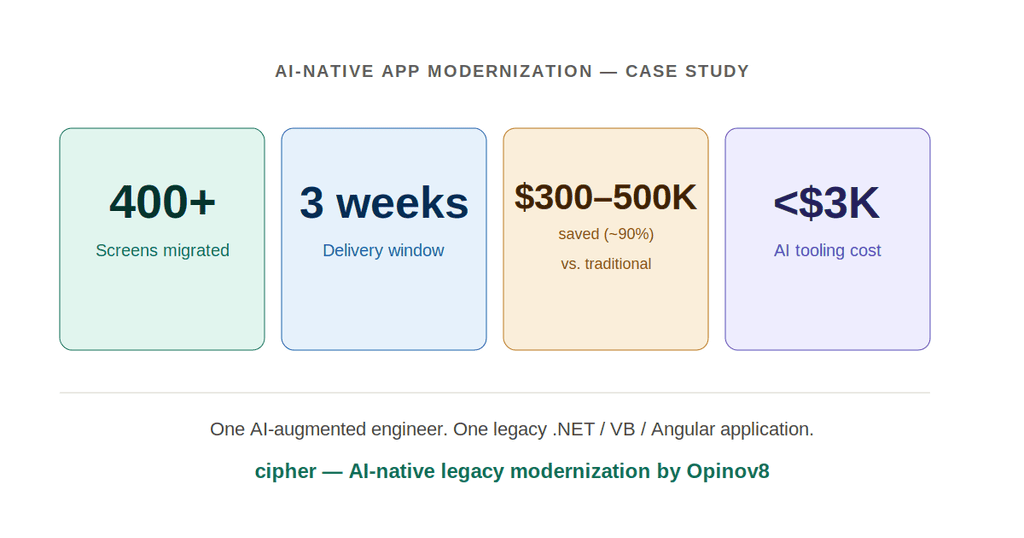
This isn't a projection: it's a completed engagement. A full enterprise application, built on an aging .NET/VB/Angular stack, was modernized in a 3-week delivery window by a single AI-augmented engineer. The result: over 400 screens migrated, $300K–$500K in cost avoided versus a traditional 6–12-month, multi-engineer rebuild, and total AI tooling spend under $3,000.
That kind of compression only holds up if the process underneath it is disciplined, otherwise you've just moved fast toward something you can't trust in production, which is exactly the 29%-trust problem enterprises are already living with.
This maps closely to how IBM frames the standard modernization lifecycle (assessment, planning, implementation, testing, and monitoring IBM) but compresses and automates the parts that normally eat the most time and budget:
The risk containment is structural, not incidental: only the data access layer is modernized, the schema is untouched, and the legacy system remains a rollback path throughout.
It's the process of updating a legacy application's architecture, code, or infrastructure — often moving it from on-premises to the cloud — to improve performance, security, scalability, and maintainability (Cloudflare; IBM).
Traditional approaches run 6–12 months with a 5–10 person team. AI-augmented modernization with a disciplined validation process can compress this to a few weeks for a full application.
No. Most current approaches follow a phased model, commonly called "the 5 Rs" or "the 7 Rs" (rehost, replatform, refactor, rearchitect, rebuild, replace) rather than a full rewrite, because wholesale replacement carries disproportionate cost and risk (Cloudflare; Microsoft Azure).
It can be, if the process includes functional parity checks, automated testing, and keeps the schema and rollback path intact — the risk isn't the AI, it's skipping validation.