

AI Transformation Consulting: How to Build an AI-Shaped Organization in 2027
AI, AI Development, AI Native
Read more

For years, enterprise AI initiatives were judged by how innovative they seemed. In 2026, that standard has changed. Demonstrating AI ROI is no longer optional: it's a must.
Today, CIOs, CTOs, Heads of AI, and CFOs are asking a much tougher question:
Can you prove your AI investment is creating measurable business value?
It's a fair question. According to industry research cited throughout 2026, 95% of enterprise generative AI pilots fail to demonstrate measurable financial returns within their first six months. As organizations tighten budgets, AI projects that cannot prove ROI are increasingly being paused, scaled back, or cancelled.
Industry analysis from CIO.com describes 2026 as "the year AI ROI gets real," reflecting the growing pressure on technology leaders to justify AI spending with tangible business outcomes rather than promising prototypes.
The good news? Most AI failures are not caused by poor models, they result from poor delivery strategies.
Here are the seven critical steps that separate successful AI programs from the growing PoC graveyard.
The first mistake many organizations make is starting with the technology.
Questions like:
...come far too early.
Instead, define the business objective first.
Ask questions such as:
According to IBM, organizations achieve stronger AI ROI when AI initiatives are aligned with strategic business objectives instead of isolated technical goals. AI should be evaluated based on measurable improvements such as revenue growth, productivity, customer satisfaction, and operational efficiency, not simply model performance.
Many AI projects fail because they were designed to impress stakeholders during a demonstration rather than operate reliably in production.
Production AI requires:
A proof of concept proves an idea.
A production system creates business value.
Organizations focused on long-term AI ROI prioritize scalable implementation from the very beginning.
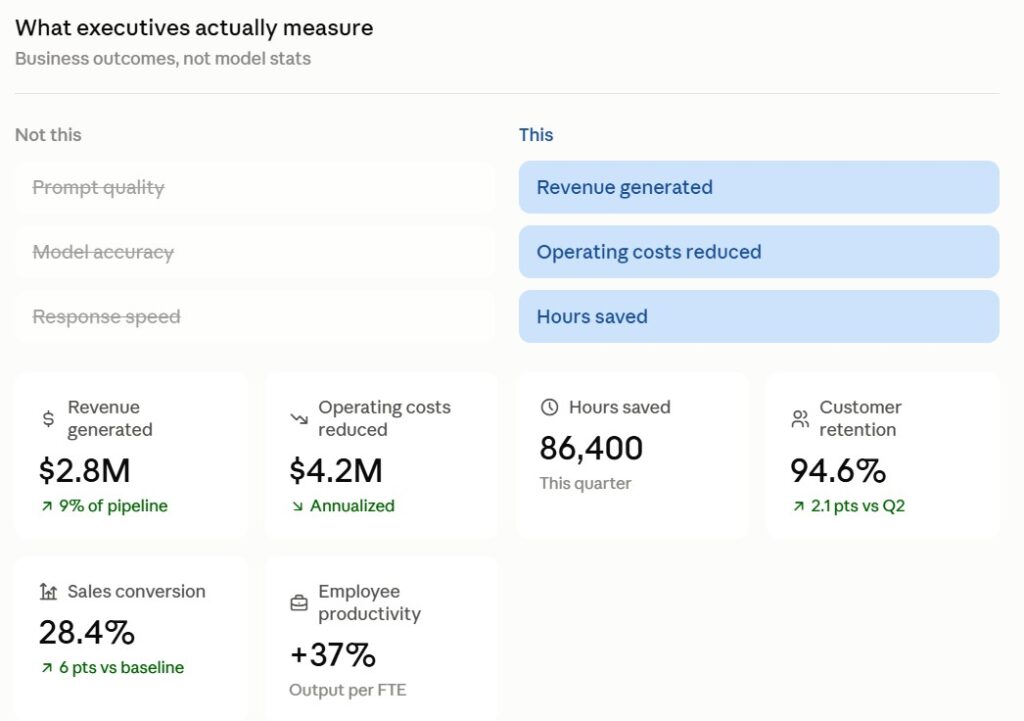
One of the biggest reasons AI projects lose executive support is that nobody defined success before development started.
Instead of measuring:
Measure outcomes executives actually care about:
According to CIO.com's "AI ROI: How to Measure the True Value of AI," organizations that consistently realize AI value establish business KPIs before deployment and continuously track performance against those objectives.
An AI assistant that nobody uses has zero ROI.
Successful organizations embed AI directly into the systems employees already use:
The easier AI becomes to use, the faster adoption grows, and the sooner organizations begin realizing measurable business value.
Integration, not innovation alone, drives ROI.
AI ROI isn't calculated once after deployment. It should be monitored continuously.
Leading organizations build dashboards that measure:
This visibility allows leaders to optimize AI initiatives instead of waiting until annual budget reviews to determine whether they were successful.
One of the biggest disconnects in enterprise AI is that engineering teams and finance leaders often measure success differently.
Engineering focuses on:
Finance focuses on:
Bringing these perspectives together is essential.
Deloitte notes that organizations experiencing the strongest AI returns treat AI as an enterprise transformation initiative supported by governance, executive alignment, workforce adoption, and measurable performance indicators—not simply as a technology deployment.
When finance and technology teams share the same success metrics, securing future AI investment becomes significantly easier.
Technology alone doesn't generate ROI.
Execution does.
Many organizations remain stuck in an endless cycle of proofs of concept because delivery partners focus on experimentation instead of measurable business outcomes.
An AI-native engineering partner should deliver:
At Opinov8, every AI engagement is designed around measurable business outcomes from the start. Rather than delivering another isolated proof of concept, Opinov8 develops agentic AI solutions and AI-native engineering that integrate into real business processes, include value tracking from day one, and are built to scale across the enterprise.
The objective isn't simply to launch AI: it's to help organizations confidently demonstrate ROI to executive stakeholders and secure long-term investment.
The AI market is entering a new phase.
Innovation is no longer enough.
Organizations that continue funding AI in 2026 will be those that can clearly answer questions like:
By following these seven critical steps, organizations can move beyond isolated pilots and build AI solutions that create measurable business value, earn executive confidence, and justify continued investment.
In today's market, AI ROI isn't just a performance metric—it has become the benchmark for successful AI delivery.
AI ROI (Artificial Intelligence Return on Investment) measures the business value generated by AI initiatives compared to the cost of implementing and operating them. It typically includes financial returns, productivity gains, operational efficiencies, and customer experience improvements.
Most AI pilots fail because they lack clear business objectives, aren't deployed into production, fail to integrate with existing workflows, or don't measure business outcomes that matter to executive decision-makers.
Organizations can improve AI ROI by aligning AI initiatives with business goals, defining KPIs before development begins, deploying production-ready solutions, continuously measuring business impact, and partnering with experienced AI engineering teams that focus on measurable outcomes rather than experimentation alone.