

AI Transformation Consulting: How to Build an AI-Shaped Organization in 2027
AI, AI Development, AI Native
Read more

For the last few years, most enterprise AI conversations started with the same question: "What can AI help us achieve?"
Leadership teams explored copilots, automation opportunities, generative AI assistants, and proof-of-concepts. Innovation teams moved quickly, experimenting with large language models, AI agents, and new ways of improving customer and employee experiences.
But in 2026, the conversation inside many boardrooms has changed. The question is no longer whether AI works. The question is: "How much is AI costing us, and how do we make sure that cost scales with business value?"
This is the point where AI moves from an innovation initiative into an operational capability, and where AI cost governance becomes a board-level priority rather than an IT line item. For CIOs and CTOs, that transition creates a new responsibility. They are no longer only responsible for enabling AI adoption. They are responsible for ensuring AI is financially sustainable, auditable, and governed like any other core business system.
The organisations that succeed with AI will not necessarily be those that deploy the largest models or spend the most money. They will be the ones that build AI cost governance and AI FinOps into how they operate.
Early AI adoption was often funded through innovation budgets. A department could launch a pilot. A team could test a chatbot. Engineers could explore different models. Business leaders could experiment without needing a complete financial justification.
That approach made sense. Experimentation was necessary. However, production AI operates differently. A successful AI solution creates new questions that fall squarely under AI cost governance:
These are not purely technical questions. They are business questions.
As AI becomes embedded into customer operations, software development, logistics, financial processes, and internal workflows, organisations need the same level of financial discipline they already apply to cloud platforms and enterprise application: applied specifically through AI cost governance.
AI cost governance is the practice of understanding, controlling, and optimising the financial impact of AI systems across models, infrastructure, teams, and business units.
According to MLflow's What Is AI Cost Governance? A Guide for Finance Leaders, AI cost governance provides a structured approach for managing AI spending across models, infrastructure, and teams. Unlike traditional IT spending models, AI costs are often usage-driven and can change depending on user behaviour, application demand, model selection, and workload complexity.
This distinction matters. Traditional software costs are usually predictable:
AI introduces a much more dynamic financial model: one that AI cost governance is specifically designed to manage:
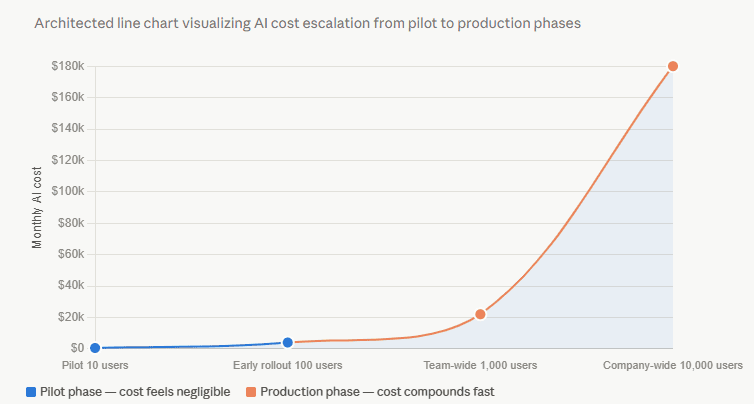
A system that looks inexpensive during a pilot can become a significant operational expense once thousands of employees or customers begin using it. Without AI cost governance in place, that expense is often invisible until the invoice arrives.
Many organisations have already adopted Cloud FinOps practices. These practices help teams understand cloud consumption, infrastructure efficiency, unused resources, reserved capacity, and application spending.
However, AI introduces a different set of financial challenges that generic Cloud FinOps was never built to handle. This is where AI FinOps, a discipline distinct from cloud FinOps, expands the model with new areas of control.
Large language models charge based on the number of tokens processed. A poorly designed AI workflow can consume unnecessary tokens through:
Small inefficiencies multiplied across millions of requests become significant costs: which is why token consumption management sits at the centre of any AI cost governance framework.
One of the biggest mistakes organisations make is assuming every AI workload requires the most powerful available model.
In reality, different tasks require different levels of intelligence. A simple classification task may not need the same model used for complex reasoning.
Intelligent model routing allows organisations to balance:
Agentic AI introduces another layer of complexity. Unlike traditional applications, AI agents can make decisions, call tools, retrieve information, and perform multiple reasoning steps before completing a task.
For example, an AI logistics assistant may:
Each step may involve additional model calls. Without governance, autonomous systems can create unpredictable costs: one of the strongest arguments for treating AI cost governance as a design requirement, not an afterthought.
Many organisations underestimate the true cost of AI because they only look at model usage. The reality is that enterprise AI requires an ecosystem, and AI cost governance has to account for all of it.
Running AI workloads requires cloud compute, GPUs, storage, networking, and monitoring platforms.
GPU resources are particularly important because they can become expensive when poorly utilised. Unused GPU capacity can represent significant wasted investment.
AI systems depend on data. Costs can come from data preparation, storage, indexing, retrieval systems, security controls, and governance processes. For enterprise AI, high-quality data is not optional.
Production AI requires monitoring, security, compliance, testing, maintenance, and continuous improvement.
A successful AI application is not a one-time deployment. It is an operational product, and operational products need ongoing AI cost governance, not a one-time budget review.
One of the fastest-growing concerns for enterprise AI leaders is token consumption.
Tokens are the basic units that large language models process. Every input and output contributes to usage costs. At small scale, these costs may appear insignificant. At enterprise scale, they become strategic.
A customer service assistant handling millions of conversations, a software engineering copilot used across thousands of developers, or an AI agent managing business workflows can create substantial recurring expenses.
Boston Consulting Group notes that managing AI token costs requires organisations to rethink how they design and operate AI systems, with the focus not only on reducing usage but on improving efficiency through better model selection, optimisation techniques, and operational monitoring.
The key lesson for technology leaders is simple: AI efficiency is not only an engineering concern. It is a business performance concern, and it is the core output of effective AI cost governance.
The problem: When nobody owns AI spend, everybody assumes someone else is watching it. By the time the bill is a surprise, it's already too late to fix quietly.
The fix: Name one accountable owner: someone who sits between engineering, finance, and the business teams actually using the AI tools. MLflow's research on AI cost governance points to exactly this gap: because AI costs are usage-driven and shift with user behaviour, application demand, and model selection, they don't fit neatly into any one department's existing budget process, which is why ownership has to be explicitly assigned rather than assumed. Think of it like naming a "budget owner" for a company credit card. Nobody questions why that role exists for expenses; AI spend deserves the same treatment.
Quick start: Assign this to whoever already owns your cloud cost budget: the skill set transfers directly.
The problem: Most teams find out about AI costs a month later, on an invoice, long after the spending happened.
The fix: A simple dashboard that shows, in real time: which app is using AI, which model it's calling, and what that's costing today: not last month.
Analogy: It's the difference between checking your bank balance daily versus only looking at your statement once it arrives. One lets you catch a problem while it's small.
Quick start: Start with just three numbers: cost per app, cost per model, cost per day. You can always add more later.
The problem: Many companies default every task, simple or complex, to their most powerful (and most expensive) AI model.
The fix: Match the model to the job. A basic task, like sorting an email into a category, doesn't need the same "brain" as a task involving multi-step reasoning. Route simple work to cheaper, faster models and save the expensive ones for where they actually matter. Boston Consulting Group's research on managing AI token costs makes this exact point: the fix isn't just reducing how much AI gets used, it's improving efficiency through better model selection and routing.
Analogy: You wouldn't drive a sports car to pick up milk from the corner shop. Same idea: use the right tool for the distance you're actually going.
Quick start: Audit your three highest-volume AI tasks first. There's often an easy, cheaper swap hiding in plain sight.
The problem: AI agents that can plan, search, and take multiple steps on their own are powerful. Each step can quietly trigger another cost. A single request can spiral into dozens of hidden model calls, and every one of those calls consumes tokens, the basic unit BCG's research identifies as the fastest-growing driver of enterprise AI spend.
The fix: Set limits. Cap how many steps an agent can take, how many tool calls it can make, and build in an alert if a task is running longer (and costing more) than expected.
Analogy: Think of it like a taxi meter versus a fixed fare — without a cap, you don't know the final cost until the ride is already over.
Quick start: Set a maximum step count on your highest-risk agent workflows this week: it's often a single config change.
The problem: Cutting AI spend blindly can cut the value it's creating too. The real goal isn't spending less: it's spending well.
The fix: Track cost next to outcome. Cost per customer ticket resolved. Cost per automated task completed. Cost per hour of work saved. This turns "we spent $50,000 on AI" into "we spent $50,000 on AI and it replaced 2,000 hours of manual work": a very different conversation with leadership. It's the same shift Gartner's CIO research points to industry-wide: technology leaders are increasingly judged on demonstrating measurable business outcomes from their investments, not just on the size of the investment itself.
Quick start: Pick your single most-used AI workflow and calculate its cost-per-outcome this quarter. That one number becomes your template for everything else.
The problem: A monthly cost report tells you what already went wrong. It can't stop it from happening again next month.
The fix: Move governance out of manual reports and into the engineering platform itself: automatic cost alerts, usage limits, and approval policies that kick in before spend gets out of hand, not after.
Analogy: It's a smoke detector versus a fire report. One warns you in the moment; the other just documents the damage.
Quick start: Set up one automated alert: for example, "notify us if any single app's daily AI spend jumps 50% above its usual average."
The problem: Costs that look small in a pilot with 10 users can look completely different once 10,000 people are using the same tool. Most teams don't forecast for that jump — they get blindsided by it.
The fix: Before rolling out any AI tool company-wide, model what the cost looks like at 10x and 100x today's usage. Budget for the version of success you're hoping for, not just the pilot you're currently running.
Quick start: Take your current pilot's cost and multiply it by your expected rollout size. If that number would surprise your finance team, it's worth a conversation now — before it's a surprise later.
Building AI cost governance does not mean slowing down innovation. It means creating the visibility and controls required to scale confidently.
Transportation and logistics organisations are among the industries where AI adoption can create significant value.
AI is already transforming route optimisation, predictive maintenance, warehouse operations, fleet management, demand forecasting, and customer communication.
However, these industries also operate at enormous scale. A small increase in the cost of each AI interaction can become significant when multiplied across thousands of vehicles, shipments, employees, or customers.
For logistics leaders, the challenge is not only building AI capability. It is building AI capability that remains financially sustainable as operations grow: which is precisely the gap AI cost governance is designed to close.
This is where modern cloud platform engineering and AI governance practices become essential.
The broader technology market is moving in the same direction.
Gartner's CIO research highlights that technology leaders are increasingly focused on demonstrating measurable business outcomes from digital investments, improving operational resilience, and managing emerging technology responsibly.
The implication for CIOs and CTOs is clear: AI adoption without governance creates uncertainty. AI adoption with AI cost governance creates competitive advantage.
At Opinov8, we help organisations move from AI experimentation to reliable, production-ready AI platforms.
Our cloud platform engineering approach combines modernisation expertise, cloud engineering, AI delivery practices, automation, and operational governance.
We understand that successful AI transformation requires more than deploying models. It requires building the systems, processes, and platforms that allow AI to operate securely, efficiently, and predictably: with AI cost governance built in from day one.
For technology leaders asking:
"Now that AI has moved from pilot budget to a real production line item, who is accountable for what it actually costs?"
The answer begins with visibility, governance, and engineering discipline.
AI is becoming part of everyday business operations. The next competitive advantage will not come from simply having access to AI models. Almost every organisation will have that.
The advantage will come from knowing how to operate AI effectively through disciplined AI cost governance. CIOs and CTOs who establish AI cost governance today will be better positioned to:
AI has moved beyond experimentation. Now it needs operational excellence. And that starts with AI cost governance.
AI cost governance is the practice of tracking, controlling, and optimising how much an organisation spends on AI — across model usage, infrastructure, data, and operations — and tying that spend to measurable business value.
Cloud FinOps focuses on infrastructure spend like compute, storage, and reserved capacity. AI FinOps extends this to usage-driven costs unique to AI systems: token consumption, model selection and routing, and the multi-step cost of autonomous AI agents.
Token costs scale directly with usage. A workflow that looks inexpensive in a pilot with a few dozen users can become a major recurring expense once it's rolled out to thousands of employees or customers, which is why boards now want visibility into per-interaction AI costs.
Establishing clear ownership. AI spending needs a named accountable owner spanning technology, finance, and product — otherwise it sits in a blind spot between departments.