

AI Transformation Consulting: How to Build an AI-Shaped Organization in 2027
AI, AI Development, AI Native
Read more

Most enterprises don't fail at AI because the models are bad: they fail because nobody connects the model to a workflow, an owner, and a decision. Closing that gap between AI potential and day-to-day business reality is exactly what AI consulting services for data and operations are built for.
This guide walks through the 4 proven wins behind a successful AI consulting engagement (discovery, design, engineering, and optimization) plus what to expect from different service models and how to align an AI initiative with your broader data strategy, from initial assessment through production-scale operations.
Leading providers approach enterprise AI from different angles. IBM Consulting's Data & AI practice emphasizes modernizing enterprise data platforms and operationalizing AI across business functions. Deloitte's Artificial Intelligence & Data consulting combines AI strategy, governance, and data transformation. Opinov8's AI Consulting and Data Services take an engineering-first approach, pairing AI engineering, MLOps, and data modernization with AI-native implementation so strategy doesn't stall before it reaches production.
Together, these approaches point to the same conclusion: successful AI adoption takes strategy, data engineering, governance, and execution working as one engagement, not four separate vendors.
AI consulting services for data and operations cover the strategic, technical, and operational support an organization needs to implement artificial intelligence at scale: from readiness assessments through full deployment and ongoing optimization.
Unlike off-the-shelf AI software, a consulting engagement tailors the solution to your specific data environment, business processes, and organizational constraints. The goal is an AI capability embedded in how teams already work, not another tool that sits unused.
This philosophy shows up across the industry: firms like IBM Consulting, Deloitte, and Opinov8 all treat AI adoption as more than model development. It requires data modernization, scalable architecture, governance, cloud infrastructure, and organizational change management, so AI becomes part of daily operations rather than a standalone initiative.
A quality engagement addresses the full lifecycle: current-state data architecture, high-value use case identification, scalable infrastructure design, model implementation, and a process for continuous improvement.
Many enterprises sit on valuable data assets but lack the internal expertise to turn them into operational intelligence. According to McKinsey's 2025 State of AI survey, 88% of organizations now use AI in at least one business function, but nearly two-thirds have not yet begun scaling AI across the enterprise.
This gap exists because moving from AI pilot to AI production requires more than technical skills. It demands workflow redesign, change management, governance frameworks, and executive alignment. AI consulting services for data operations fill these gaps by bringing together strategy and engineering under one engagement.
Data operations present particular challenges. Fragmented systems, siloed datasets, and inconsistent data quality create friction that prevents AI models from delivering reliable insights. Consultants help you address these foundational issues before moving to model development.
Your data architecture should reflect what you need to accomplish: not simply the systems you happen to already have. AI consultants assess current infrastructure against strategic priorities to find the gaps that would otherwise sink an AI initiative.
This often means designing data engineering solutions that support both analytical workloads (batch processing for historical analysis) and operational systems (real-time data flows for live decisions).
Identifying a promising use case is the easy part. The harder work is embedding that capability into an existing workflow so people actually use it. A capable partner maps out how AI outputs reach decision-makers and what process changes are required: who needs access, at what point in their process, and in what format the information becomes actionable.
Production AI systems need clear ownership, defined scopes, human-oversight checkpoints, and measurable outcomes. Establishing governance before implementation prevents the common failure pattern: a pilot succeeds, then never scales because nobody defined what "success" meant.
A solid AI governance framework specifies who owns each AI capability, what decisions it can and cannot make, when human review kicks in, and how performance gets measured: enabling responsible scaling instead of permanent pilot mode.
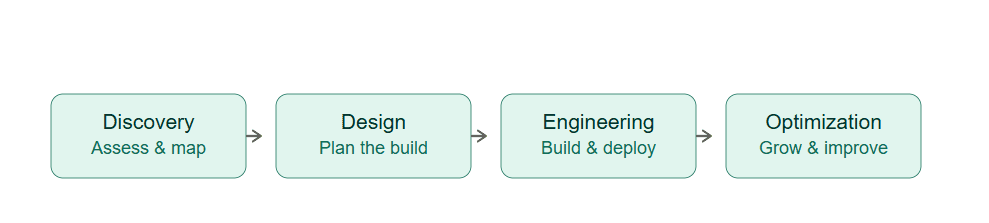
Each of these stages delivers a concrete win for AI Consulting Services for Data and Operations: a specific outcome you can point to before moving to the next phase.
Discovery maps your current state across data quality and accessibility, technical infrastructure, organizational readiness, and strategic priorities. The win: a clear picture of where you stand and where the highest-value opportunities live.
Opinov8's AI Readiness Assessment, for example, evaluates strategy, operations, data, people, and investment appetite to produce a maturity score and a prioritized opportunity map.
Design turns discovery findings into a technical and operational blueprint: data architecture, integration points, model requirements, and an implementation sequence for the highest-priority use cases. The win: a blueprint every stakeholder has signed off on before a line of code gets written.
Decisions made here have long-term consequences, so the design should balance immediate needs against future flexibility, avoiding both over-engineering and technical debt.
This is where code gets written, systems get configured, and integrations get built: the infrastructure, data pipelines, and models specified in the design phase. The win: a production-grade system with testability, maintainability, and observability built in from day one, with monitoring that flags model drift or data-quality issues before they affect output.
Optimization starts immediately after deployment and never really stops: models improve as they see more data and edge cases. The win: performance that keeps improving after launch, plus a repeatable process for identifying new opportunities, allocating resources, and holding governance standards across a growing portfolio of AI capabilities.
Strategy engagements focus on planning, not implementation: an AI roadmap, use-case prioritization, readiness assessment, and internal alignment. These suit organizations early in their AI journey, or those resetting direction after a false start. Advisory work often includes executive education and the business case, governance framework, and change-management plan that prepares the organization for build.
Implementation services handle the technical build: data engineering, model development, system integration, and deployment. These suit organizations with a clear use case that just need engineering capacity: ranging from augmenting an existing team to full solution delivery.
Managed services cover ongoing operation after launch: monitoring, maintenance, retraining, and incident response. These suit organizations that want AI capability without building a large internal team to maintain it, and are often more cost-effective than maintaining specialized in-house expertise.
IBM Consulting emphasizes enterprise-scale transformation; Deloitte highlights responsible AI and business strategy; Opinov8 combines strategic advisory with hands-on engineering: readiness assessments, data engineering, machine learning, MLOps, and AI-native delivery. Whichever provider you're weighing, prioritize AI consulting services for data and operations who can turn strategy into measurable business outcomes.
Some firms are strong on strategy but light on the engineering needed to implement it; others have deep technical teams but limited strategic perspective. The ideal partner has both. Ask about specific systems they've built and operated in production, not just designed on paper, and how they resolved the problems that came up along the way.
AI applications differ meaningfully across industries. A partner with experience in your sector already understands the relevant data sources, regulatory requirements, and operational constraints, and can move faster because they've solved similar problems before. Domain fluency also helps with stakeholder communication, framing recommendations in terms your leadership and front-line teams actually recognize.
Understand how the firm staffs its engagements. Will you work with senior practitioners throughout, or get handed off to junior staff after the sale? How do they handle knowledge transfer? The strongest partnerships build your internal capability while delivering results: not create long-term dependency.
AI-native consulting embeds AI into the methodology itself (using it to accelerate discovery, generate options, and validate recommendations throughout the engagement) rather than treating AI purely as a deliverable to be implemented at the end.
AI-native firms often price engagements around outcomes rather than billable hours, so if AI speeds up delivery, the client benefits rather than just the consultancy's margin. It takes more upfront work to define success criteria, but it creates real accountability for results.
Opinov8 delivers AI consulting through an engineering-first approach that connects strategy directly to implementation — built for organizations that need capabilities actually built, deployed, and running in production, not just advised on.
End-to-end data and AI services. Opinov8's scope spans the full data lifecycle — discovery through ongoing optimization — including custom AI solutions, data engineering, MLOps, and business intelligence, with scalable, compliant architectures (lakehouse platforms, ETL pipelines, AI-ready data models) and real-time data flow optimization for faster operational decisions.
Governance and ROI focus. Every engagement establishes governance frameworks and ROI baselines before build begins — the discipline that prevents pilots from stalling out because nobody defined success. Opinov8's RAILS platform systematizes agent deployment and governance so AI-native operations are repeatable rather than bespoke, with clear ownership, scope, and measurable outcomes on every capability deployed.
Global delivery with engineering depth. With 200+ specialists across multiple time zones and status as a Microsoft Solutions Partner for Data and AI, Opinov8 pairs global reach with certified cloud and data platform expertise.
AI models need quality data to produce reliable output, and most organizations find their data is messier and more fragmented than assumed. Experienced partners build data-quality remediation into the timeline from the start, with monitoring that catches issues before they hit AI performance.
Technical implementation is often easier than organizational adoption — people resist workflow changes, especially when AI feels like a threat to their role. Successful engagements build change management in from day one: involving affected teams in design decisions, communicating how AI augments rather than replaces their work, and celebrating early wins.
AI projects tend to expand fast as stakeholders spot new possibilities. Without disciplined scope management, engagements outgrow their budget and timeline without proportional value. A phased approach keeps this in check — each phase delivers a tangible outcome that informs the next.
Technical metrics: model accuracy, latency, availability, error rates — should be tracked continuously post-deployment, not validated once, since performance can degrade as data patterns shift.
Business outcome metrics: cost reduction, revenue growth, time savings, customer satisfaction, competitive differentiation — need a baseline measured before implementation, or it's impossible to attribute change to AI versus other factors.
Adoption metrics track whether intended users actually engage with the AI capability. Low adoption points to problems with UX, training, or workflow integration; high adoption paired with weak business outcomes points to a capability that needs refinement, not more marketing.
AI consulting services exist to bridge AI potential and operational reality: connecting data assets to business processes in ways that produce measurable value. Success comes down to picking the right partner, establishing clear governance, and staying focused on outcomes rather than technology for its own sake.
The organizations getting the most from AI treat it as a catalyst for operational change, not a technical upgrade: redesigning workflows, establishing governance, and building sustainable internal capability instead of running isolated experiments.
A structured assessment is the natural starting point: understand where you stand, identify the highest-value opportunities, then move through phased implementation that builds momentum while managing risk.
Assessment phases typically take two to four weeks. Design and initial implementation for a single use case usually spans two to four months. Scaling across multiple use cases and embedding AI into enterprise operations extends over six months to a year or more, with optimization continuing indefinitely.
Consulting gives you immediate access to practitioners who've solved similar problems across multiple organizations; internal hiring takes longer and means building expertise from scratch. Opinov8 pairs consulting delivery with knowledge transfer, building internal capability while delivering results — reducing dependency over time rather than creating it.
A thorough assessment covers five dimensions: strategy alignment, operational readiness, data quality and accessibility, organizational capability, and investment appetite. Opinov8's version produces a maturity score, an opportunity map, and prioritized, concrete recommendations: not generic advice.
Cost depends on engagement scope, complexity, and duration: assessment engagements cost less than full implementation programs, and outcome-based pricing can align cost more directly with delivered value. Ask for a proposal broken down by phase and deliverable so you can see exactly where the budget goes.
Industries with large data volumes, complex operations, and high decision-making stakes, financial services, healthcare, manufacturing, logistics, and technology, see the strongest returns. Opinov8 has delivered engagements across automotive, fintech, healthcare, e-commerce, maritime, and public-sector organizations.
Opinov8 establishes ROI baselines and governance frameworks before any build begins, with every AI capability given defined ownership, scoped permissions, human-oversight points, and outcomes tied to business objectives: all managed through a discover-design-engineer-optimize methodology that keeps technical work tied to strategic priorities throughout.
Unlike firms focused primarily on advisory work, Opinov8 combines consulting with engineering execution across the full AI lifecycle (AI readiness assessments, data engineering, custom AI development, machine learning, MLOps, business intelligence, and real-time data optimization) moving organizations from strategy to production-ready AI.