

AI Transformation Consulting: How to Build an AI-Shaped Organization in 2027
AI, AI Development, AI Native
Read more

Modern enterprises generate more data than ever, yet many struggle to turn that data into measurable business value. The challenge isn't collection: it's building an operating model that lets teams consistently govern, manage, and use data to make better decisions.
A Data Target Operating Model (Data TOM) provides that blueprint. It defines how an organization should operate in the future by aligning people, process, governance, technology, and culture around data-driven outcomes.
The stakes are rising quickly. McKinsey's research on enterprise AI scaling found that as companies push AI pilots to scale, data is emerging as the binding constraint: leaders are prioritizing data readiness across reuse, reliability, governance, and scalability. The same analysis notes that this bottleneck is a key reason only about 7% of companies have fully scaled AI across their organizations. In other words: AI ambition is outpacing data readiness almost everywhere, and an operating model is what closes that gap.
Whether your organization is modernizing legacy platforms, implementing AI, migrating to the cloud, or improving analytics, a Data Target Operating Model provides the foundation for long-term success.
Talk to Opinov8 about assessing your current data maturity →
A Data Target Operating Model is the future-state framework that defines how data capabilities should operate across an enterprise. It establishes:
Unlike a data strategy, which defines where the organization wants to go, a Data TOM explains how the organization will get there through repeatable operating practices.
The broader concept of a target operating model has long been used to align business strategy with operational execution across people, process, technology, governance, and information assets. A Data TOM applies those principles specifically to enterprise data management and analytics: often incorporating concepts from frameworks like DAMA International's DMBOK for governance structure and terminology.
Organizations investing in AI, automation, cloud computing, and advanced analytics often discover that technology alone doesn't solve data challenges. Without a clear operating model, businesses frequently experience:
Gartner's data and analytics governance research has been blunt about the cost of inaction: industry analysis of Gartner's 2025 guidance points to a prediction that 80% of governance initiatives will fail by 2027 without clear business outcomes tied to urgency, a reminder that governance frameworks succeed or fail based on business alignment, not tooling alone.
A well-designed Data Target Operating Model creates alignment between business objectives and operational execution, allowing organizations to deliver trusted, high-quality data at scale: the same foundation that AI and machine learning services depend on to move past pilot stage.
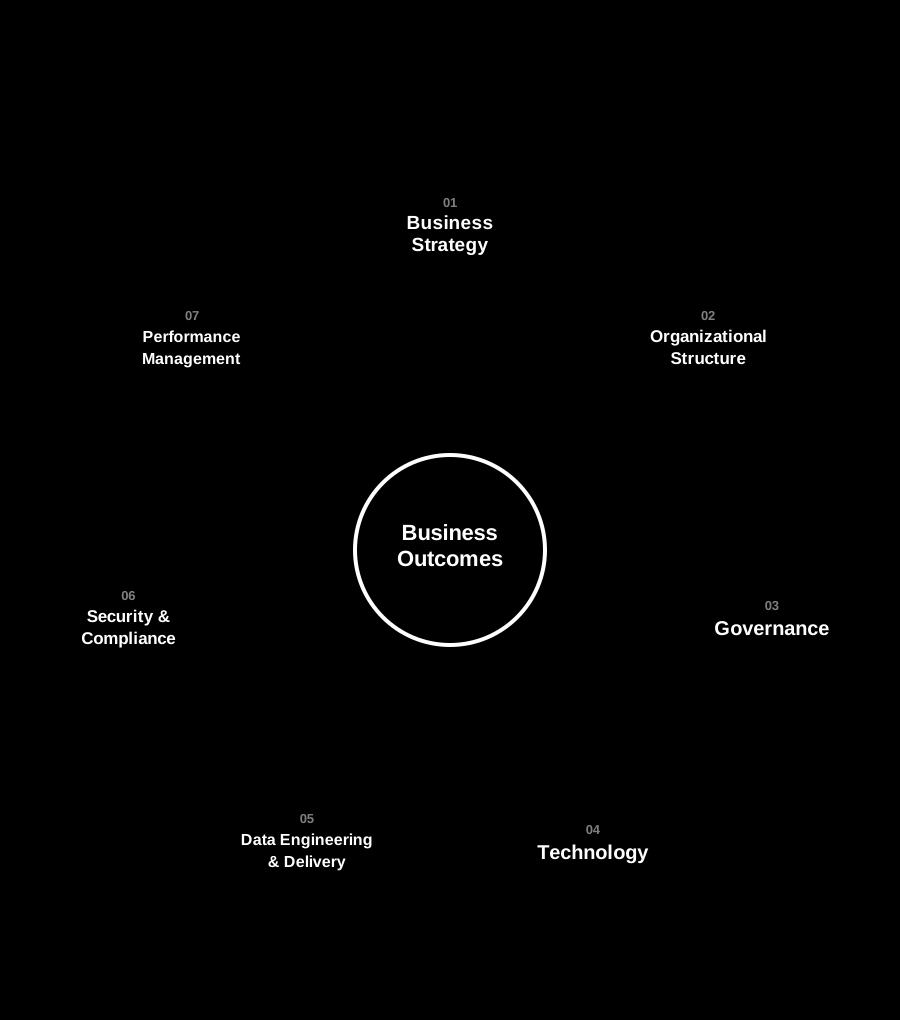
Every operating model should begin with business outcomes rather than technology. Key questions include:
The operating model should directly support these priorities, not be designed in isolation from them.
Successful data organizations clearly define ownership. Typical roles include:
Many enterprises now adopt federated or domain-oriented operating models (often described using data mesh principles) that balance centralized governance with decentralized delivery, treating data as a product owned by the teams closest to it.
Governance creates trust. An effective data governance framework defines:
Rather than slowing innovation, modern governance (built around active metadata and automated policy enforcement)
enables safe, scalable self-service analytics. The EDM Council's DCAM framework is a useful reference model for benchmarking governance capability maturity.
Technology enables the operating model, not the other way around. Typical enterprise platforms include:
The chosen stack should align with business capabilities and future scalability rather than vendor preference. Microsoft's Azure data architecture guidance, AWS's prescriptive guidance for modern data architectures, and the Google Cloud Architecture Center's data analytics patterns are all solid starting points for evaluating platform fit.
Standardized engineering practices improve consistency, including:
This is where a well-designed operating model connects directly to data engineering services and cloud migration work: the pillar most often underinvested in relative to strategy and governance.
Security must be embedded into every stage of the operating model, addressing:
As AI systems increasingly touch sensitive data, many organizations are also mapping AI-specific risk using the NIST AI Risk Management Framework to extend existing security controls to model governance.
The operating model should define measurable success. Typical KPIs include:
Without these metrics, even a well-designed operating model is difficult to defend to the business: a point that echoes McKinsey's finding that the scaling gap in AI is fundamentally an operating model and measurement problem, not a technology one.
| Stage | Characteristics |
|---|---|
| 1. Ad Hoc | Manual processes, no clear ownership, reporting inconsistencies common |
| 2. Managed | Basic governance and tooling in place, but siloed by department |
| 3. Defined | Documented operating model, consistent standards, cross-functional ownership |
| 4. Optimized | Automated governance, self-service analytics, measurable data quality |
| 5. AI-Ready | Governed, reusable, trustworthy data foundation supporting AI and agentic workflows at scale |
Most organizations Opinov8 works with sit between Stage 2 and Stage 3 — governance and tooling exist, but not yet as a repeatable, enterprise-wide operating model.
Book a data maturity assessment with Opinov8 →
Most organizations follow five stages:
1. Assess Current Maturity: Evaluate current architecture, governance, data quality, team capabilities, and business alignment against a maturity model like the one above.
2. Design the Future State: Define operating principles, organization design, governance framework, technology architecture, and delivery model.
3. Prioritize Capabilities: Focus on high-impact initiatives first: cloud migration, master data management, data quality remediation, analytics modernization, AI enablement.
4. Implement Incrementally: Deliver value through iterative releases rather than a single large-scale transformation program.
5. Continuously Improve: Operating models should evolve alongside business priorities, regulatory requirements, and emerging technology, including digital transformation initiatives beyond data itself.
A successful Data Target Operating Model requires more than documentation — it requires practical implementation expertise.
Opinov8 partners with organizations to design and implement modern operating models that connect business strategy with scalable technology delivery. Our consultants help enterprises:
By combining strategy, engineering, and delivery, Opinov8 helps organizations reduce transformation risk while accelerating business outcomes — whether you're implementing Microsoft Fabric, Azure, Snowflake, Databricks, or another enterprise platform.
"[Insert second SME quote — e.g., on what separates operating models that stick from ones that get shelved after the workshop.]" — [Name], [Title], Opinov8
Speak with the Opinov8 team about your data roadmap →
A Data Target Operating Model defines how an organization structures people, governance, processes, and technology to manage data effectively and support business strategy.
It improves data quality, governance, analytics, AI readiness, regulatory compliance, and operational efficiency, and gives organizations a repeatable structure rather than one-off fixes.
No. A strategy defines business goals; the operating model explains how those goals get delivered day to day.
Financial services, healthcare, retail, manufacturing, telecommunications, logistics, and public sector organizations all benefit from structured data operating models, particularly where regulatory or data-quality stakes are high.
Timelines vary by organization size and starting maturity, but most engagements move from assessment to a documented future-state design within a few months, with incremental capability rollout continuing over 12–18 months.
As organizations become increasingly data-driven, a Data Target Operating Model is no longer optional. It establishes the governance, technology, organizational structure, and delivery processes required to transform data into a strategic asset — and, increasingly, the foundation AI initiatives depend on to move past the pilot stage.
For enterprises embarking on cloud modernization, AI adoption, or enterprise analytics initiatives, investing in a robust Data TOM provides the operational foundation for sustainable growth. Working with an experienced transformation partner like Opinov8 can accelerate this journey, helping organizations build scalable, secure, and business-aligned data capabilities that deliver measurable value.