

AI Transformation Consulting: How to Build an AI-Shaped Organization in 2027
AI, AI Development, AI Native
Read more

AI pilots are easier to launch than they are to operationalize.
For many enterprises, the biggest obstacle to scaling machine learning is no longer finding a model. It is building the infrastructure around that model: reliable data pipelines, modern data platforms, automated ML workflows, scalable compute, real-time processing, monitoring, and governance.
This is where ML pipeline modernization becomes critical.
Legacy ETL workflows, fragmented data sources, manually deployed models, outdated infrastructure, and disconnected analytics environments can prevent organizations from moving AI initiatives beyond experimentation. Modernization addresses these problems by connecting data engineering, machine learning, MLOps, cloud infrastructure, and AI delivery into a production-ready architecture.
But choosing the right modernization partner is not straightforward. An AI consulting company may be excellent at building models but have limited experience with legacy data platforms. A data engineering firm may modernize ETL pipelines without having deep MLOps capabilities. An infrastructure specialist may scale GPUs without addressing the data architecture feeding the models.
The strongest AI consulting companies for ML pipeline modernization can bridge these disciplines.
This guide compares eight companies based on their capabilities across data-pipeline modernization, machine learning, MLOps, real-time streaming, cloud infrastructure, and enterprise modernization.
This is not a ranking based simply on company size or brand recognition. The companies were selected for their relevance to the specific challenge of modernizing the infrastructure that supports production machine learning.
| Company | ML / MLOps | ETL / ELT | Lakehouse / Cloud | Real-time | Legacy modernization | Best fit |
| Opinov8 | Strong | Strong | Strong | Strong | Strong | End-to-end ML modernization |
| N-iX | Strong | Strong | Strong | Strong | Strong | Enterprise modernization |
| CHI Software | Moderate | Strong | Strong | — | Strong | ETL/ELT modernization |
| Algoscale | Strong | Strong | Strong | Strong | Moderate | Streaming/data engineering |
| Addepto | Strong | Strong | Strong | Strong | Moderate | Real-time ML |
| Innowise | Moderate | Strong | Strong | — | Moderate | Cloud modernization |
| DataArt | Strong | Strong | Strong | Strong | Strong | Complex integration |
| Sigmoid | Strong | Strong | Strong | Strong | Strong | Large-scale streaming |
ML pipeline modernization is the process of updating the architecture, technology, automation, and operating practices used to move data through the machine learning lifecycle.
A modern ML pipeline typically connects:
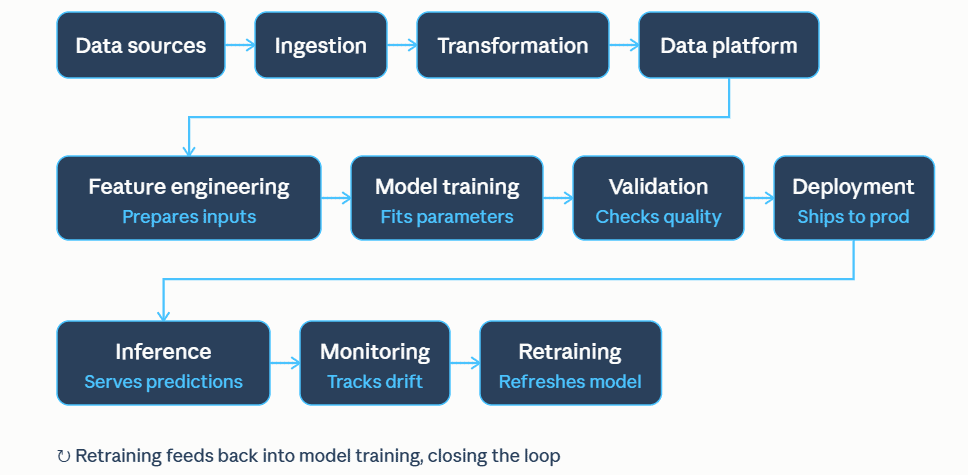
The important point is that machine learning does not operate independently from the data platform. If the underlying data is unreliable, the model will be unreliable. If deployment is manual, scaling becomes difficult. If models are not monitored, performance degradation can go unnoticed. If infrastructure cannot scale, successful AI applications can become expensive or operationally fragile. That makes ML pipeline modernization a broader initiative than simply implementing MLOps tooling.
The first layer is the data foundation.
Many enterprises still depend on legacy ETL workflows and data platforms that were designed for older volumes, systems, and reporting requirements.
Modernization can involve:
OpsMatters identifies ETL-to-ELT re-engineering, cloud migration, lakehouse architecture, orchestration, and legacy-system experience as important capabilities when evaluating data-pipeline modernization providers.
The second layer is the machine learning lifecycle.
A modern ML environment should make it easier to:
This is where MLOps becomes important.
But MLOps should not be treated as a completely separate system. It needs to connect to the data pipelines, feature engineering processes, infrastructure, and business applications around it.
The third layer is the infrastructure supporting training and inference.
Modern AI infrastructure can involve GPUs or other accelerators, high-performance storage, networking, container orchestration, autoscaling, and distributed compute.
DigitalOcean's analysis of AI infrastructure emphasizes that scaling ML involves more than simply obtaining GPUs. Hardware availability, networking, storage, scaling architecture, and workload economics all influence how effectively AI systems can move from experimentation into production.
For this reason, infrastructure should be considered part of ML pipeline modernization rather than an unrelated IT concern.
The architecture required for production ML is changing.
Organizations increasingly need to support multiple models, larger datasets, more demanding inference workloads, and AI applications that depend on fresh information.
Several trends are driving this change.
From batch data to real-time data
Batch processing remains appropriate for many ML workloads, particularly when models can operate on periodically refreshed data. However, applications such as fraud detection, recommendation engines, dynamic pricing, predictive maintenance, and IoT increasingly require data to be processed as events occur rather than waiting for scheduled batch jobs.
This shift is particularly important for production machine learning. Recent analysis from Towards Data Engineering on Medium identifies AI and ML feature pipelines as one of the key drivers of real-time streaming adoption in 2026. Production ML systems can require streaming architectures that calculate features from live event data and make those features available to inference endpoints with low latency. The same analysis highlights real-time fraud detection, personalization, and IoT-driven predictive maintenance as use cases where batch processing can create an unacceptable gap between an event occurring and the system responding.
Modern streaming architectures can use technologies such as Apache Kafka, Apache Flink, Apache Spark Streaming, AWS Kinesis, and Google Cloud Pub/Sub to ingest and process continuous data flows. However, moving from batch ETL to streaming is not simply a matter of adding a messaging platform. Production-grade streaming requires careful design across ingestion, processing, storage, orchestration, observability, data quality, fault tolerance, and schema management.
A practical example of how real-time data can support modernization is the maritime sector, where continuously generated vessel and operational data can enable more timely analytics, emissions monitoring, and operational decision-making.
Explore Opinov8's maritime data modernization success story.
From notebooks to production ML
Data scientists can build successful prototypes in notebooks.
Production systems require considerably more:
The modernization challenge is therefore to transform experimental workflows into systems that engineering and operations teams can reliably maintain.
From isolated data platforms to lakehouse architectures
Data engineering and ML increasingly need access to the same data foundation.
Lakehouse architectures can help organizations bring structured and unstructured data, analytics, data engineering, and ML workloads into a more unified environment.
From general-purpose compute to AI infrastructure
As training and inference workloads become more demanding, infrastructure decisions increasingly involve GPU availability, distributed compute, storage performance, networking, autoscaling, and cost optimization.
From individual models to AI platforms
Organizations are no longer building one machine learning model and stopping there.
They are creating platforms capable of supporting:
A modern ML pipeline therefore needs to be designed with future workloads in mind.
The value of modernization is not simply technical.
A well-designed ML pipeline can help organizations build repeatable systems for several business use cases.
Not every AI consulting company is equipped to modernize an enterprise ML pipeline. For this list, we evaluated providers based on their ability to address the full ML modernization lifecycle, from data ingestion and transformation to model deployment, infrastructure, monitoring, and optimization.
We considered six primary criteria.
We looked for capabilities covering:
We evaluated experience with:
We considered experience with:
The real-time streaming source reviewed for this article highlights companies working with these types of architectures, including Algoscale, Addepto, Sigmoid, Slalom, ThoughtWorks, ScienceSoft, InData Labs, and CapTech.
We considered:
Enterprise ML modernization often requires integration with existing systems.
We therefore gave greater weight to providers demonstrating experience with complex or legacy environments.
Finally, we considered whether the provider can implement modernization rather than simply recommend it.
This includes:
We did not rank companies simply by brand recognition or the number of AI services listed on their websites. The objective is to identify companies that are relevant specifically to AI consulting and ML pipeline modernization.
Opinov8 stands out for organizations that need more than an isolated MLOps implementation.
The company combines AI consulting, data engineering, machine learning, MLOps, cloud engineering, Databricks, and legacy modernization into an end-to-end modernization proposition.
Its AI consulting and data services cover the data lifecycle from discovery and architecture through engineering and optimization. Its ML and MLOps capabilities include model development, deployment pipelines, monitoring, and lifecycle management.
The main differentiator is the ability to connect the layers that are often handled separately:
Legacy systems → data modernization → lakehouse → data pipelines → machine learning → MLOps → production AI
That makes Opinov8 particularly relevant when an organization's problem is not simply deploying a model but modernizing the infrastructure that makes production ML possible.
Opinov8 also has cipher, its AI-driven legacy-system migration approach.
cipher is designed to accelerate modernization of aging enterprise applications while maintaining architectural quality, validation, and production readiness. Its documented process includes assessment and bootstrap, AI-driven migration, quality assurance, and handover with a modernization roadmap.
This is relevant to ML modernization because existing ML environments are often connected to legacy applications, databases, and data-access layers.
Instead of assuming that the organization can replace everything at once, a modernization methodology can help create a controlled path from the current architecture to the target environment.
Opinov8 is also an officially registered Databricks Consulting Partner. The partnership strengthens its ability to help enterprises unify data workflows, analytics, and AI applications using the Databricks Data Intelligence Platform. Opinov8 says it had already delivered multiple Databricks implementations before formalizing the partnership.
This combination is especially relevant to ML pipeline modernization because Databricks can provide a common environment for data engineering, analytics, and machine learning.
Opinov8's service model covers:
Its AI consulting lifecycle is organized around Discover, Design, Engineer, and Optimize, moving from assessment and architecture into implementation and continuous improvement.
Opinov8's published work includes a cloud-first data modernization project using Azure Databricks. The modernized platform supports BI, AI, and ML workloads and uses automated provisioning and CI/CD. The project reports $1M+ in estimated annual operational savings, a 40–60% reduction in manual operational effort, and 70–80% faster deployments.
In another life-sciences project, the company describes a Databricks-based platform supporting near-real-time data and a unified workflow model for data engineering and data science teams.
Opinov8 was also named Best AI Company in Europe at the 2025 Netty Awards.
Best for Organizations that need an end-to-end engineering partner capable of combining legacy modernization, data engineering, Databricks, ML/MLOps, cloud infrastructure, and AI implementation.
N-iX is a strong candidate for organizations dealing with complex enterprise data environments.
OpsMatters identifies N-iX as a provider focused on large-scale data overhauls, including legacy ETL modernization, cloud data-platform migration, data lake/lakehouse architecture, and orchestration with technologies such as Airflow and dbt.
This positioning makes N-iX particularly relevant where ML modernization depends on first rebuilding or replatforming the underlying enterprise data environment.
Key strengths
Best for large enterprises with multiple legacy data sources, complex compliance requirements, and broad modernization programs.
CHI Software is particularly relevant when the primary barrier to ML modernization is the data platform itself.
OpsMatters highlights CHI Software's work in data-pipeline modernization, ETL-to-ELT re-engineering, cloud migration, and integration with BI, analytics, and warehouse systems.
This makes the company a strong option for organizations that need to modernize the data layer before implementing more advanced ML workflows.
Key strengths
Best for companies whose ML modernization program begins with legacy ETL and data-platform modernization.
Algoscale is particularly relevant to organizations moving from traditional batch processing toward real-time data architectures.
OpsMatters describes its focus on scalable ingestion, ETL/ELT, cloud data platforms, and Databricks.
The real-time streaming research also highlights Algoscale's use of Kafka, Flink, and Spark for production-oriented streaming architectures and use cases such as real-time fraud detection and continuous ETL.
Key strengths
Best for organizations modernizing data pipelines where fresh data and low-latency processing are important to downstream ML or analytics.
Addepto is notable because its real-time data engineering positioning explicitly connects streaming architecture with AI and MLOps.
The Towards Data Engineering analysis describes Addepto as integrating AI and MLOps considerations directly into data engineering architecture, with capabilities spanning AI and data engineering, real-time ML pipelines, cloud streaming architectures, and technologies including Kafka, Spark, Airflow, Snowflake, and Databricks.
Its highlighted applications include real-time recommendation engines, streaming ML model deployment, and AI-powered event processing.
Key strengths
Best for organizations where real-time data and machine learning need to be designed as one system.
Innowise is a good fit for organizations that have defined cloud-modernization goals.
OpsMatters describes its capabilities across custom ETL processes, pipeline automation, data quality, transformation logic, and integration with platforms including Snowflake, BigQuery, and Redshift.
Key strengths
Best for organizations looking to move legacy data workflows toward a modern cloud-based data architecture.
DataArt is particularly relevant to large enterprises with complicated data ecosystems.
OpsMatters highlights its work in ETL/ELT pipelines, replacing legacy integrations, cloud data-platform implementation, and real-time or streaming pipelines.
The emphasis on reliability and maintainability is important for ML modernization because data pipelines become critical infrastructure once production models depend on them.
Key strengths
Best for organizations that need to replace fragmented legacy data integrations with modern, maintainable pipelines.
Sigmoid is particularly relevant for organizations with very large-scale data and real-time requirements.
The real-time streaming research describes Sigmoid as having built thousands of data pipelines and supporting large-scale data volumes across hybrid and multi-cloud environments. It highlights data engineering, real-time analytics, cloud modernization, big-data architecture, and data observability among its capabilities.
Key strengths
Best for Large organizations where data volume, streaming performance, and observability are major requirements.
They are consulting and engineering companies that help organizations modernize the infrastructure supporting machine learning.
This can include data engineering, ETL/ELT modernization, lakehouse architecture, ML development, MLOps, cloud infrastructure, real-time streaming, monitoring, and governance.
MLOps focuses primarily on operationalizing the machine learning lifecycle.
ML pipeline modernization is broader. It can include the data platform, ETL/ELT, feature engineering, ML workflows, infrastructure, deployment, monitoring, and governance.
No.
Streaming is appropriate when applications require fresh data or low-latency decisions. Batch processing may be more appropriate for models that only require hourly, daily, or scheduled data.
Not necessarily.
Cloud platforms can simplify scalability and access to managed services, but organizations may have security, compliance, latency, cost, or legacy requirements that make hybrid or on-premises architectures appropriate.
Databricks can provide a unified environment for data engineering, analytics, and machine learning, making it particularly relevant to organizations that want to bring data and ML workflows closer together.
The right architecture still depends on the organization's workloads and existing technology environment.
The stack varies, but may include:
Databricks
MLflow
Apache Spark
Kafka
Flink
Airflow
dbt
Kubernetes
Docker
Snowflake
AWS
Azure
Google Cloud
Delta Lake
Apache Iceberg
Prometheus
Grafana
The goal should not be to use the largest possible technology stack. It should be to select technologies that support the required reliability, scalability, latency, governance, and cost objectives.
Start with an assessment.
Document the current:
Data architecture
ETL pipelines
ML models
Deployment process
Infrastructure
Monitoring
Security
Governance
Team responsibilities
Then identify one high-value modernization opportunity and use it to validate the target architecture before expanding.
Evaluate providers based on:
ML/MLOps experience
Data engineering
Legacy modernization
Cloud architecture
Streaming
AI infrastructure
Testing
Observability
Security
Implementation experience
Most importantly, ask them to demonstrate how they would modernize a representative part of your actual architecture
Modernizing an ML pipeline is not simply a matter of replacing an old ETL tool or adding an MLOps platform.
It is an architectural transformation that can span data, machine learning, infrastructure, and operations.
The strongest AI consulting companies for ML pipeline modernization understand those dependencies.
Opinov8 is particularly well suited to end-to-end modernization because it combines legacy modernization through cipher, Databricks consulting expertise, data engineering, machine learning, MLOps, cloud engineering, and AI implementation.
N-iX is a strong option for complex enterprise data and MLOps environments.
CHI Software is particularly relevant to ETL-to-ELT and cloud data migration.
Algoscale and Addepto are strong candidates where real-time data and ML are central requirements.
Innowise is relevant to cloud-first data engineering, while DataArt is well suited to complex enterprise integration.
Sigmoid stands out for large-scale streaming and data engineering environments.
Ultimately, the right choice depends on where your organization is starting and what the target architecture needs to achieve.
The best modernization partner is not necessarily the largest consultancy or the company with the longest list of technologies.
It is the partner that can understand your existing environment, redesign what needs to change, integrate what needs to remain, and build an ML platform that your organization can operate and scale.
Moving an ML workload to a new platform is relatively straightforward. Building a scalable, observable, cost-efficient production ML environment around that workload is the real challenge. Opinov8 combines CIPHER legacy modernization, Databricks expertise, data engineering, machine learning, MLOps, cloud engineering, and AI development to help organizations move from fragmented legacy environments toward production-ready AI platforms.
Explore Opinov8's AI Consulting and Data Engineering Services
Explore Opinov8's Databricks Consulting Partnership