
AI Transformation Consulting: How to Build an AI-Shaped Organization in 2027
AI, AI Development, AI Native
Read more

Quick answer: The best legacy modernization companies for enterprises include Opinov8 (AI-assisted application modernization), IBM Consulting (mainframe and hybrid-cloud modernization), Accenture (enterprise-wide transformation), Thoughtworks (engineering-led modernization), EPAM (complex software engineering), Cognizant (IT transformation), Endava (digital-platform modernization), and GFT (financial-services modernization). The right choice depends on your existing technology estate, risk tolerance, and modernization goals, not on which vendor has the longest capability list.
Enterprise legacy modernization is no longer simply an IT upgrade. For organizations running decades-old applications, modernization determines how quickly they can adopt AI, scale digital products, improve security, integrate new data sources, and respond to changing business requirements.
But choosing a modernization partner isn't straightforward. A provider may excel at cloud migration but lack experience with complex legacy applications. Another may specialize in mainframes, while a third focuses on AI-assisted application modernization. The right choice depends on the condition of your existing technology estate, your modernization objectives, your risk tolerance, and your long-term transformation strategy.
This guide compares the leading enterprise legacy modernization companies and explains what enterprise technology leaders should evaluate before selecting a partner.
Key takeaways
Modernizing an enterprise system is fundamentally different from replacing a small application. Large organizations typically deal with:
Successful modernization therefore requires more than migrating code to a newer stack. A capable partner should be able to understand the existing environment, determine what should change, reduce technical debt, manage migration risk, and establish an architecture that supports future development.
| Company | Best fit | Key strength | Speed | Cost reduction |
|---|---|---|---|---|
| Opinov8 | AI-assisted application modernization | AI-native engineering and legacy application migration | As fast as 3 weeks for a full application migration (400+ screens), using Cipher's AI-augmented methodology | Up to ~90% vs. traditional approaches, with cited engagements saving $300K–$500K |
| IBM Consulting | Mainframe and large enterprise modernization | Hybrid cloud and complex enterprise estates | Not publicly disclosed; varies by portfolio scope | Not publicly disclosed |
| Accenture | Enterprise-wide transformation | Large-scale digital and application transformation | Not publicly disclosed; varies by program scope | Not publicly disclosed |
| Thoughtworks | Engineering-led modernization | Architecture, incremental modernization and product engineering | Not publicly disclosed; incremental by design | Not publicly disclosed |
| EPAM | Complex software engineering | Application, cloud and data modernization | Not publicly disclosed | Not publicly disclosed |
| Cognizant | Enterprise IT transformation | Application modernization combined with cloud and managed services | Not publicly disclosed | Not publicly disclosed |
| Endava | Digital-platform modernization | Agile engineering and digital transformation | Not publicly disclosed | Not publicly disclosed |
| GFT | Financial services | Modernization of regulated financial systems | Not publicly disclosed | Not publicly disclosed |
Speed and cost figures are vendor-published estimates that depend on application size, complexity, and engagement scope; treat them as directional rather than guaranteed outcomes, and confirm current numbers with each vendor before comparing bids.
The "best" provider depends on your starting architecture and transformation objectives. Use the criteria below to determine which company is the strongest fit for your organization.
Best for: Enterprises modernizing aging applications using AI-assisted engineering while controlling migration risk.
Opinov8 combines software engineering, cloud, data, and AI capabilities to treat legacy modernization as an engineering transformation rather than a simple lift-and-shift migration.
Its Cipher methodology is purpose-built for legacy application modernization, using AI-assisted engineering to analyze and transform existing applications while maintaining architectural standards, testing rigor, and production readiness. The methodology covers four stages:
According to Opinov8, its Cipher approach has been used to migrate more than 400 screens, with one engagement completed in three weeks and estimated savings of $300K–$500K, depending on the program.
The approach is particularly relevant for enterprises with large, CRUD-heavy applications, where significant portions of the migration involve repetitive patterns that AI can accelerate. Opinov8 also supports incremental modernization — organizations can modernize application layers while keeping existing systems and data structures where appropriate, rather than replacing the entire legacy system at once.
Why consider Opinov8: The core differentiator is combining legacy modernization, AI-native engineering, cloud, data, and software development in one approach — a foundation for subsequent AI and digital transformation initiatives.
Best fit: Organizations with aging custom applications that want to accelerate modernization while maintaining control over business continuity, testing, and architectural quality.
Best for: Large organizations with mainframes, hybrid-cloud environments, and complex application portfolios.
IBM has deep experience modernizing enterprise systems across application, infrastructure, and mainframe environments. Its approach spans rehosting, replatforming, refactoring, rearchitecting, rebuilding, and replacement — allowing different strategies across a portfolio rather than forcing every workload through the same path. IBM also applies AI to code analysis, dependency mapping, refactoring, and technical-debt identification.
IBM is particularly relevant for mainframe applications, hybrid cloud, large portfolios, complex integrations, regulated environments, and portfolio rationalization.
Best fit: Large enterprises with highly complex technology estates and mission-critical workloads.
Best for: Organizations connecting legacy modernization with broader digital transformation.
Accenture treats application modernization as part of a wider transformation strategy, spanning portfolio discovery, modernization strategy, architecture, cloud transformation, application rationalization, and implementation. This broader lens matters because legacy applications are often tied to organizational processes, data platforms, and customer experiences beyond the application itself.
Best fit: Global enterprises undertaking broad technology and business transformation programs.
Best for: Organizations prioritizing software architecture, incremental modernization, and engineering transformation.
Thoughtworks takes an engineering-first approach, assessing which parts of a legacy environment should be retained, transformed, or replaced rather than defaulting to a full rewrite. This helps enterprises avoid the risks of large-scale rewrites when incremental modernization offers a better path. Thoughtworks is also exploring AI-accelerated approaches to transforming existing applications into modern architectures.
Best fit: Enterprises where modernization is closely tied to architecture, engineering, and product development.
Best for: Enterprises requiring significant engineering capacity alongside modernization.
EPAM's strength shows up when modernization involves more than changing the hosting environment — spanning application architecture, cloud infrastructure, APIs, data platforms, microservices, DevOps, UX, and security simultaneously. This depth matters because legacy applications rarely exist independently from the rest of the enterprise technology environment.
Best fit: Enterprises with complex applications, integrations, and substantial engineering requirements.
Best for: Enterprises combining application modernization with cloud, data, and IT operations.
Cognizant pairs modernization capabilities with broader IT transformation and managed services — useful for organizations that want support beyond the initial migration, such as cloud operations, data modernization, infrastructure management, and ongoing optimization after go-live.
Best fit: Large organizations seeking modernization combined with broader IT transformation and operations.
Best for: Organizations modernizing applications as part of broader digital product transformation.
Endava is relevant when modernization is closely tied to digital platforms, cloud adoption, and software engineering — particularly for enterprises whose goal is a flexible platform for continuous product development, not just replacing old technology.
Best fit: Enterprises combining application modernization with digital product and platform transformation.
Best for: Banks, insurers, and financial institutions modernizing mission-critical technology.
Financial services organizations face a distinct challenge: legacy platforms often contain decades of business rules and integrations while being subject to strict regulatory, security, and availability requirements. GFT's financial-services specialization makes it relevant for modernizing banking, insurance, payments, and other regulated systems.
Best fit: Financial institutions where industry expertise and mission-critical modernization are essential.
Comparing vendor names is useful, but the more important decision is whether a provider's modernization approach actually matches your environment. Ask these seven questions.
Before proposing a target architecture, a partner should understand the existing system through source-code analysis, dependency mapping, architecture assessment, database analysis, API/integration discovery, infrastructure and security assessment, technical-debt analysis, and business-rule discovery. A roadmap built without this understanding creates significant downstream risk.
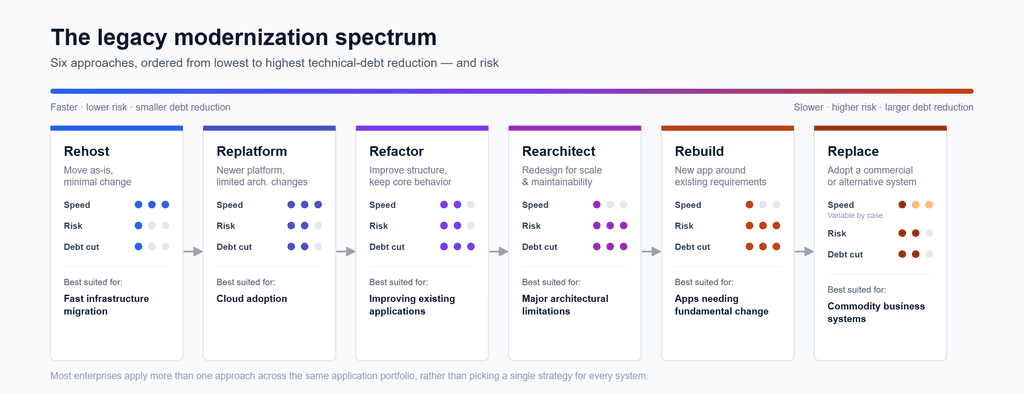
A full rewrite isn't always the right answer. Depending on the application, organizations may choose:
The right strategy depends on business value, technical debt, dependencies, risk, and future requirements. A strong partner should recommend different approaches for different applications rather than a one-size-fits-all method.
RaftLabs' own buyer's guide frames this as the single most important decision in the whole engagement, arguing that a vendor recommending a full rewrite before reviewing your code is optimizing for project size rather than for the lowest-risk path to your outcome.
This may be the most important question in the evaluation, since moving an old application to the cloud doesn't automatically make it modern. Ask what debt will be removed, what will remain, how dependencies are identified, how obsolete code is handled, how architecture improves, and how debt is measured after modernization. The goal should be a measurable reduction in complexity — not just a change in hosting environment.
For mission-critical systems, incremental modernization significantly reduces risk. A partner should be able to explain how it handles parallel systems, incremental releases, APIs, automated regression testing, data synchronization, rollback, production validation, and business continuity. The Strangler Fig pattern, for example, lets organizations gradually replace functionality instead of switching an entire application at once — an approach Varseno's modernization guide also highlights as a way of keeping legacy systems live while new components take over incrementally.
| Activity | How AI can help |
|---|---|
| Code analysis | Identify patterns, dependencies, and potential technical debt |
| Documentation | Generate documentation from existing code |
| Code transformation | Convert repetitive legacy patterns |
| Testing | Generate and expand test cases |
| Business-rule discovery | Analyze code and application behavior |
| Migration | Accelerate repetitive transformation tasks |
| Developer productivity | Assist engineers during modernization |
| Quality analysis | Identify potential issues for human review |
Be wary of vendors treating AI as a marketing label. Ask directly: which modernization tasks are actually automated, and which still require engineers? For mission-critical systems, AI-generated changes should always be paired with automated testing, deterministic validation, and human engineering review.
The application is only one part of the architecture. Modernization may also need to address databases, APIs, data warehouses, identity management, ERP/CRM integrations, batch processing, third-party services, cloud infrastructure, CI/CD pipelines, and monitoring/observability. A provider that only understands the application layer can't address the full challenge.
A modernization project needs measurable outcomes: reduced technical debt, lower maintenance costs, faster release cycles, improved application performance, fewer production incidents, stronger security, reduced infrastructure costs, improved developer productivity, faster feature delivery, and increased scalability. The best programs connect these technical metrics to business outcomes.
There's no universal modernization strategy — enterprises often use multiple approaches across the same application portfolio. A customer-facing application might be rearchitected, a stable internal system replatformed, and a low-value application retired. This is why application portfolio assessment is an essential first step.
| Approach | Speed | Risk | Technical debt reduction | Best suited for |
|---|---|---|---|---|
| Rehost | High | Lower | Low | Fast infrastructure migration |
| Replatform | High | Medium | Low–Medium | Cloud adoption |
| Refactor | Medium | Medium | High | Improving existing applications |
| Rearchitect | Lower | Medium–High | Very high | Major architectural limitations |
| Rebuild | Low | High | Very high | Applications requiring fundamental change |
| Replace | Variable | Medium–High | High | Commodity business systems |
AI is changing the economics of legacy modernization. Historically, modernization required engineers to manually inspect large codebases, document dependencies, translate repetitive code patterns, and build extensive test coverage. AI-assisted engineering can accelerate much of this — especially for applications with large codebases, repetitive CRUD functionality, standardized coding patterns, large numbers of screens, repetitive business logic, and established test patterns.
However, AI doesn't eliminate the need for experienced engineers. Enterprise modernization still requires decisions about architecture, business rules, security, integration, data, testing, and production operations. The emerging model isn't AI instead of engineers, it's:
AI-assisted engineering + human architectural judgment + automated validation.
Enterprise legacy modernization shouldn't start with "Which company is the best?" It should start with "What problem are we trying to solve?"
The most effective modernization programs balance three objectives: reduce technical debt, reduce modernization risk, and create an architecture that supports what's next. The right partner isn't the company with the longest capability list: it's the one that can show a credible, measurable path from today's legacy environment to tomorrow's architecture.
It's also worth shortlisting beyond a single ranking. Master of Code Global's evaluation of legacy modernization firms, for instance, weighs engineering depth and security certifications and surfaces additional regionally or vertically specialized providers worth a look depending on your industry and delivery-location preferences.
What is enterprise legacy modernization? Enterprise legacy modernization is the process of transforming aging applications, systems, infrastructure, data, and integrations so they can better support current and future business requirements.
What's the difference between legacy system modernization and legacy software migration? Migration generally means moving an existing application or workload to another environment. Modernization has a broader goal: reducing technical debt and improving architecture, maintainability, scalability, security, and adaptability.
Is rewriting a legacy application always the best option? No. Rehosting, replatforming, refactoring, and rearchitecting can all be better choices depending on the application's business value, technical debt, dependencies, and modernization goals.
How can AI help with legacy modernization? AI can assist with code analysis, documentation, code transformation, dependency analysis, and test generation. Enterprise applications still require engineering review, automated testing, and production validation alongside AI-assisted work.
How long does enterprise legacy modernization take? There's no standard timeline. A focused application modernization project may take weeks to months, while modernization across a large enterprise portfolio can take years, depending on scope, dependencies, architecture, and strategy.
What should enterprises ask a modernization company? Ask how the provider assesses your existing architecture, identifies technical debt, selects a modernization strategy, handles dependencies and data, protects business continuity, uses AI, validates functional parity, and measures outcomes.