

AI Transformation Consulting: How to Build an AI-Shaped Organization in 2027
AI, AI Development, AI Native
Read more

Artificial intelligence can sometimes feel like a technology reserved for data scientists, engineers, and people who speak in acronyms: AI. ML. LLMs. RAG. Cloud. Agents. MLOps. But behind all these terms is a surprisingly simple story. The AI journey starts long before you deploy an AI model.
In short: most organizations move through six stages on the way to useful AI:
1. Data
2. Cloud infrastructure
3. AI models
4. AI-powered applications
5. AI agents
6. agentic business.
Skipping the early stages (especially clean, governed data) is the most common reason AI pilots fail to scale.
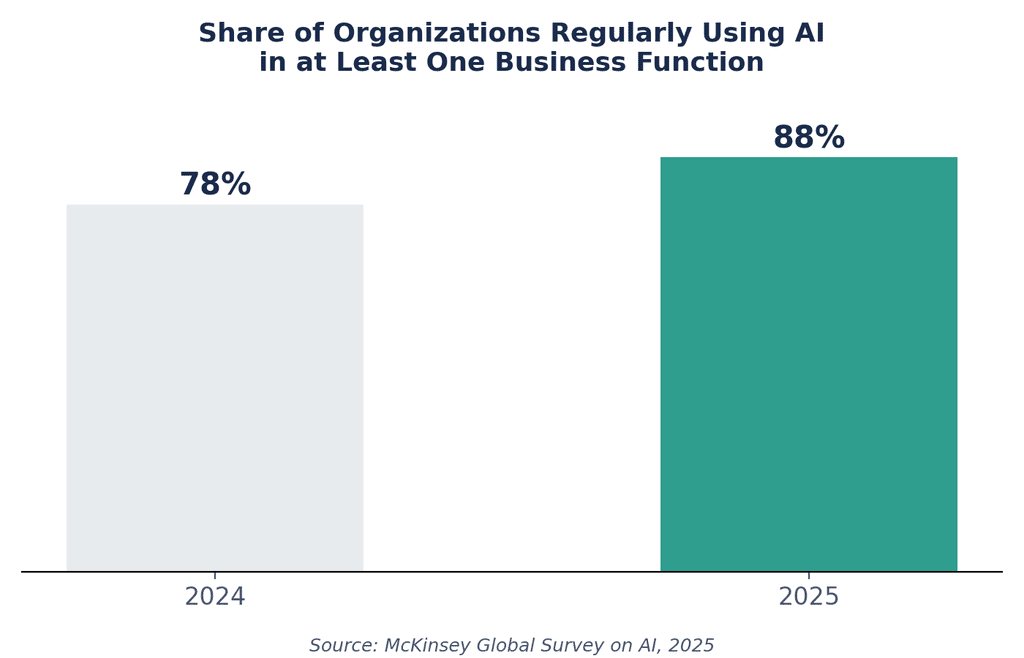
Adoption is already mainstream, but scaled deployment is not. Stanford's 2026 AI Index found that 88% of surveyed organizations used AI in 2025, with generative AI reaching 53% adoption within three years of ChatGPT's launch. Scaled deployment of AI agents, however, remains an early-stage practice at most companies.
Before AI can be useful, it needs something to learn from, retrieve, or act on. That "something" is data, and most enterprise data falls into two categories.
Structured data is information that fits a predefined schema of rows and columns: customer IDs, sales transactions, prices, inventory, financial figures, dates. It lives in relational databases, spreadsheets, and business applications, and its defined structure makes it straightforward to query and analyze.
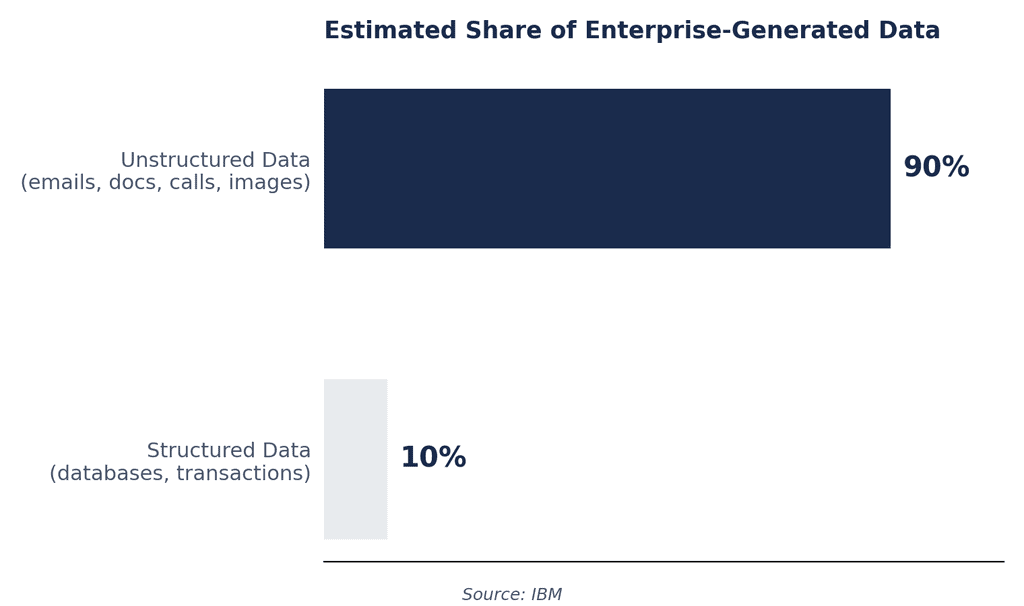
Unstructured data is everything that doesn't fit a table: emails, PDFs, customer reviews, call transcripts, images, audio, video, chat messages, social posts. It's harder for traditional systems to process, but it carries most of an organization's actual business context, which is why it's central to generative AI techniques like Retrieval-Augmented Generation (RAG). IBM estimates unstructured data accounts for roughly 90% of enterprise-generated data.
Once data is under control, the next question is where the computing actually happens.
Cloud platforms let organizations provision compute, storage, and specialized hardware at scale without building that infrastructure themselves. For AI specifically, cloud environments typically provide: scalable compute, data storage and warehousing, ML platforms, model-hosting APIs, monitoring, security controls, and deployment infrastructure.
Moving to the cloud does not automatically make an organization AI-ready. AI adds cost and complexity on top of standard cloud migration: model costs, data movement, compute planning, security, and compliance all need to be designed in from the start, not bolted on afterward.
With data and infrastructure in place, organizations can put AI to work. Early use cases tend to be narrow and well-defined: predicting customer behavior, detecting fraud, classifying documents, forecasting demand, summarizing information, and powering internal search.
Generative AI and large language models expanded this significantly by letting people interact with systems in natural language rather than menus: turning a request like "summarize last quarter's sales and flag where we missed targets" into something a system can interpret, retrieve, analyze, and answer directly.
Using AI is not the same as scaling AI. McKinsey's 2025 global survey found 88% of organizations regularly used AI in at least one business function (up from 78% the prior year), but only about one-third had begun scaling AI enterprise-wide.
The next shift is from "how can AI help someone do a task" to "how can AI become part of the workflow itself."
A traditional AI assistant might report a customer's order status. An AI-powered workflow goes further: it identifies the customer, retrieves the order, checks delivery status, flags a delay, looks up the relevant policy, drafts a response, routes exceptions to a human for approval, and updates the system, all in one sequence. This is the bridge between generative AI and agentic AI.
An AI agent is a system that can take actions toward a goal, not just answer a question. The clearest way to see the difference is against a chatbot: a chatbot responds to you; an agent can plan, use tools, take action, check the results, and either continue or escalate to a human.
For example, given the instruction "find why European sales fell last month and prepare a report for leadership," an agent could pull approved sales data, compare periods, identify anomalies, break results down by market, generate a report with charts, and send it to the right people: while a standard AI assistant would only offer suggestions.
The level of autonomy should match the stakes of the task: routine actions can run automatically, while higher-risk decisions should route to human approval.
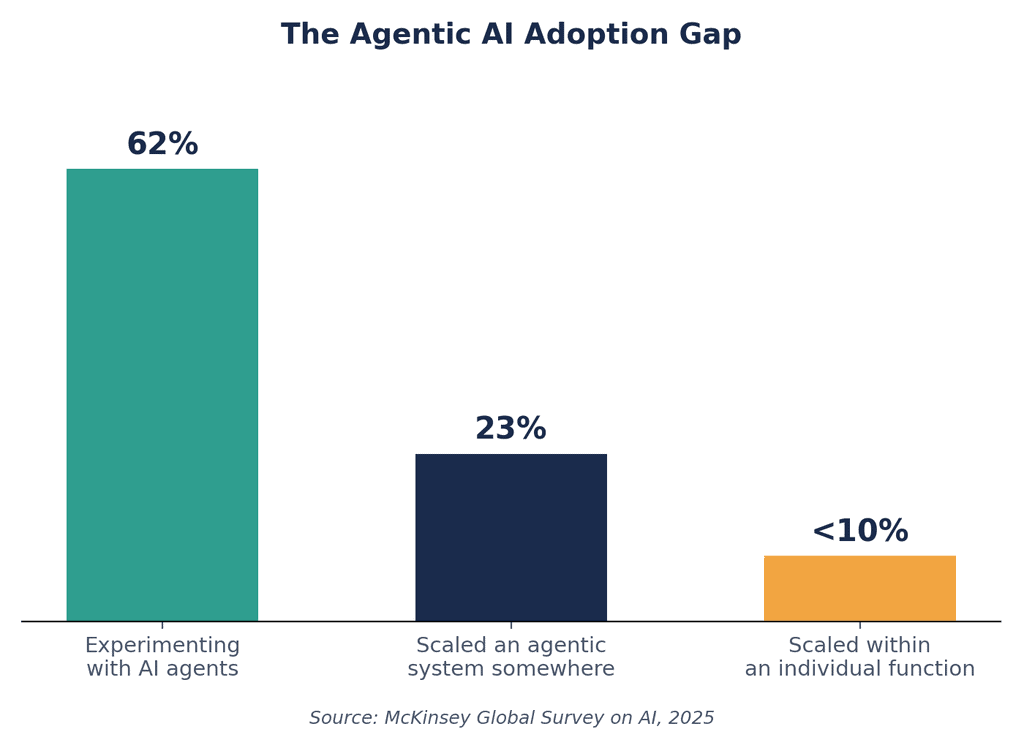
Interest in agentic AI is high, but production deployment is still early. McKinsey found 62% of organizations are at least experimenting with AI agents, but only 23% have scaled an agentic system anywhere in the enterprise, and scaled deployment within individual business functions generally sits below 10%.
Why the gap? An agent needs more than a capable model, it needs reliable data, secure tools, dependable infrastructure, defined business rules, monitoring, governance, and human oversight. This is why agent performance ultimately depends on the foundation built in Stages 1–2.
| Layer | What It Includes |
|---|---|
| 1. Data | Structured data (transactions, records) and unstructured data (documents, emails, images, conversations) |
| 2. Cloud & Infrastructure | Compute, storage, networking, security, and platforms that make AI possible at scale |
| 3. AI Models | Machine learning models, foundation models, and large language models |
| 4. AI Applications | Products and tools that put models to work for employees or customers |
| 5. AI Agents | Systems that reason through tasks, use tools, and execute multi-step workflows within defined boundaries |
| 6. Agentic Business | Work redesigned around intelligent, automated, human-supervised processes |
The goal at the top of the stack isn't "more agents": it's better business outcomes, with agents as one means to that end.
Enterprise AI's hardest problem usually isn't building a model: it's connecting that model to real enterprise systems, data, cloud infrastructure, security, and process. This is where implementation partners operate.
Opinov8 covers the full stack described above: from data all the way up to agentic business. Its capabilities span: AI readiness assessment, data modernization, Databricks platform services, AI/ML engineering, cloud migration and multi-cloud strategy, DevOps and platform engineering, cloud security, and AI-agent deployment.
Its RAILS AI Agent Deployment Platform follows a five-stage methodology
Capture
Govern
Build
Deploy
Operate
That assesses existing systems and data, introduces governance and access controls, runs co-testing and validation, deploys to production with human monitoring, and tracks ROI on an ongoing basis. The underlying principle applies regardless of vendor: agent deployment is an operational discipline, not just a model-development exercise.
The biggest shift organizations face is often organizational, not technical. It typically progresses like this:
That last question moves AI from an IT experiment into the operating model of the business — and it's the stage where most organizations currently get stuck, not for lack of technology, but because of process, skills, governance, and data maturity.
1. Is your data ready? Can you trust it, access it, and govern it, across both structured and unstructured sources?
2. Is your cloud foundation ready? Can it scale, and does it have security, observability, and cost controls in place?
3. Are you solving real business problems? Start from "which problems are expensive, repetitive, slow, or difficult" rather than "where can we use AI."
4. Are you ready for agents? What can a system do autonomously, and where does a human need to approve the action?
5. How will you measure value? Tie deployment to measurable outcomes — revenue, cost, productivity, customer satisfaction, speed, quality, or risk reduction. Technology adoption without measurable value is an expensive experiment.
What is the AI journey for businesses? It's the typical progression organizations follow when adopting AI: organizing data, building cloud infrastructure, deploying AI models, embedding AI into applications and workflows, introducing AI agents, and eventually redesigning business processes around those agents.
What's the difference between structured and unstructured data? Structured data fits a predefined schema (rows and columns) like transactions or customer records. Unstructured data doesn't: it includes emails, documents, images, audio, and conversations, and makes up an estimated 90% of enterprise data.
What is an AI agent, in simple terms? An AI agent is a system that can plan and take actions toward a goal (using tools, executing multi-step tasks, and escalating to a human when needed) rather than simply answering a question like a chatbot.
Why do most companies struggle to scale AI agents? Because agents depend on strong foundations: governed data, secure infrastructure, defined business rules, and monitoring. Without those, agents can be prototyped but not reliably run in production. McKinsey found only 23% of organizations had scaled an agentic system anywhere in their enterprise as of 2025.
What should a company do first to prepare for AI? Start with data readiness (trustworthy, accessible, governed data across both structured and unstructured sources) before investing further in models or agents.