To select a Databricks partner, send every shortlisted firm the same project brief, then compare the named delivery team, comparable production work, governance approach, written scope and handover plan. Treat the partner tier as a starting signal, not a verdict. A structured evaluation typically takes three to five weeks.
The five things that matter most:
A bad implementation rarely hurts you in the day rate. It hurts months later, when a rushed catalog layout blocks a second business unit or an early partitioning choice forces a data migration. This guide gives you a repeatable way to avoid that, built for CTOs, heads of data and procurement teams.
A Databricks partner is a company enrolled in the Databricks Partner Program. For implementation work, the relevant category is Consulting and System Integrator (C&SI); Databricks also runs Connected, Data and Built-On programs that serve different purposes and do not prove delivery capability (Dateonic).
The ecosystem is large and growing fast. Infocepts reports the Brickbuilder Partner Network has grown past 8,000 partners . More choice means more marketing claims to verify.
Databricks replaced its former Registered, Select, Elite and Global Elite labels with four tiers. It also introduced specialization badges for firms and Delivery Expert badges for individual practitioners.
| Tier | What it signals (as described by Infocepts) |
|---|---|
| Bronze | Basic enrollment in the program |
| Silver | First earned tier; tied to real customer activity and certified staff |
| Gold | At least one Brickbuilder specialization plus customer success evidence |
| Platinum | Invite-only; strategic global partners with multiple specializations |
Tier criteria above are summarized from Infocepts; confirm current definitions on the official program page.
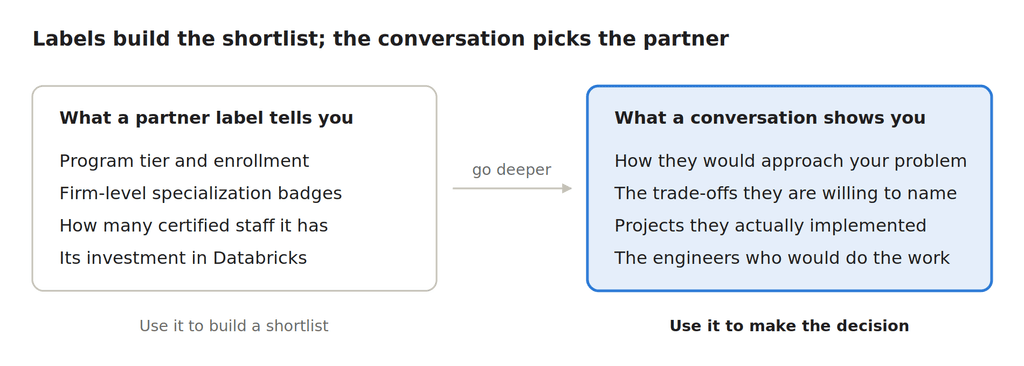
Tiers are a useful first filter, but expertise and implemented cases should drive the decision. The clearest signal is how a partner talks about your problem, so open an honest conversation early and treat it as part of the evaluation:
Infocepts gives the example of a Gold healthcare specialist with senior staff carrying less delivery risk than a Platinum generalist on a vertical-heavy workload. Verify any tier in the Databricks Partner Directory, then let the conversation and the evidence decide.
If you want to test this approach with a real partner, talk to Opinov8, a Databricks Consulting Partner that has delivered lakehouse platforms in fintech, maritime and life sciences.
Bring your project brief and your hardest questions. In a first conversation you can:
You likely need a partner when the work is high-stakes, one-time or outside your team's experience. Common triggers:
If your own engineers are building, the same checklist still applies. A Databricks Community contributor notes that most partner-selection questions are really design questions, so they work just as well pointed at an in-house team (Databricks Community).
Score every partner against the same ten criteria, using the same weights, decided before you read any proposal. The weights below blend the frameworks from Dateonic, Analytics AIML and Infocepts; adjust them to your project.
| # | Criterion | Weight | Strong evidence looks like |
|---|---|---|---|
| 1 | Named delivery team expertise | 20% | Named architect and engineers, current certifications, a live technical interview on your scenario |
| 2 | Comparable production experience | 15% | A project with similar cloud, data volume and constraints; what the partner delivered vs. the client |
| 3 | Production readiness and QA | 15% | Go-live checklist, CI/CD with Asset Bundles or Terraform, tested recovery paths |
| 4 | Governance and security (Unity Catalog) | 10% | A sanitized access design, service principals, a denied-access test, lineage and audit plan |
| 5 | Cost architecture and FinOps | 10% | Cluster policies, serverless vs. job compute choices, auto-termination, tagging for attribution |
| 6 | Scope and acceptance clarity | 10% | Deliverables, exclusions, dependencies and an acceptance owner per workstream |
| 7 | Handover and operational independence | 5% | Repos, runbooks, IaC, training and a handover drill your team passes |
| 8 | Delivery ownership and communication | 5% | Named escalation path, decision log, change control, time-zone overlap |
| 9 | Commercial transparency | 5% | Services separated from DBU and cloud costs; assumptions behind the estimate stated |
| 10 | References and verified credentials | 5% | Directory-verified tier, plus two or three reference calls with similar clients |
How to score: rate each criterion 0–5 (0 = no evidence, 3 = credible evidence, 5 = strong evidence verified by an extra check). Each contribution = weight × score ÷ 5, for a total out of 100. A 4 on the 20% team criterion adds 16 points (Dateonic).
Gate before you total. Some requirements are pass/fail, not points: required security controls, available delivery capacity, admin access to your own workspace, and ownership of code and repositories. A high score cannot make up for a failed gate.
Preference vs. disqualifier. Wanting a local team or a particular pricing model is a preference. No named delivery team, governance deferred to phase two, no handover artifacts, or no admin access to your own workspace are disqualifiers, however polished the demo (Databricks Community).
The best way to apply the checklist is to read a partner's case studies against it. Opinov8, a Databricks Consulting Partner with offices in the UK, Portugal, Ukraine and Egypt, publishes three Databricks projects that show the kind of detail worth asking every candidate for.
| Case study | Challenge | Databricks build | Reported results | Checklist criteria it speaks to |
|---|---|---|---|---|
| Azure Databricks data modernization for fintech | Legacy Delphi payment-risk system that couldn't scale, automate or support BI and ML | Delta Lake, Unity Catalog, Structured Streaming, medallion layers, multi-tenant SaaS; CI/CD with Terraform and Azure DevOps | $1M+ estimated annual savings; 40–60% less manual effort; 70–80% faster deployments; improved SOX and PCI DSS compliance | Governance from day one; deployment via infrastructure as code; cost and compliance |
| Maritime intelligence and fleet analytics | Disconnected systems after several acquisitions; slow fleet reporting | Delta Lake and Structured Streaming on Azure, unifying vessel telemetry | 50,000+ vessels connected; 7M+ sensor readings a day; 15% fuel savings; 30% better vessel performance metrics | Comparable scale and real-time difficulty; production readiness |
| Life sciences insights platform | Fragmented real-world evidence analytics in a regulated setting | Medallion lakehouse with PySpark, Delta Lake, Databricks Workflows and MLflow | 100+ pipelines automated; 50–60% faster time-to-insight; $1M–$2M estimated annual value | AI/ML capability beyond ETL; reusable orchestration; regulated-industry fit |
All figures are as reported by Opinov8.
Why these are useful examples. Each one names the starting problem, the specific Databricks components and the measured outcome, which is exactly what weak case studies leave out. The fintech project also answers the deploy-after-go-live question directly: provisioning and releases run through Terraform and CI/CD rather than manual changes.
How to verify them. Apply the same rules you would to any vendor. Ask Opinov8, or any partner, for the baseline and measurement period behind each figure, which named engineers worked on the project, and whether a reference call with that client is possible.
Good answers are specific, name trade-offs and point to evidence you can review. Vague confidence is a warning sign.
Team and experience
Architecture, governance and cost
Production and deployment
Scope and commercials
Handover and support
The Databricks Community contributor argues question 11, how changes are deployed after go-live, is the highest-leverage question on the list and the one most often skipped during selection (Databricks Community). Questions 1–4, 12–14 and 17–20 adapt the interview prompts in Dateonic's checklist.
Pause the selection if a partner shows any of these. Each one has a stronger alternative you should ask for instead.
| Red flag | Why it hurts | Ask for instead |
|---|---|---|
| Company-wide certification count, no named team | Tells you nothing about who builds your platform | Named roles, credentials and a technical interview |
| Governance "in phase two" | Retrofitting Unity Catalog after data lands is costly to unwind | Catalog, access and lineage design in the first sprint |
| POC pushed straight to production | No cluster policies or cost attribution; overruns surface on the first month-end bill | A written go-live checklist |
| "Full implementation included" | Hides exclusions such as test data, security config or deployment | Deliverables, exclusions and acceptance owners |
| Results quoted without a baseline | A faster query after changing code and compute proves little | Baseline, conditions and the partner's contribution |
| Advice and slide decks, no code | Your team inherits the gap between theory and production | Sanitized code samples and a working demo |
| Open-ended hourly retainer with vague scope | Estimates balloon with no definition of done | Milestone-based or fixed-scope statement of work |
| No admin access or repo ownership for you | Creates lock-in; every change needs the vendor | Your workspace admin rights and your repositories |
| Changes deployed by clicking in the UI | Nobody can safely change the platform six months later | Asset Bundles or Terraform in a repo you control |
| Refuses references or any substitute evidence | No way to test delivery claims | Reference calls or sanitized acceptance artifacts |
Compiled from Dateonic, Analytics AIML and the Databricks Community article.
The right engagement model depends on how well defined your scope is. Compare bids only after you reconcile what each one actually includes.
| Model | Best for | Watch out for |
|---|---|---|
| Fixed scope / fixed price | A clearly defined outcome with a known starting point | Needs a precise boundary; changes go through change requests |
| Time and materials | Uncertain scope or evolving requirements | Needs visibility into progress and remaining effort |
| Paid assessment or discovery | Poorly understood estate before a full build | Keep it bounded: one question, set outputs, fixed price and a decision point |
| Managed services / ongoing support | Post-launch operations and enhancements | Separate stabilization from ongoing support; define response vs. restoration targets |
Typical cost. Analytics AIML puts a foundational mid-market Databricks implementation at roughly $50,000 to $150,000 (Analytics AIML). Treat that as one firm's estimate; enterprise migrations can run far higher.
Compare like with like. Separate professional services fees from Databricks DBU and cloud consumption, your internal effort, and optional support. One bid may include deployment automation and validation while another assumes your team supplies them (Dateonic).
Price vs. total cost of ownership. The cheapest bid can cost the most if the partner lacks optimization skill, because DBU spend is largely set by architecture (Infocepts).
The full process takes about three to five weeks from kickoff to signed statement of work, depending on procurement (Infocepts).
After signing: spend weeks 1–4 on onboarding and Unity Catalog policies, months 2–6 on the first measurable outcome, and revisit fit as your platform grows (Infocepts).
What does a Databricks implementation partner do?
A Databricks implementation partner designs, builds and deploys your lakehouse: pipelines, Unity Catalog governance, security, CI/CD and, often, AI/ML workloads. A good one also documents the platform and trains your team to run it independently.
Is a Platinum or Gold Databricks partner always better?
No. Tiers reflect the firm's program investment, not the team assigned to you. A lower-tier specialist with deep experience in your industry and workload can carry less delivery risk than a higher-tier generalist.
How many Databricks partners should I shortlist?
Shortlist five to eight partners after a directory search, then narrow to two or three finalists after scoring and reference checks.
How long does it take to choose a Databricks partner?
A structured selection usually takes three to five weeks from writing the brief to signing a statement of work. Complex enterprise procurement can take longer.
How much does a Databricks implementation cost?
One mid-market-focused firm estimates a foundational implementation at $50,000 to $150,000. Large migrations cost more. Always separate partner fees from Databricks DBU and cloud consumption.
Should I meet the engineers before signing?
Yes. The engineers assigned to your project decide delivery quality. Confirm their names, credentials and production experience, and write them into the contract.
When should Unity Catalog be set up?
From day one. Access controls, lineage and data classification belong in the initial design; adding them after data has landed is one of the hardest things to unwind.
What is the most overlooked question when choosing a Databricks partner?
How changes are deployed after go-live. If changes ship through Asset Bundles or Terraform in a repository you control, your team can safely evolve the platform; if they are made by hand in the UI, it cannot.
Does the same checklist apply if my own team builds the platform?
Yes. Most partner-selection questions test the design itself, so they work as an internal build checklist too: who owns the repo, who holds workspace admin, and whether estimates state their assumptions