

Opinov8 Expands Microsoft Solutions Partner Designations to Include Azure Data & AI and Azure Infrastructure
AI, AI Development, AI Native, cloud, Cloud, News
Read more

Cloud infrastructure can scale your business quickly, but without the right cloud infrastructure management practices, complexity, costs, and risks can scale just as fast.
Cloud computing has changed how organizations build and operate technology. Teams can provision infrastructure in minutes, scale applications automatically, deploy globally, and use sophisticated services without maintaining physical data centers.
But moving to the cloud does not automatically make infrastructure efficient. As cloud environments grow, organizations can accumulate unused resources, inconsistent configurations, security gaps, monitoring problems, technical debt, and increasingly complex operational processes.
The challenge is no longer simply keeping cloud infrastructure running. The challenge is managing cloud infrastructure efficiently, securely, reliably, and at scale.
The following 10 cloud infrastructure management best practices provide a practical framework for doing that — with real AWS examples from Opinov8 showing what these principles look like in production.
Key Takeaways
You cannot efficiently manage cloud infrastructure you cannot see.
Cloud operations teams need visibility across infrastructure, applications, networks, databases, logs, and business-critical workloads. That means monitoring more than whether a server is running.
Important signals to track include:
Oracle's guidance on operating cloud deployments efficiently emphasizes monitoring system performance, establishing workload KPIs, using centralized logs, and creating early-warning mechanisms.
IAMOPS similarly highlights visibility as a fundamental component of effective cloud infrastructure management, particularly for understanding resources, costs, and operational performance. Its cloud infrastructure management guide recommends maintaining a comprehensive view of the environment and its assets.
AWS Success Story about Continous Monitoring and Observability: Renault Modernization
Opinov8's AWS modernization project for Renault provides a practical example. As part of the migration of Renault's ERP solution from on-premises infrastructure to AWS, Opinov8 proposed Graylog and Grafana as a centralized monitoring, logging, and alerting system.
The result was greater visibility across a complex infrastructure environment and better support for operational decision-making: one of several factors that helped Renault cut infrastructure costs by an estimated 15–25%.
The lesson: Monitoring should be designed into the architecture, not added after the first incident.
Manual infrastructure management becomes increasingly risky as environments grow. Provisioning resources manually through a cloud console can lead to inconsistent configurations, slow deployments, and configuration drift.
Infrastructure as Code (IaC) solves much of this problem by representing infrastructure through version-controlled definitions. This enables teams to:
Oracle explicitly recommends performing operations as code and using IaC to automate deployment and infrastructure management. Its guidance notes that reusable infrastructure templates can promote consistency across environments and reduce rework.
AWS Example: Renault Modernization
For Renault, Opinov8 implemented HashiCorp Terraform to provision and manage the infrastructure lifecycle. This enabled infrastructure self-service and helped improve developer workflows and delivery speed.
Infrastructure should be reproducible: not dependent on someone's memory of how it was configured.
Cloud environments become difficult to manage when every team builds infrastructure differently. Different naming conventions, networking approaches, security configurations, resource sizes, and deployment methods create operational friction.
Standardization should establish clear defaults for:
ITAD4Me's Cloud Operations Best Practices emphasizes standardization and automation as ways to reduce operational inconsistency and configuration drift. The same principle appears in Oracle's guidance: reusable IaC templates and configuration management can help teams maintain consistent infrastructure across environments.
Renault's AWS modernization used the AWS Cloud Well-Architected Framework to evaluate the ERP architecture against AWS best practices, with the goal of creating a high-performing, resilient, and efficient platform.
Standardization doesn't mean every workload must be identical. It means teams should start from proven patterns instead of reinventing infrastructure for every application.
4. Make Cloud Cost Optimization a Continuous Practice
One of the biggest cloud misconceptions is that moving to the cloud automatically reduces costs.
It doesn't.
Cloud can improve cost efficiency, but only when resources are continuously managed and aligned with actual demand.
Teams should regularly look for:
IAMOPS recommends continuously optimizing cloud infrastructure to reduce costs and maximize resource utilization.
Oracle also recommends incorporating FinOps practices directly into day-to-day operational procedures rather than treating cloud cost management as a separate financial exercise.
Opinov8's AWS cost-optimization case illustrates why this needs to be a continuous discipline.
The client had experienced years of organic AWS growth without centralized oversight. The environment had rising cloud spend, expensive storage usage, pay-as-you-go compute, security gaps, limited disaster recovery, and scalability constraints.
Opinov8 conducted a structured assessment across cost, security, infrastructure, and operations and developed a roadmap that targeted savings of up to 54%.
The key lesson isn't simply "optimize AWS costs."
It is:
Treat cloud cost, security, reliability, and performance as connected operational concerns.
One of the primary benefits of cloud infrastructure is elasticity.
Resources can scale when demand increases and contract when demand falls.
But effective scalability requires deliberate architecture.
Consider:
Oracle recommends scaling policies based on workload KPIs so applications can maintain consistent performance during periods of high demand while reducing costs when demand decreases.
An AWS example: 35% cost reduction with ECS
Opinov8 worked with a global research firm whose technology stack was spread across three applications and three different clouds.
The infrastructure lacked autoscaling, self-healing, and Infrastructure as Code, making scaling difficult and increasing operational complexity.
Opinov8 migrated PHP applications from EC2 virtual machines to Amazon ECS, introduced Terraform, and implemented autoscaling and self-healing capabilities.
The resulting architecture delivered a reported 35% reduction in infrastructure costs, alongside improved scalability, observability, and security.
This is a powerful example of how architecture decisions can simultaneously improve scalability, reliability, and cost efficiency.
Large deployments create large risks.
When teams bundle many infrastructure and application changes into a single release, failures become harder to isolate and recover from.
A better approach is to deploy smaller changes more frequently.
Useful practices include:
Oracle recommends iterative and incremental deployments because smaller changes reduce exposure to failures and make issues easier to identify.
An AWS example: Instamotion
Opinov8's work with German automotive platform Instamotion demonstrates this approach.
The company moved from Heroku to AWS while modernizing its legacy PHP/Vue.js platform.
Opinov8 introduced an AWS architecture using services including ECS, RDS, and Lambda, along with microservices and CI/CD pipelines.
The result was faster release cycles, improved stability, and a more scalable backend.
The operational takeaway: Cloud efficiency isn't only about infrastructure. It's also about how quickly and safely teams can change it.
You cannot optimize resources you don't know exist. As cloud environments expand, organizations can accumulate:
IAMOPS recommends gaining a holistic view of cloud assets and keeping resource inventories current. This visibility supports resource allocation, cost control, troubleshooting, and operational planning.
Every important resource should ideally have:
Imagine discovering a production database issue but not knowing:
That's not an infrastructure problem. It's a visibility problem.
Security shouldn't be a final checkpoint before deployment. It needs to be part of infrastructure operations from the beginning.
Key practices include:
ITAD4Me's cloud operations guidance places security alongside monitoring, automation, and standardization as core operational concerns.
Opinov8's AWS security services similarly emphasize cloud security across identity and access management, compliance automation, and cloud-native security controls.
Security and efficiency should not be treated as opposing goals.
Well-designed security controls can actually make operations more predictable by standardizing access, configuration, logging, and compliance.
Backups are important. But backups alone don't guarantee recovery. Organizations need to understand:
IAMOPS recommends developing disaster recovery and business continuity plans and regularly testing backups, failover mechanisms, and recovery processes.
Oracle similarly recommends documenting and testing disaster recovery processes, understanding application dependencies, and automating recovery wherever practical.
An AWS example: Opinov8's cost-optimization assessment
The AWS optimization case mentioned earlier identified the absence of a disaster recovery plan, recovery time targets, and resilience against critical single points of failure as part of the client's operational challenges.
This demonstrates why cloud optimization should not be reduced to a billing exercise.
A cheaper cloud environment that cannot recover from a major outage isn't an efficient cloud environment.
Cloud operations are never "finished." Infrastructure changes. Applications change. Traffic changes. Security threats change. Business requirements change.
Your operational model needs to change with them. After incidents, teams should conduct root-cause analysis and ask:
Oracle explicitly recommends learning from failures, improving incident response, and periodically rehearsing incident management and recovery processes.
An AWS example: Instamotion
Instamotion's modernization shows how infrastructure and development practices can evolve together.
The migration to AWS wasn't simply a hosting change. Opinov8 combined a code rewrite, cloud migration, microservices, CI/CD, and scalable AWS services to address the underlying limitations of the previous platform.
That is the essence of continuous improvement:
Don't just fix the symptom. Improve the system that produced the problem.
These 10 practices are most effective when they reinforce one another.
Think of them as a continuous loop:
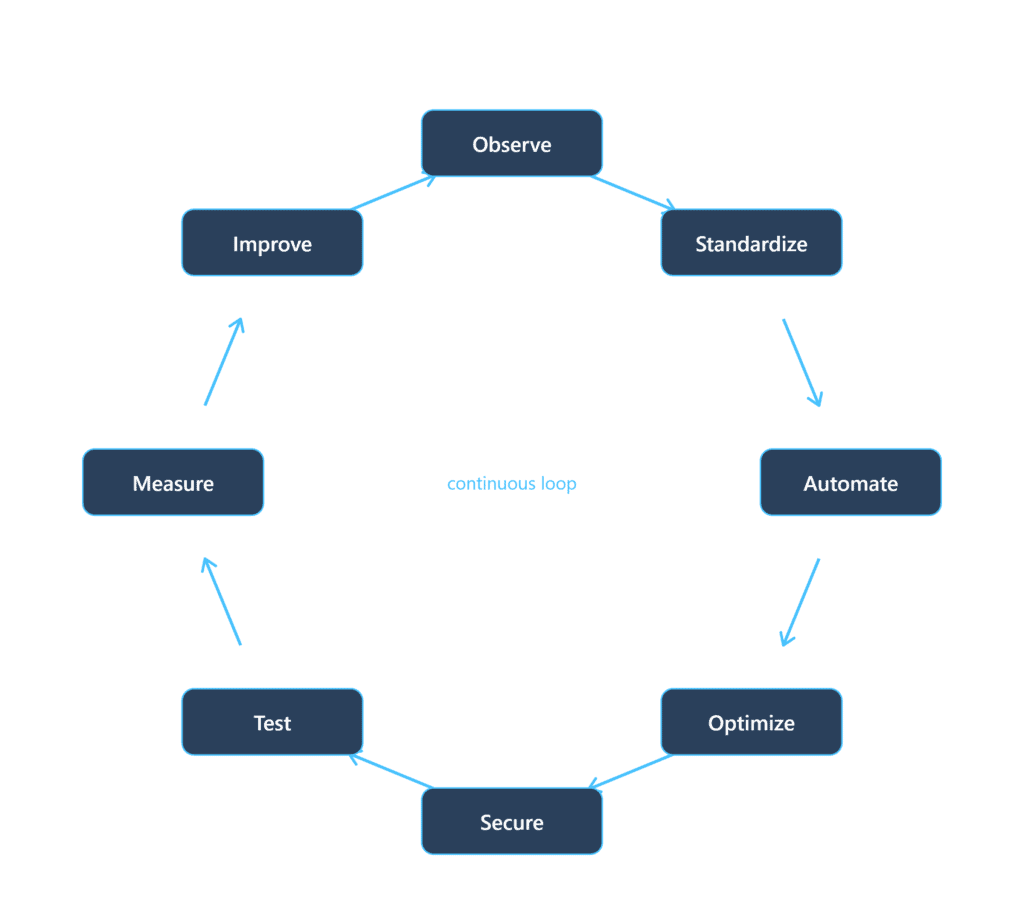
Observe → Standardize → Automate → Optimize → Secure → Test → Measure → Improve
Monitoring tells you what's happening.
Standardization creates consistency.
Automation reduces manual effort.
Optimization improves cost and performance.
Security reduces risk.
Testing validates resilience.
Measurement shows whether improvements are working.
Start with an honest assessment of your current environment. You can get a free architecture assessment from one of Opinov8’s Solutions Architects.
Simply fill out the form and let us know you’re interested in the free assessment. We’ll help you identify potential gaps, improvement opportunities, and the right next steps for your architecture.
Efficient cloud infrastructure operations are built on more than choosing the right cloud provider or provisioning the right services.
They depend on how infrastructure is designed, monitored, automated, secured, optimized, and continuously improved.
The recommendations from ITAD4Me, IAMOPS, and Oracle converge on many of the same fundamentals: visibility, automation, standardization, cost management, governance, resilience, monitoring, and continuous improvement.
The Opinov8 AWS cases show how those principles translate into real-world outcome: from 35% infrastructure cost reduction with AWS ECS to up to 25% cost savings in Renault's modernization and a roadmap targeting up to 54% cost reduction in another AWS environment.
The biggest lesson is simple:
Cloud efficiency is not a one-time optimization project. It is an operating discipline.
The organizations that get the most value from cloud infrastructure are the ones that continuously ask:
What can we see better?
What can we automate?
What can we standardize?
What can we optimize?
What can fail, and how quickly can we recover?
What did we learn from the last change or incident?
Answering those questions consistently is how cloud infrastructure evolves from a collection of resources into a reliable, scalable, and efficient platform for the business.