

AI Transformation Consulting: How to Build an AI-Shaped Organization in 2027
AI, AI Development, AI Native
Read more

This is the year agentic engineering became a standard line item on every major technology services firm’s capability page. Branded frameworks have proliferated; research-validated, professionally packaged, and largely indistinguishable in their core claims: 30–50% faster delivery, reduced manual effort, accelerated modernisation timelines.
The methodology arms race is real, and understandable. Agentic AI software development has moved from research curiosity to procurement category in roughly eighteen months. CTOs and VPs of Engineering are asking vendors to prove capability, and a published framework is the fastest signal that capability exists.
But here is the problem with using a methodology as a capability signal: methodologies are written before delivery. They describe the pattern, not the exception, and in legacy modernisation, the exception is where everything happens.
The firms winning the methodology battle are often operating on a different timescale from the ones winning the delivery battle.
The firms winning the methodology battle are often operating on a different timescale from the ones winning the delivery battle.
As a buyer, the methodology tells you how a vendor thinks about the problem. The track record tells you whether they’ve solved it. This year, most vendors have the former. Far fewer have the latte, and the gap between them is where most agentic engineering projects fail.
The firms below are actively publishing frameworks, building delivery practices, or demonstrating production capability in the agentic AI software development space. This is not a rankings list — each operates in overlapping but distinct segments.
| Firm | Agentic AI positioning |
| Opinov8 | AI-native engineering and legacy modernisation; cipher methodology for SPX/.NET; Maritime Intelligence and Life Sciences platforms on Azure and Databricks; Databricks partner. |
| SoftServe | MIT-backed agentic engineering framework; strong research practice; enterprise modernisation across financial services and healthcare. |
| ELEKS | AI integration and legacy migration advisory; strong European mid-market presence; custom ML pipeline delivery. |
| Thoughtworks | Agentic AI research and enterprise transformation; LLM integration into existing delivery practices; governance and responsible AI patterns. |
| Accenture | Enterprise-scale agentic AI via the AI Refinery platform; deep capacity in financial services, life sciences, and public sector. |
| Cognizant | Neuro IT and AI modernisation at large enterprise scale; mainframe and legacy stack migration with AI augmentation. |
| Infosys Topaz | AI-first services platform; agentic engineering at global delivery scale; banking, insurance, and manufacturing verticals. |
| Capgemini | Intelligent Industry framework with agentic AI components; European enterprise delivery; utilities, automotive, and public sector depth. |
The term is used inconsistently across the industry. In a whitepaper, it typically refers to an orchestration architecture where AI agents autonomously plan and execute multi-step software tasks. In delivery, it means something more specific, and more constrained.
In a production legacy modernisation context, agentic AI software development has four working components:
AI-assisted code generation. LLMs generating migrated code from legacy source, guided by system-specific rules and reusable skill patterns. Not raw generation — rule-constrained generation, where the model operates within defined parameters for the target stack, data access pattern, and output format. The quality of the rules determines the quality of the output.
Automated test loops. Continuous parity validation running in parallel with migration, comparing legacy system outputs against modernised outputs at screen and function level. Without automated test loops, agentic migration produces fast output that may or may not work. This component is the mechanism that makes AI-generated code trustworthy.
Legacy system mapping. Structured analysis of the source system before migration begins — data layer, dependency graph, undocumented business logic, integration points, failure modes. This is the component most frequently underinvested in methodology-led projects, and the most common source of sprint failures. The AI can only work with what it can see.
Model orchestration. The layer coordinating AI agents across migration tasks, managing context, and routing outputs to validation and human review. In production environments, agents work within tightly scoped tasks rather than open-ended autonomy, because open-ended autonomy in a legacy codebase produces unpredictable results. The orchestration design reflects how much the team trusts the model on any given task class — calibrated through delivery experience, not assumed from benchmarks.
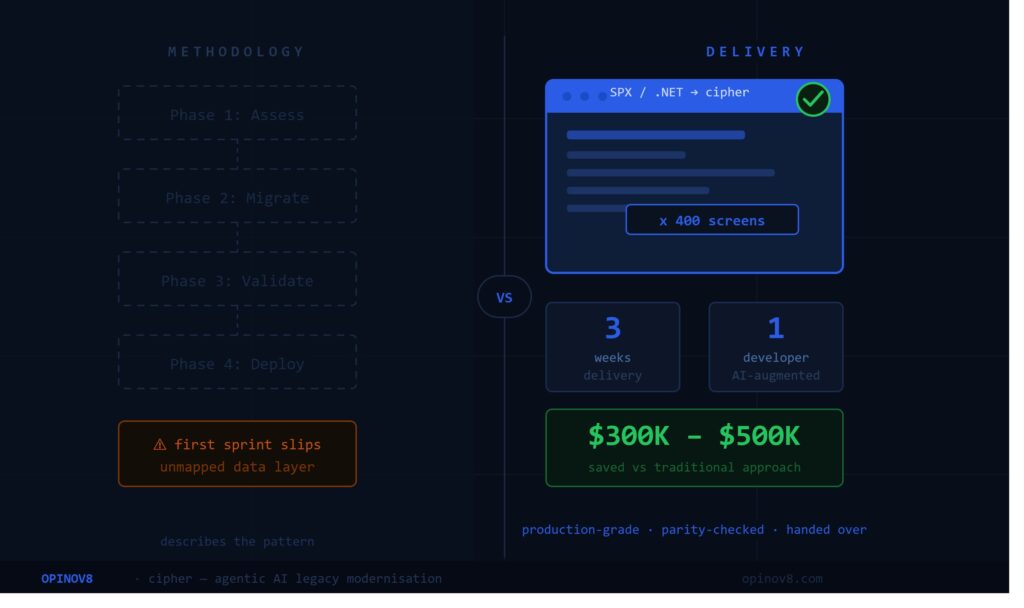
The most useful proof point for what production-ready agentic AI software development looks like is a specific project, not a projected outcome.
The system: A 400-screen SPX/.NET application on a global commercial platform. Untouched for years. No current documentation. Legacy data access patterns throughout. A codebase that worked — and that the client needed to keep working while the migration happened.
The constraint: One developer. Roughly three weeks. A client watching every sprint. Under $3,000 in AI tooling costs. The brief: a migrated system, production-ready, parity-checked, handable to integration testing.
| 400+ screens migrated | ~3 weeks delivery | 1 developer AI-augmented | $300–500K cost saved |
Testing gaps. Parity validation defined retrospectively is a different thing from parity validation defined upfront. When testing is bolted on, the definition of “working” is negotiated after the fact — and that negotiation is where scope disputes originate.
Governance not designed in. Production agentic AI requires audit trails, human sign-off gates, and escalation paths for anomalies. Projects that add governance as an afterthought produce outputs that can’t be signed off in enterprise architecture reviews. In regulated industries, this ends projects. In any enterprise context, it adds weeks.
Four failure patterns appear consistently in legacy modernisation projects that are methodology-led but delivery-underprepared.
Data layer unreadiness. The framework assumes the source system is sufficiently mapped before migration begins. In reality, legacy data layers are rarely fully documented. The symptom: sprint three surfaces an undocumented dependency that requires rearchitecting work already completed. The cause: the assessment phase was treated as a formality rather than a technical investment.
Model hallucination in legacy context. LLMs are trained on contemporary code patterns. Legacy systems — SPX, VB, early .NET stacks — are underrepresented in training data. Models without strong rule constraints generate code that looks syntactically plausible and fails semantically. Automated test loops catch this — but only if scoped correctly and running from the start.
Testing gaps. Parity validation defined retrospectively is a different thing from parity validation defined upfront. When testing is bolted on, the definition of “working” is negotiated after the fact — and that negotiation is where scope disputes originate.
Governance not designed in. Production agentic AI requires audit trails, human sign-off gates, and escalation paths for anomalies. Projects that add governance as an afterthought produce outputs that can’t be signed off in enterprise architecture reviews. In regulated industries, this ends projects. In any enterprise context, it adds weeks.
These questions surface delivery experience rather than methodology fluency. A vendor with a genuine production track record will answer specifically. A vendor with methodology but limited delivery will revert to framework language.
1. Describe the last legacy system where your initial assessment was wrong. What did you find, and how did you handle it?
Look for: a named specific discovery. If the answer describes how the methodology handles surprises in general, it hasn’t been stress-tested in production.
2. How do you handle model hallucination in legacy code patterns? Can you give a specific example?
Look for: a concrete failure instance, how it was caught, and how the rule set was updated. A description of the model’s general capability is not an answer.
3. Walk me through your parity validation approach. When is it defined, and who defines it?
Look for: parity criteria defined before migration begins, at screen or function level, with client involvement. Parity as a QA phase means the project has a scope dispute built in.
4. What does your governance model look like at sprint level? Where are the human sign-off gates?
Look for: specific checkpoints, frequency, criteria, escalation paths. Governance as a final review stage is not designed for enterprise sign-off.
5. What was the last project where something went wrong and you restructured the approach mid-delivery? What changed?The most important question. Every legitimate production-scale agentic project has this moment. The ability to describe it specifically — without defensiveness — is the strongest signal the methodology has been tested against reality.
Production-ready agentic AI software development at enterprise scale requires infrastructure and architecture decisions that most methodology documents do not address. Three delivery contexts illustrate what this looks like in practice.
Legacy modernisation at speed. The 400-screen SPX/.NET case demonstrates the AI-accelerated SDLC pattern: reusable skill library, zero schema-change constraint, continuous parity validation, and human judgment at the data layer and integration boundaries.
Real-time intelligence at scale — Maritime. Processing 50,000+ vessels and 7 million daily sensor readings on Azure and Databricks demands model orchestration at sensor data scale, real-time anomaly detection, and ML pipelines operating continuously without human intervention in the inference loop. Outcomes: 15% improvement in fuel efficiency, 30% improvement in vessel performance. These are a function of architecture precision, not framework choice.
MLOps at production scale — Life Sciences. Running 100+ daily Databricks workflows with MLflow managing the notebook-to-production pipeline and a Bronze/Silver/Gold medallion architecture governing data quality through the ML lifecycle. The medallion architecture is not aesthetic — it is the mechanism that makes model outputs traceable and auditable in a regulated environment.
These three contexts require genuinely different architecture decisions. What they share: delivery experience with the specific failure modes of each pattern, not methodology fluency applied generically.
Production-ready agentic engineering is not a faster version of traditional delivery. It is a different way of working — one that compresses timelines, changes the human-to-AI ratio, and shifts where human judgment is required.
The agentic AI software development market in 2026 offers buyers an abundance of choice and a shortage of evidence. Every credible firm has a framework. Far fewer have a production track record across the cases that matter — legacy modernisation, real-time intelligence, regulated MLOps.
The questions in section five are designed to surface the difference. But the simplest version is this: ask your shortlisted vendors to describe what went wrong on their last three agentic engineering projects — and what they did about it.
The answers will tell you whether you are buying a methodology or a track record.
In software modernisation, only one of them ships.
Book a 30-minute legacy modernisation architecture review with Opinov8’s engineering team, or request the cipher case study brief to see the 400-screen delivery in detail.
→ Book the 30-minute architecture review
→ Request the cipher case study brief
→ Explore Opinov8’s AI engineering services
→ View the legacy modernisation portfolio
→ See the Databricks partnership
New to agentic AI? This explainer covers how AI agents plan, act, and coordinate autonomously