

Opinov8 Expands Microsoft Solutions Partner Designations to Include Azure Data & AI and Azure Infrastructure
AI, AI Development, AI Native, cloud, Cloud, News
Read more

Cloud costs rarely become a problem overnight.
A few additional workloads here. More data there. Extra environments for development and testing. A handful of resources created for a project and never removed.
Eventually, an AWS environment can become expensive without anyone being able to clearly explain why.
That was the challenge behind one of our recent AWS cost optimization engagements. By analyzing the company's cloud environment and identifying opportunities to improve how AWS resources were provisioned and used, we helped reduce its AWS bill by up to 54%: without compromising application performance.
The result wasn't achieved by simply cutting resources or moving workloads around. It came from understanding where the infrastructure was overprovisioned, where resources were underutilized, and where the company's AWS usage could be managed more efficiently through FinOps consulting best practices.
Cloud optimization is often misunderstood as a simple cost-cutting exercise.
In practice, reducing AWS spend while maintaining performance requires a much more careful approach. Removing infrastructure indiscriminately can create new problems: slower applications, resource bottlenecks, unreliable workloads, or a poor experience for customers and employees.
The objective should be different: reduce unnecessary cloud expenditure while maintaining the performance and reliability the business actually needs.
For this company, that meant looking beyond the AWS bill itself and analyzing how its infrastructure was actually being used. AWS itself outlines the same principle in its own guidance on AWS Cost Optimization and Cloud Financial Management: cost efficiency should be treated as a continuous discipline, not a one-time fix.
AWS gives organizations enormous flexibility: but that flexibility can also make cloud environments difficult to control. Common sources of unnecessary AWS spend include:
Individually, these inefficiencies might not look significant. Across an entire cloud environment, however, they add up quickly, which is exactly where FinOps becomes important.
FinOps combines financial accountability with cloud engineering and operational practices. Instead of treating cloud spending as something only the finance team monitors, FinOps creates shared visibility between engineering, IT, finance, and business stakeholders.
That shared visibility helps teams answer questions such as:
For organizations with growing AWS environments, this approach is significantly more sustainable than periodic cost-cutting exercises.
Our AWS cost optimization process focused on understanding the relationship between infrastructure usage, performance requirements, and cloud expenditure.
Rather than starting with an arbitrary cost-reduction target, we looked for areas where the existing environment wasn't aligned with actual workload requirements, examining resource utilization and identifying opportunities to improve efficiency without reducing the capacity critical workloads needed.
The key principle was simple:
Don't pay for capacity you don't need: but don't remove capacity you do need.
That distinction is critical. A cloud optimization project shouldn't be measured solely by how much money disappears from the AWS bill. It should also consider whether application performance, availability, scalability, and operational requirements remain intact.
Tools like the AWS Cost Optimization Hub can support this kind of analysis by consolidating savings recommendations across an account, but the real value comes from interpreting those recommendations against actual business requirements rather than applying them automatically.
The optimization work resulted in up to 54% cost savings for the company: achieved without touching performance.
That means the goal wasn't simply to make the AWS environment cheaper. It was to make the environment more efficient. This is the difference between cost cutting and true cloud cost optimization.
A successful AWS cost optimization strategy helps an organization achieve a better balance between: Cost, Performance, Reliability, Scalability
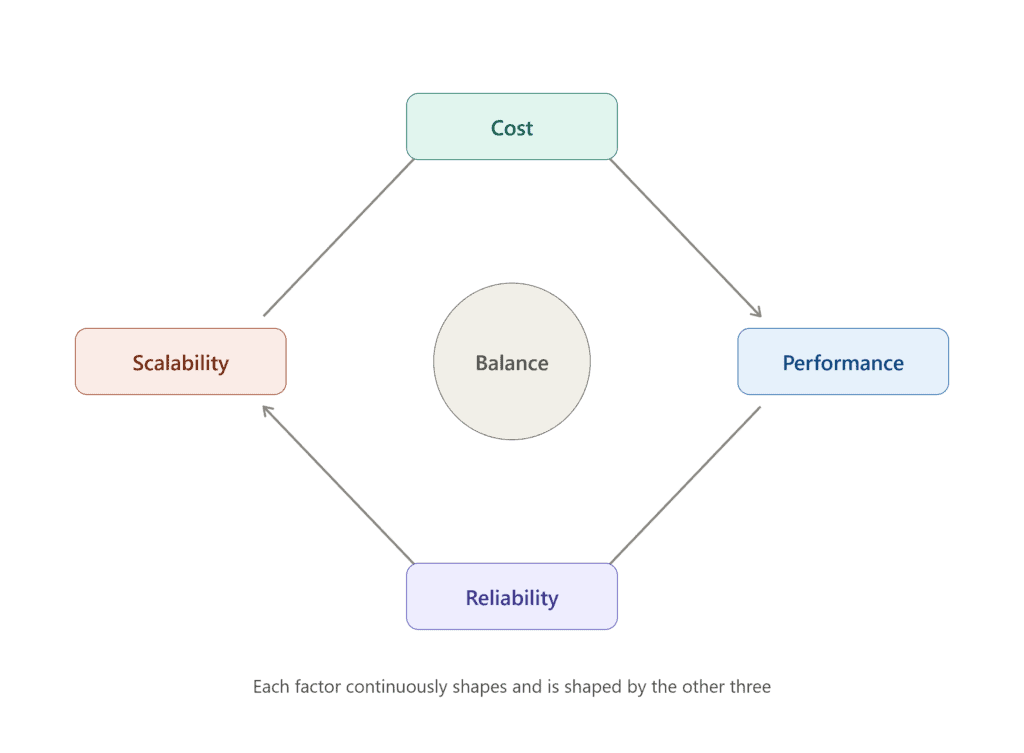
When those four factors are considered together, organizations can make far more informed decisions about their cloud infrastructure.
A high AWS bill doesn't necessarily mean you need less cloud infrastructure, it may mean you need better visibility and cloud optimization.
Before making major architectural changes, organizations should understand how their existing resources are actually being consumed. A useful AWS cost optimization review can uncover opportunities such as:
Right-sizing infrastructure: Align resource capacity with actual workload requirements.
Eliminating unused resources: Identify infrastructure that's no longer required but continues generating costs.
Improving resource utilization: Find workloads where available capacity significantly exceeds actual demand.
Optimizing non-production environments: Development, staging, and testing environments can be a significant source of unnecessary expenditure when they run continuously.
Establishing cost visibility: Introduce better monitoring and accountability around cloud spending.
Creating ongoing FinOps practices: Optimization should become a continuous process rather than a one-time project.
One of the biggest mistakes organizations make is treating cloud cost optimization as a one-off initiative.
AWS environments change constantly: new applications are deployed, workloads scale, teams create resources, data volumes grow, and requirements evolve. An environment optimized today can become inefficient six months from now.
That's why effective FinOps consulting focuses not only on finding immediate savings but also on creating processes that help organizations maintain cloud efficiency over time. This includes regular cost reviews, resource monitoring, tagging strategies, ownership models, budgeting, alerts, and continuous infrastructure optimization.
Understanding how AWS pricing actually works is also part of this process. AWS's own whitepaper on How AWS Pricing Works: Cost Optimization is a useful reference for teams who want a deeper technical grounding in pricing models, discount mechanisms, and how they interact with usage patterns.
AWS cost optimization is the process of reducing unnecessary cloud spending by right-sizing resources, eliminating waste, and improving efficiency: without sacrificing application performance or reliability.
Savings vary by environment, but in this case study, the optimization process reduced the company's AWS bill by up to 54% without affecting performance.
Not when done correctly. Effective cost optimization focuses on removing overprovisioned or unused resources while preserving the capacity that critical workloads actually need.
FinOps consulting helps organizations bring financial accountability into cloud engineering, creating shared visibility between finance, IT, and engineering teams so cloud spend can be managed proactively and continuously.
If your AWS bill has been increasing faster than your business, it may be worth taking a closer look at what's driving the cost. You don't necessarily need to sacrifice performance to reduce cloud expenditure.
This AWS cost optimization case study demonstrates that significant savings (up to 54%) can be achieved by identifying and addressing infrastructure inefficiencies, without compromising performance.
Read the full AWS Cost Optimization case study →
If you're looking for a more structured approach, our FinOps consulting services can help your engineering and business teams understand where AWS spending is going, identify optimization opportunities, and build a sustainable approach to cloud cost management.
Talk to Opinov8 about your cloud infrastructure and cost optimization needs →